The “Thud”
By WavesToJets
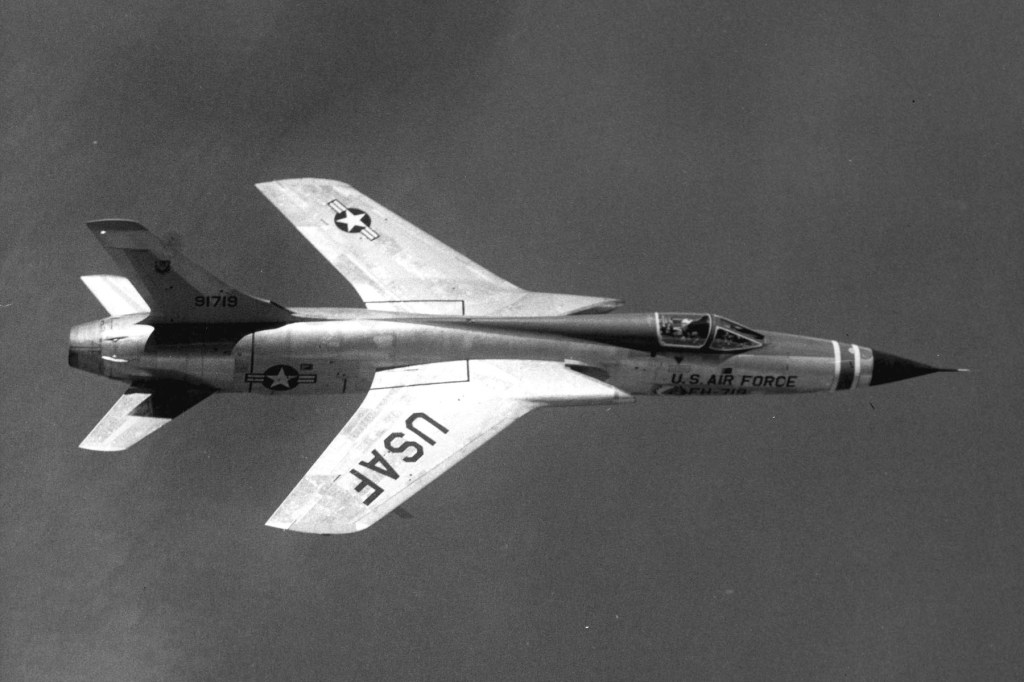
The F-105 Thunderchief was a large fighter-bomber designed by Republic Aviation, capable of operating at supersonic speeds. An airplane intially designed in the midst of the Korean War, the F-105 was operable first as a prototype in the mid-1950s. It was delivered as a production-line plane to the United States Air Force (USAF) starting in 1957.
The F-105 was notable for being a very large plane – with later variants having a total length of over 64 feet, a wingspan over 34 feet, and a height approaching 20 feet. As such, it was capable of carrying a large ordnance – over 12,000 pounds of conventional bombs – with intial models designed to carry and deliver Mk. 28 or Mk. 43 nuclear weapons.
The Thunderchief was never used in its original intended Cold War capacity – and later models housed a 390-gallon fuel tank inside what was the nuclear weapons bay. Late-production F-105s also featured two-seated fuselages for training purposes. The F-105 was used by U.S. forces primarily in anti-aircraft ground strikes during the Vietnam War.
Technological Background

The origins of the F-105 can be found in Republic Aviation, designer and producer of such aircraft as the P-47 Thunderbolt, the F-84 Thunderjet, and the F-84F Thunderflash. The idea behind the F-105 Thunderchief was to produce a supersonic fighter jet able to deliver nuclear weapons to enemy targets at low altitudes.
This development began in 1950-51, with the USAF giving a contract to Republic in 1952 for 199 of these fighter-bomber craft. However, with the Korean War winding down in 1953, this number was reduced to 37 combat fighter-bombers and 9 reconnaissance-type planes.
Further reductions in the USAF’s order came in the months to follow, and in 1954, a total of 15 of such aircraft were ordered. Over this period, the designated engine for what would become the F-105A would be the Pratt & Whitney J57 engine – as opposed to Allison J-71 turbojet engine (deemed not sufficiently powerful enough by Republic).
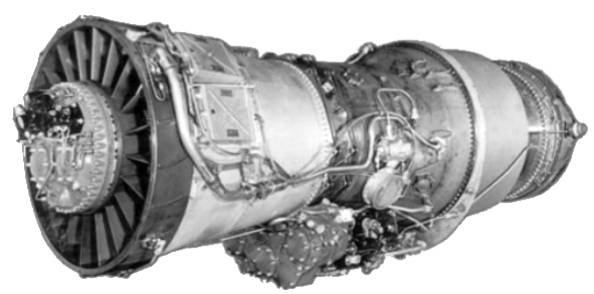
The J57, however, with its 10,200 pounds of static thrust – was only a temporary replacement for the more powerful Pratt & Whitney J75 engine – which would inhabit F-105s from the F-105B on. The intial J75 engine used had a 16,000-lb static thrust capability, with later engines having a static thrust capability of 17,200 lbs.
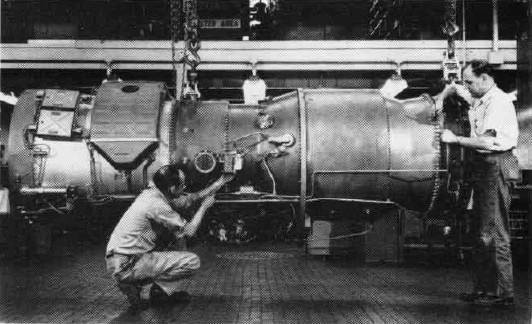
The J57-powered YF-105A first flew on October 22, 1955 from Edwards Air Force Base, California, piloted by Russell M. Roth. The plane reached a top speed of Mach 1.2 (970.2 miles per hour) in this flight, though drag experienced in supersonic speeds was high.
Later versions of the F-105 (from the F-105B version onward) addressed the high drag problem with inwardly-slanted front air intakes and a narrowing of the fuselage just before the wing root, described as “wasp waisted”. With a ventral rear fin for stabilization and clover-like pedals on the tail section acting as air brakes, stability and speed control on the F-105 could be provided.
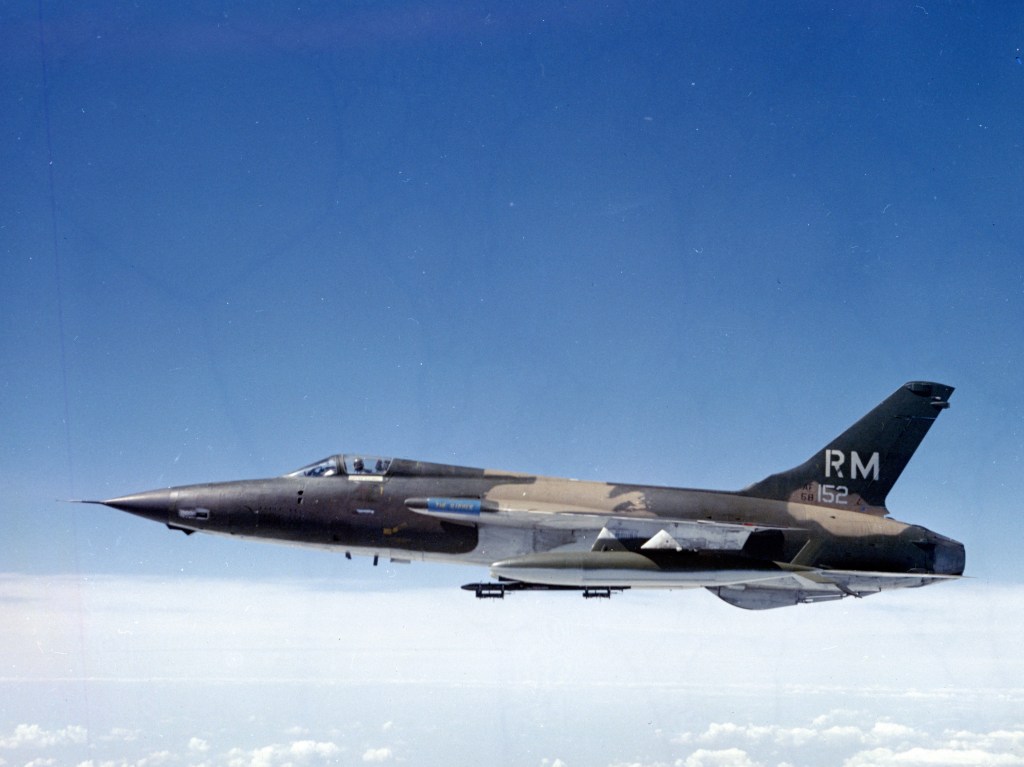
The F-105 was a massive single-seat fighter, with the F-105D variant – one of the main production versions of the craft – having a length of 64 feet, 5 inches, a wingspan of 34 feet, 11 inches, and a height of 19 feet, 8 inches. With an empty weight of 27,500 pounds, the plane could carry 1160 gallons of fuel internally, with an additional 390 gallons in its internal bay area and options to hold 450 or 650-gallon external fuel tanks on a ventral center pylon and two 450-gallon tanks via under-wing pylons.
The Thunderchief — a nickname so adopted by the USAF on June 19th 1956 — was also technologically impressive for its time: its later variants (like the F-105D, first flown June 9th, 1959) housed a fire control system (the AN/ASG-19 “Thunderstick”), and a contour-mapping radar for high and low altitudes.
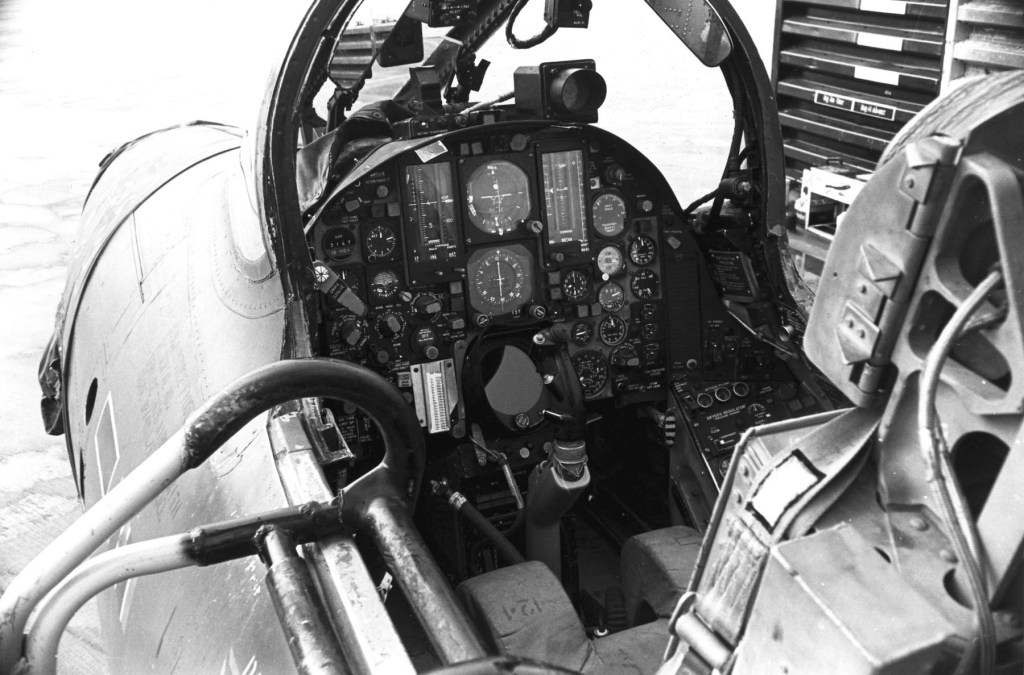
Additional features included a missile launch and air data computers, autopilot capabilities, a sight (flight vision) system, a retractable in-air refueling probe, a flight control system (the General Electric FC-5), a bomb toss computer, ranging and searching radars, and a Doppler navigator (for measuring the velocities of distant objects), the AN/APN-131.
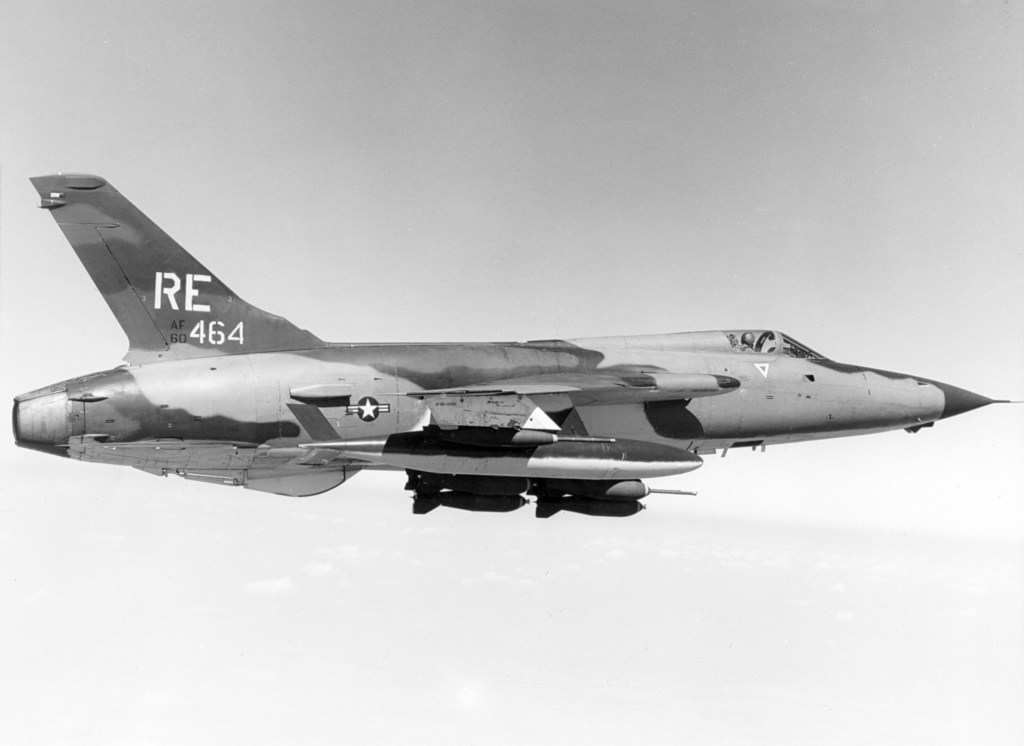
Later versions of the F-105 (especially the F-105F and F-105G) were purposed for what the USAF called “Wild Weasel” activities: the detection and destruction of enemy radar arrays and surface-to-air missile (SAM) arrangements. This was done to prevent heavy losses caused by radar-guided SAMs.
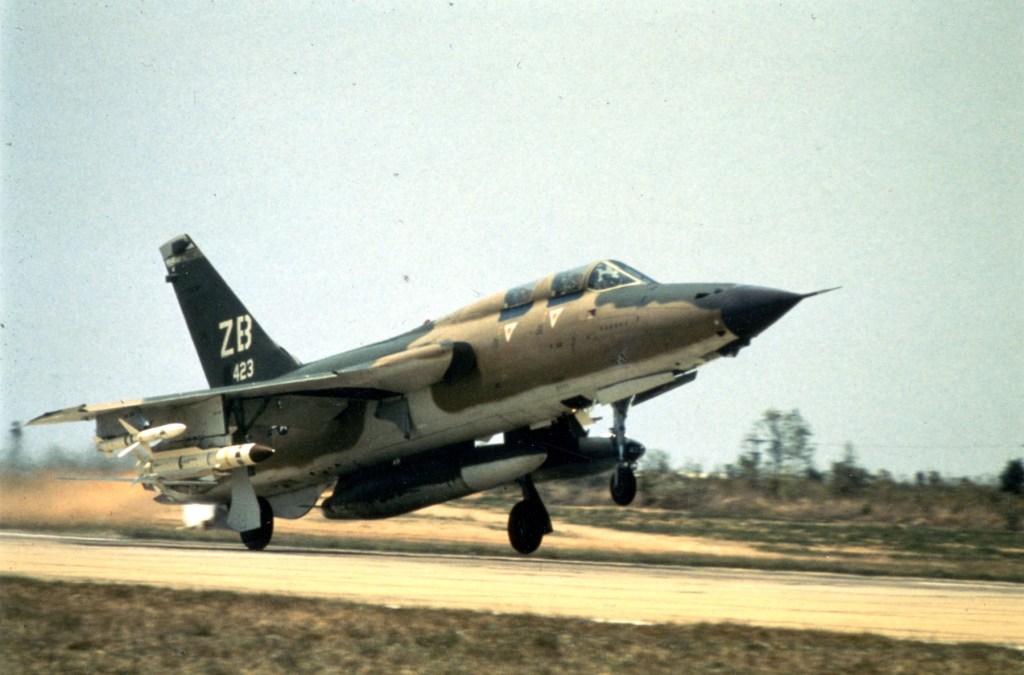
In order to do this, advanced avionics systems were used by capable F-105Fs to attack both radar locations and SAM installations – with what were called “anti-radiation” missiles, designed to hone in on radar-emitting signals. This was usually done in conjunction with less radar-capable, but heavier armed F-105Ds.
In terms of armament, the F-105 was initially designed to carry nuclear weapons, serving as a direct Cold War-era supersonic bomber – but this role was phased out during the plane’s service span. However, the enlarged interior bays and pylons on the ventral and under-wing surfaces did manage to carry quite a heavy load on conventional weapons.
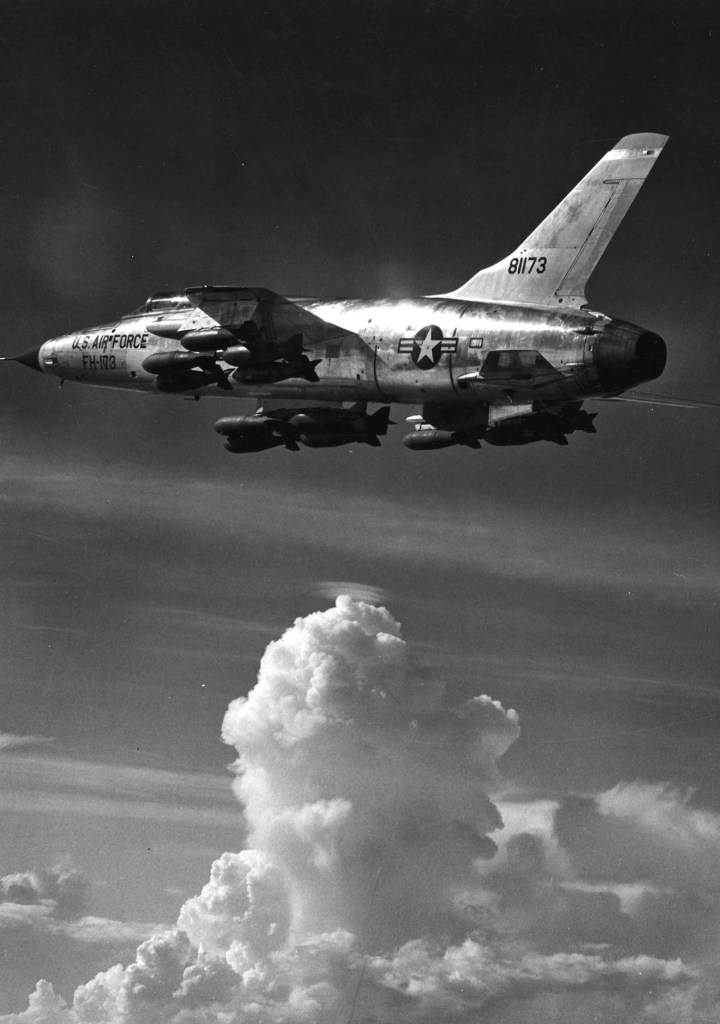
This included a total of 8,000 pounds of bombs in the interior bay and 6,000 pounds of bombs externally (for the F-105D). The Thunderchief was also typically equipped with a 20-millimeter M61A1 Vulcan rotary cannon, located in the nose. Other armaments could include rockets and guided “Sidewinder” missiles.
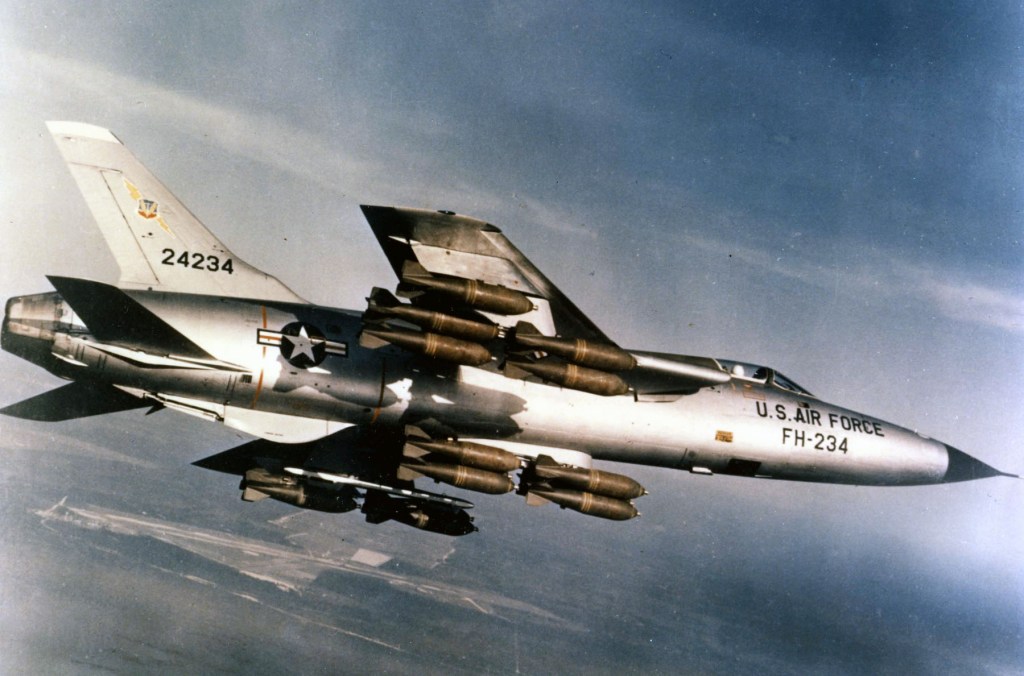
Performance wise, later versions of the F-105 Thunderchief (such as the F-105F) could reach speeds of 876 miles per hour (Mach 1.15) at sea level and 1,386 miles per hour (Mach 2.1) at 38,000 feet.
Later F-105 models – like the F-105G – were of the two-seated variety; they were also equipped with more advanced avionics, a combat camera, and jamming equipment.
In Service
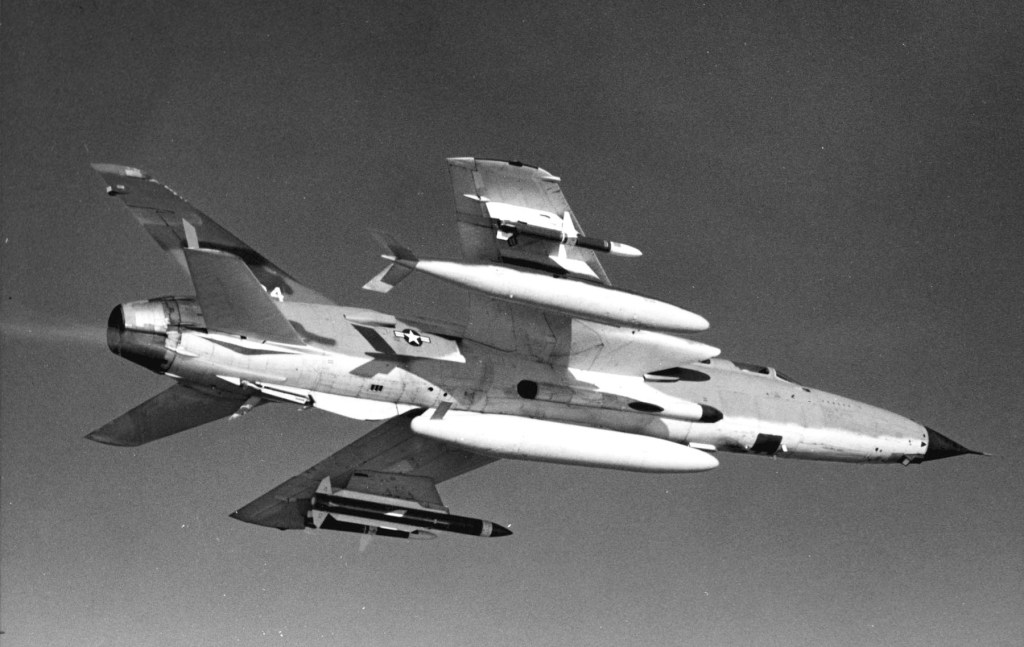
The USAF accepted the F-105B – the first major production version of the craft – on May 27th 1958. The USAF’s Tactical Air Command (TAC) used the fighter first; it was assigned to the TAC’s 4th Tactical Fighter Wing, the 335th Tactical Fighter Squadron in particular, receiving the craft in August 1958.
The 335th was operational with the F-105B in January 1959. There were several mechanical problems early on associated with the craft, including those with the fire control system, the autopilot functions, and the air data computer. By 1960 the unit was fully operational with the F-105B, and soon after, the 4th Tactical Fighter Wing’s 334th and 336th Squadrons were equipped with the aircraft.
The F-105B was to replace the F-100 Super Sabre as the USAF’s offical Thunderbird (stunt performance team) aircraft, but an fatal accident in 1964 caused the Thunderchief’s tenure on the demonstration team to be short-lived. Still, the F-105B was known for setting at least one world speed record during its time in service: that was on December 11th, 1959 – when pilot Brigadier General Joseph Moore – on a closed 100-km circuit – reached a speed of 1,216.48 miles per hour.
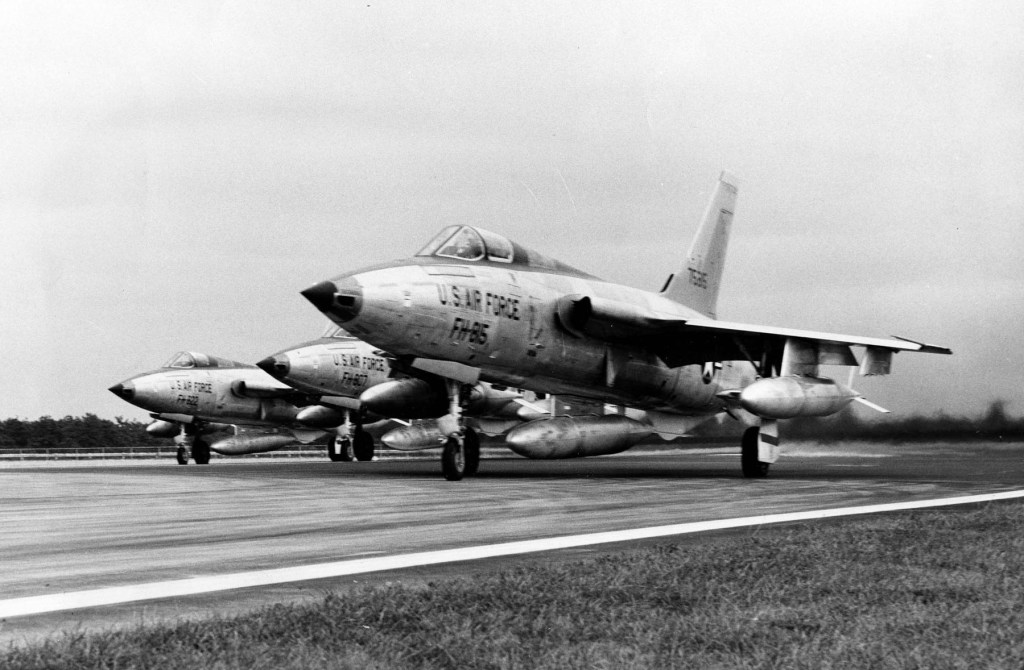
The Air National Guard used the F-105B Thunderchief from 1964 until 1981; as more F-105Ds came into the USAF, the branch used the F-105B for training purposes. The Air Force Reserves also used the F-105B until 1981.
The F-105D was the next Thunderchief variant to see USAF usage; delivery of the craft to the 335th Tactical Fighter Squadron (of the 4th Tactical Fighter Wing) began in June 1960. Similarly the 36th and 49th Tactical Fighter Wings in Europe saw the arrival of the F-105D in Europe (specifically Birtburg and Spangdahlem Air Bases, respecitively, in West Germany) starting in 1961.
Like the F-105B, the F-105D suffered technical problems and had to be grounded several times early in its service with the USAF. Though the plane was fast and capable at low altitudes, it was bulky, extremely large for a single-seat fighter, and was prone to takeoff and landing accidents – earning it the less-than-flattering nickname “Thud”.
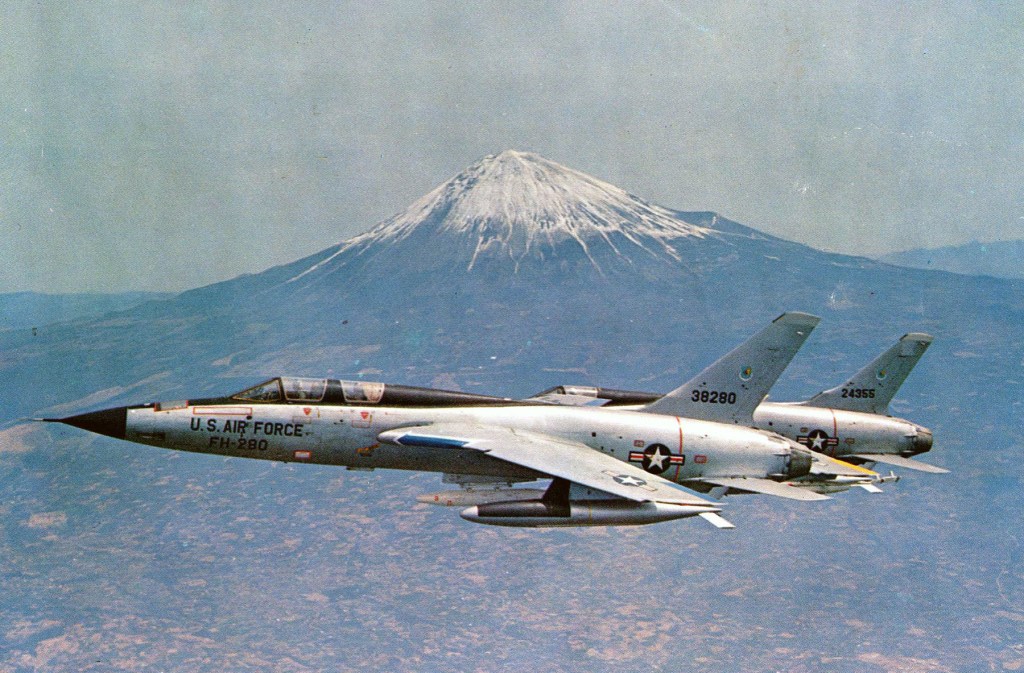
Two wings – the 8th and 18th Tactical Fighter Wings – were equipped with the F-105D and stationed in Japan starting in 1962. It was from Japan that F-105Ds were sent to Korat Royal Thai Air Force Base (from the 18th Tactical Fighter Wing) and Takhli Royal Thai Air Force Base during 1964, especially after the Gulf of Tonkin Incident.
Air operations against the North Vietnamese in the Vietnam War – using the F-105D – took place mostly from Korat and Takhli in Thailand. These included operations by the 355th and 388th Tactical Fighter Wings, participating in the 1965 – 1968 systematic bombing of North Vietnamese ground positions known as “Operation Rolling Thunder”. F-105 pilots would typically travel from Thailand to conduct missions in North Vietnam, refuelling in-air over Laos – en route and in return – with the aid of KC-135 Stratotankers.
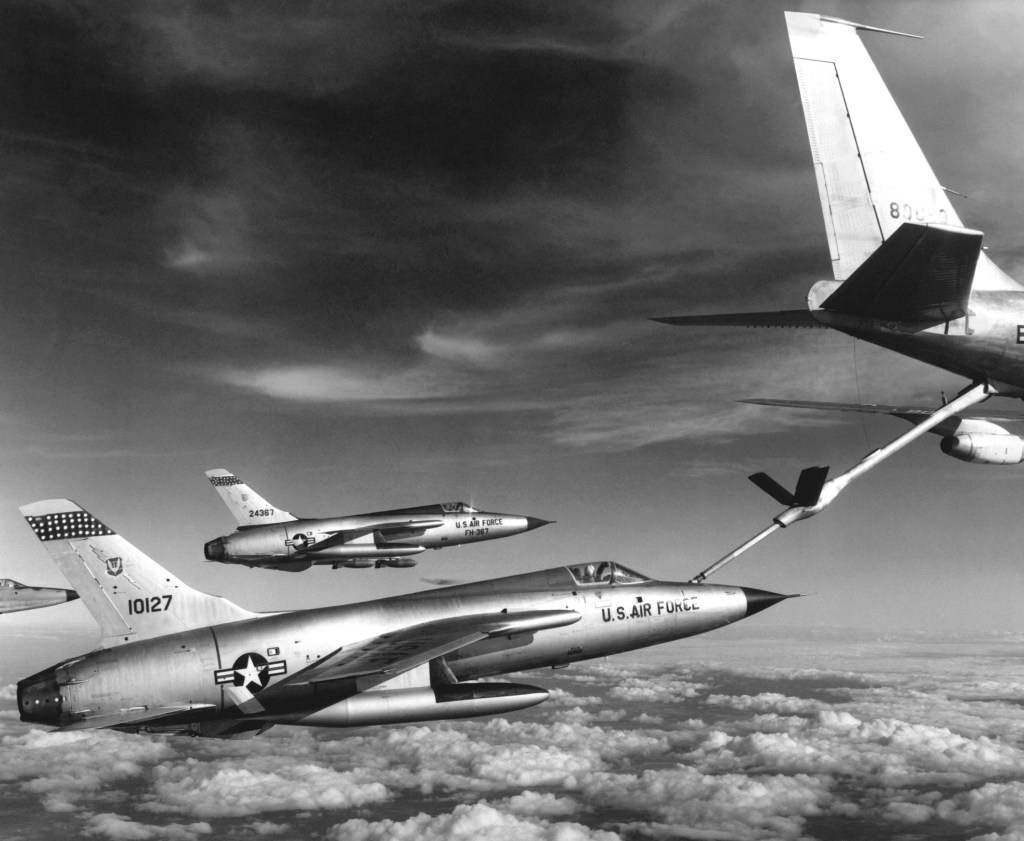
The F-105D was used in the Vietnam conflict to attack bridges (such as the Paul Doumer [now the Long Bien] Bridge on August 11th, 1967), ammunition depots (like those located at Xom Bong on March 2nd 1965), fuel storage tanks (like those in Hanoi on June 29th 1966) and, according to some – other targets, some of which, along with other actions of the U.S.-led Vietnam War bombing campaign, were not without controversy. The Thunderchief was also used to attack missile sites and radar installations later in the war, especially the F-105G Thunderchief operating in a “Wild Weasel” capacity.
USAF Thunderchief losses were high in the Vietnam War, with some 395 total lost in the conflict, with 61 due to non-combat accidents. The first air-to-air F-105 losses happened on April 4th 1965, with two pilots killed. Ground-to-air combat losses from ground units – anti-aircraft artillery (AAA) and SAM losses were far more common – with 103 out of 126 F-105Ds lost in 1966, for example, lost due to AAA fire.

The F-105 was successful in 27.5 air-to-air combat victories, all of which were made against the (Mikoyan-Gurevich) MiG-17. The majority of these victories were with the Thunderchief’s 20-mm cannon fire, 3 of them were made with AIM-9 Sidewinder missiles.
The last USAF F-105D unit in Southeast Asia began to return to United States in October 1970. The airplane type had been used in over 20,000 combat missions in the conflict. The F-105G was used until the end of the Vietnam War in 1975; the USAF Reserves and Air National Guard used F-105 units into the early 1980s.
The F-105 In Flight
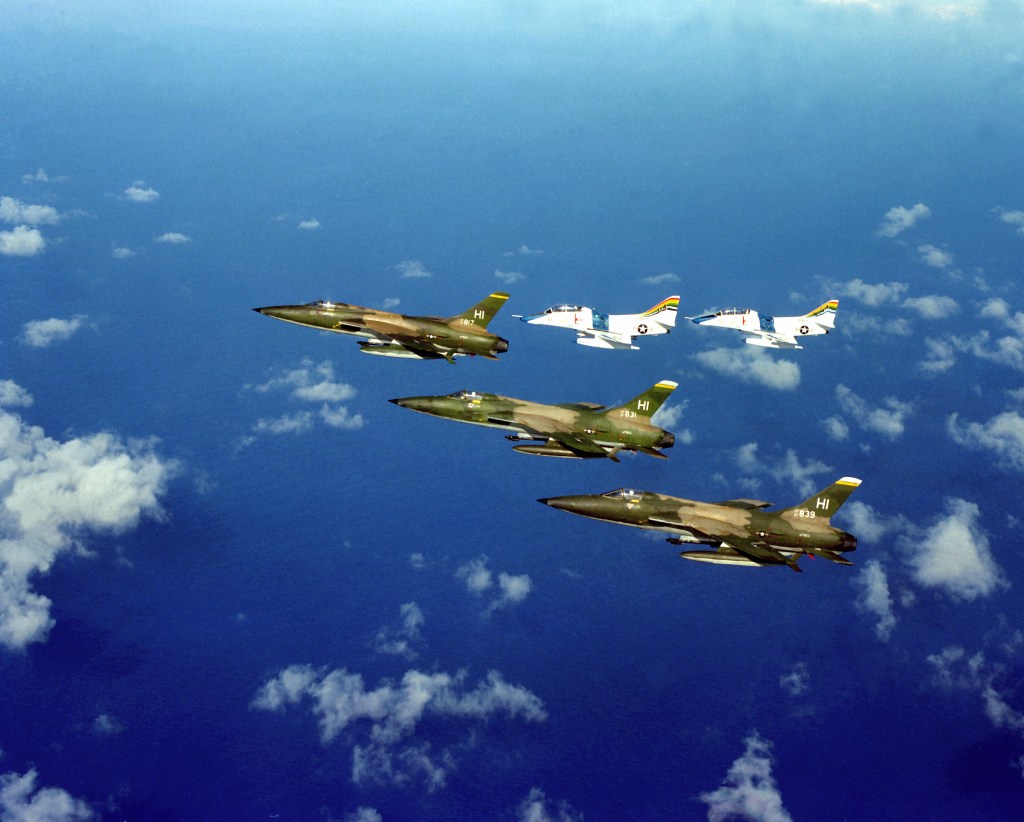
The F-105 Thunderchief was considered to be a bulky, heavy airplane – with a length of 64 feet, 5 inches, and a wingspan of nearly 35 feet (in the F-105D), it was the largest single-seat fighter in the USAF at the time of its development. In spite of its size, however, the F-105 was noted for its technical capabilities.
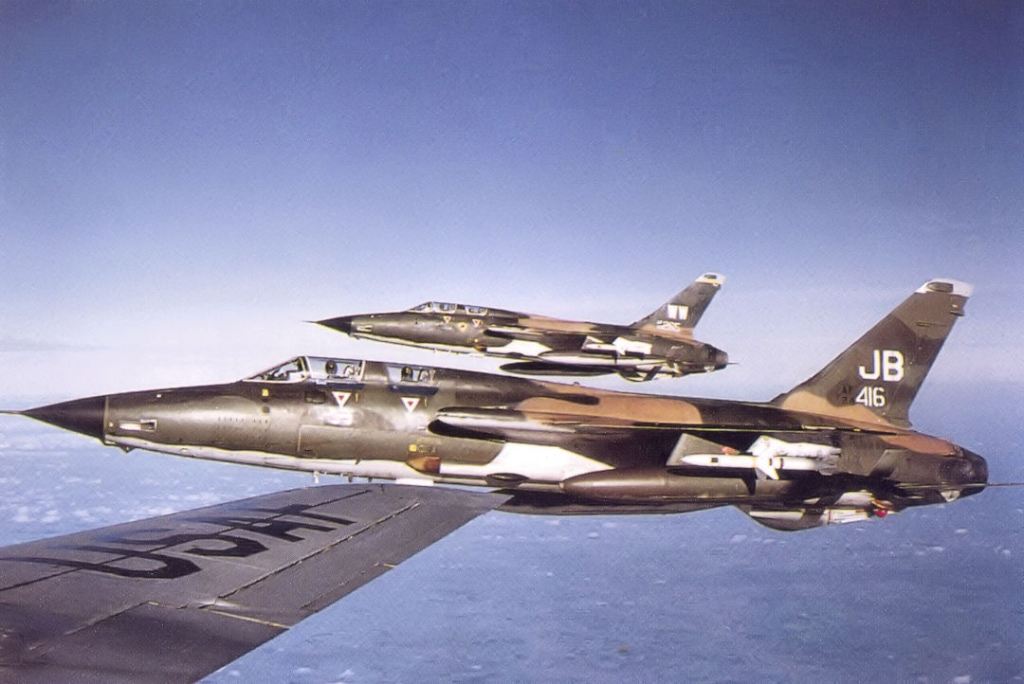
Those who performed maintenance on the craft, however, considered it to be a high-tech airplane – especially for the 1960s. The radar, navigation, and bombing systems were somewhat of a novelty for fighter jets at the time.
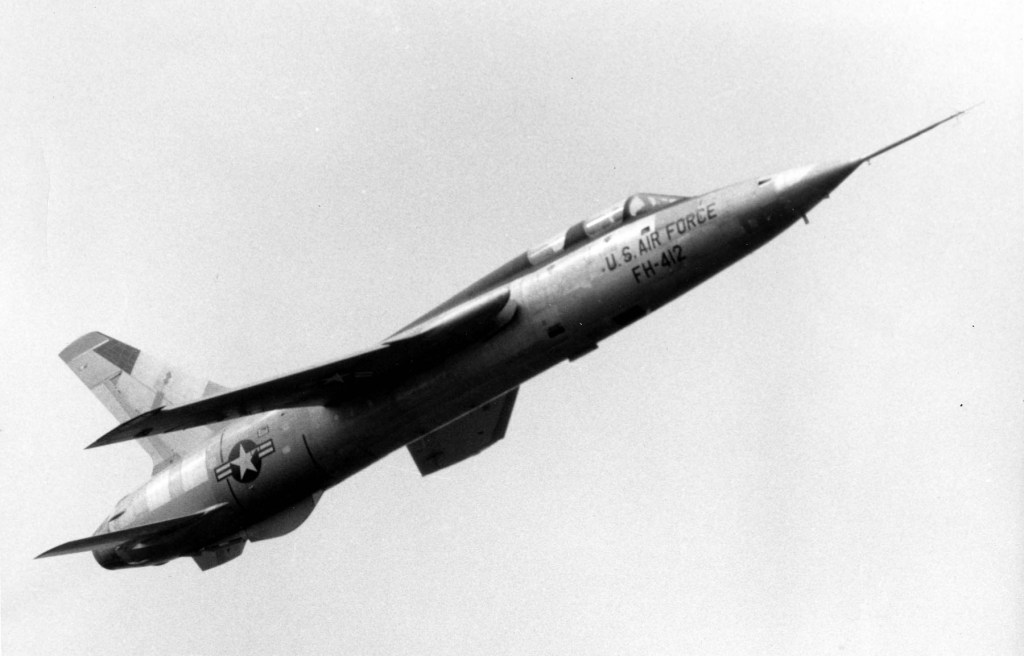
Pilots noted that the F-105 was relatively easy to fly. Its flight controls described as easy to understand, with tape gauges (instead of round gauges) for some measurements in some models.
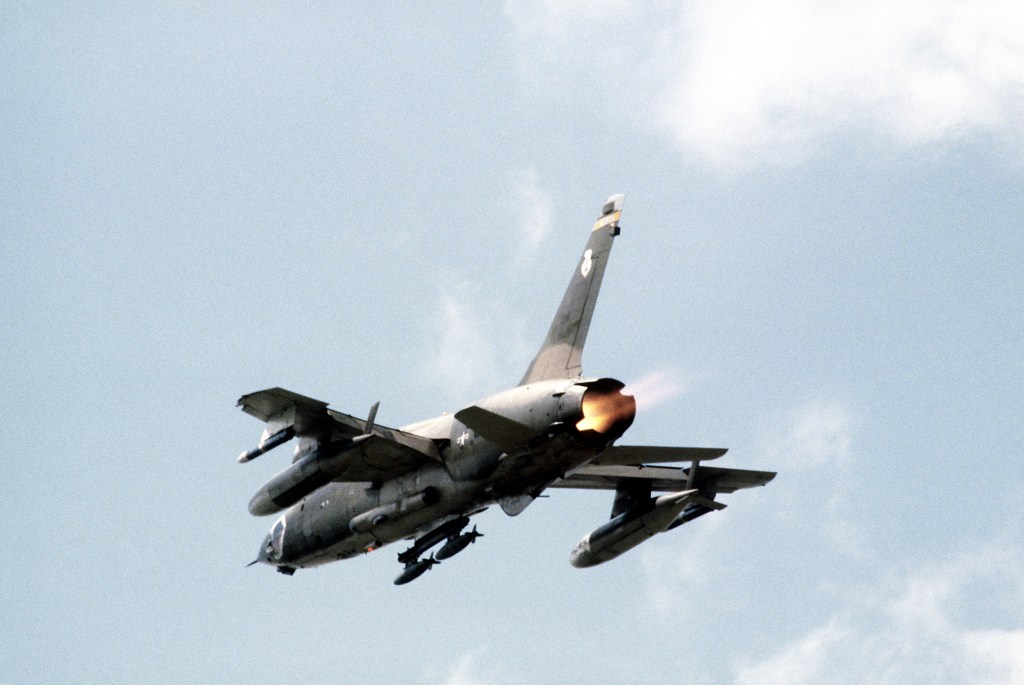
One of the few things that the Thunderchief could not do quite as well was turn or take off quickly – as it had a relatively small wing area.
However, its take-off speeds were described by some pilots as comparable to the Lockheed SR-71 Blackbird – which itself had a takeoff speed of 207 miles per hour.
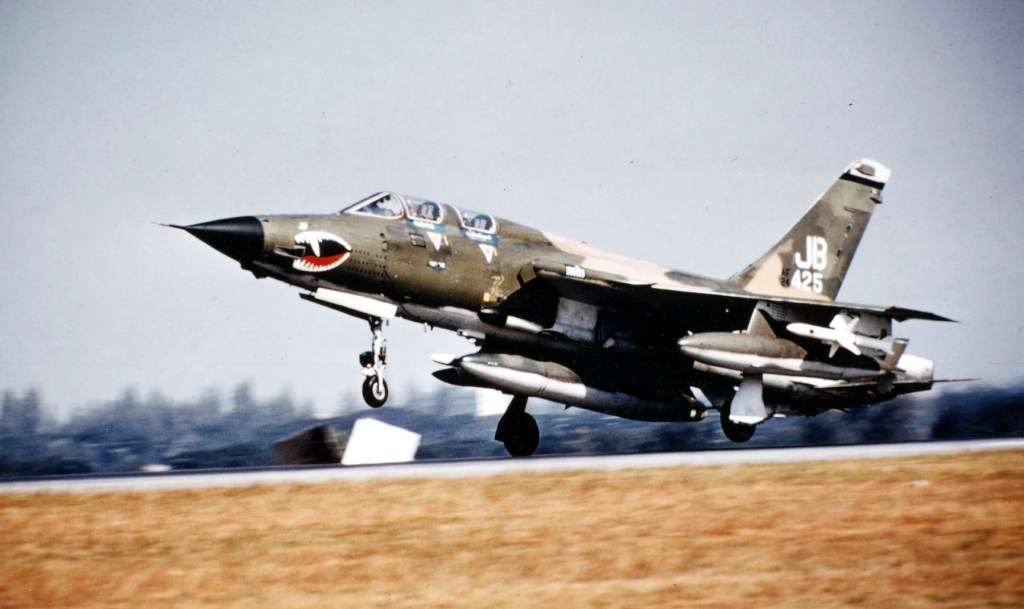
The F-105 was a high-speed supersonic jet – so for ground-attack runs, it utilized the craft’s airbrakes, arranged in a “petal” formation at the rear of the plane.
These brakes could be closed around the exhaust port of the F-105 to slow the plane. These brakes could be used in cases of dive-bombing – some pilots reported better accuracy with slower speeds.
Still, the F-105 had a high attrition rate – with over 300 planes lost to enemy forces during the Vietnam conflict. This was primarly due to anti-aircraft fire and surface-to-air missile strikes.
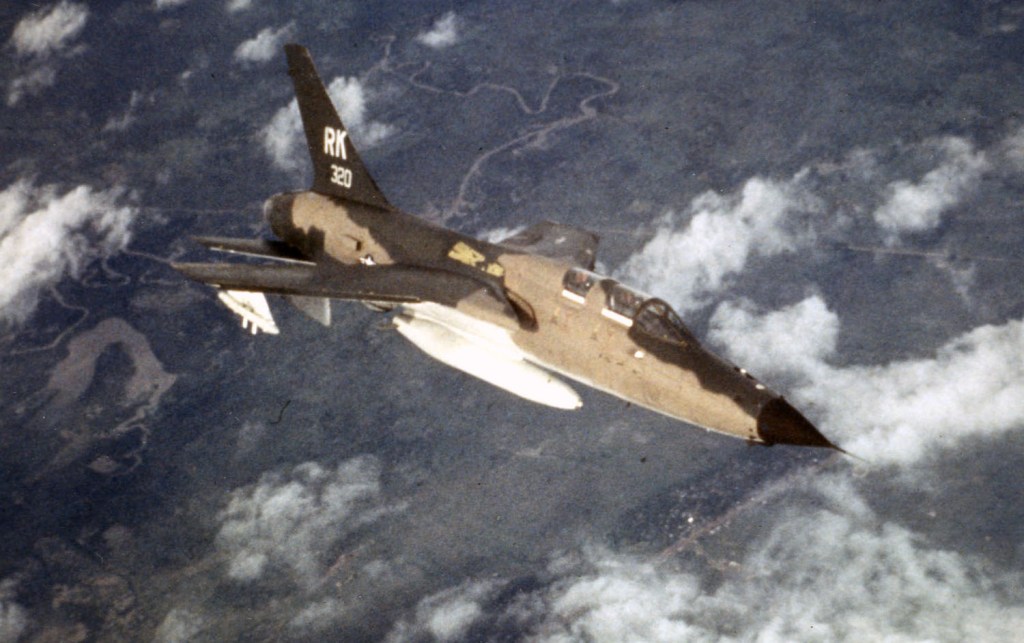
However, the airplane may have been less susceptible to take-off and landing accidents – at least in one ground crew member’s experience during the Vietnam conflict, not one F-105 was damaged in landings at Takhli Royal Thai Air Force Base, Thailand.
Pilots noted that controlling the F-105 in normal flight was an enjoyable experience. When landing, they had to descend from the cockpit – which could have a total height of over 19 feet above of a runway. Pilots would climb out of the cockpit, step on the intake, the wing, then the fuel tank – and finally jump down to the ground.
Model Variations

The F-105 Thunderchief was produced in several variants. This is a non-exhaustive list of some of the major types produced, including the:
YF-105A – The prototype version of the F-105. Originally intended to use the 14,500 pound-thrust Allison J71 engine (this thrust included use of an afterburner), the YF-105A was deemed too heavy to handle this engine in October 1953. As a replacement, the 15,000 pound-thrust (with afterburner) Pratt & Whitney J57 engine was used. The Y-F105A first flew on October 22nd, 1955. Two instances were built.
F-105B – The first production version of the F-105, accepted by the USAF on May 27th, 1957. This version featured the more powerful 23,500 pound-thrust (with afterburner) Pratt & Whitney J75 turbojet engine. Like its prototype predecessor, it featured swept wings and a large fuselage – though revamped to purpose the larger engine.
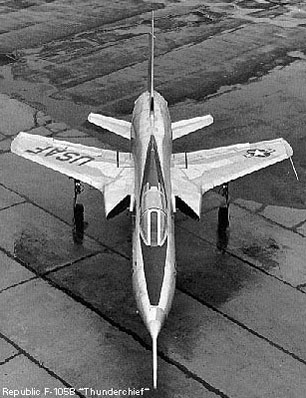

Unlike the YF-105A, the F-105B was designed to have slanted air intakes, “petal”-style air brakes on the exhaust port, and use an AN/APN 105 all-weather navigation system. Still, the F-105B was largely suitable only for daytime/fair weather use. Other features included a General Electric MA-8 fire control sytem, and a bomb bay with the capacity to carry nuclear weapons. This interior bomb bay was later used to house a 390-gallon fuel tank – a practice common with later F-105 models. 71 instances of the F-105B were produced.
F-105D –An all-weather (including intense weather and night flight) version of the F-105, the F-105D was first flown on June 9th, 1959 by pilot Lin Hendrix. With hundreds of instances of this Thunderchief variant produced, it was the last major production type of the series. Notable for housing the AN/APN 131 radar for navigation, the F-105D also had an wide array of avionics technology – including a search and ranging radar, air data and missile launch computers, and autopilot features, among other features.
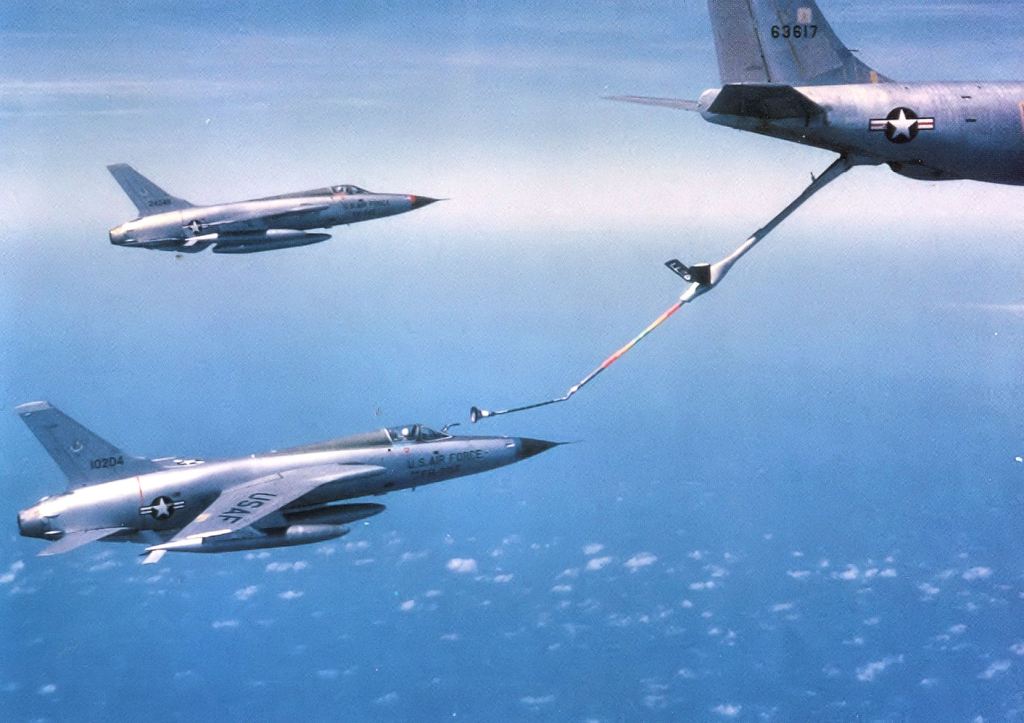
The F-105D was wider and longer than the F-105B; it could carry a total of 14,000 pounds of ordinance internally and externally. It was capable in terms of speed, it could reach 836 miles per hour at sea level and 1,420 miles per hour at 38,000 feet. The Pratt & Whitney J75-P-19W engine the F-105D used could reach 26,500 pounds of thrust with using an afterburner. The USAF used this model extensively in the Vietnam War; in total, 610 F-105Ds were produced.
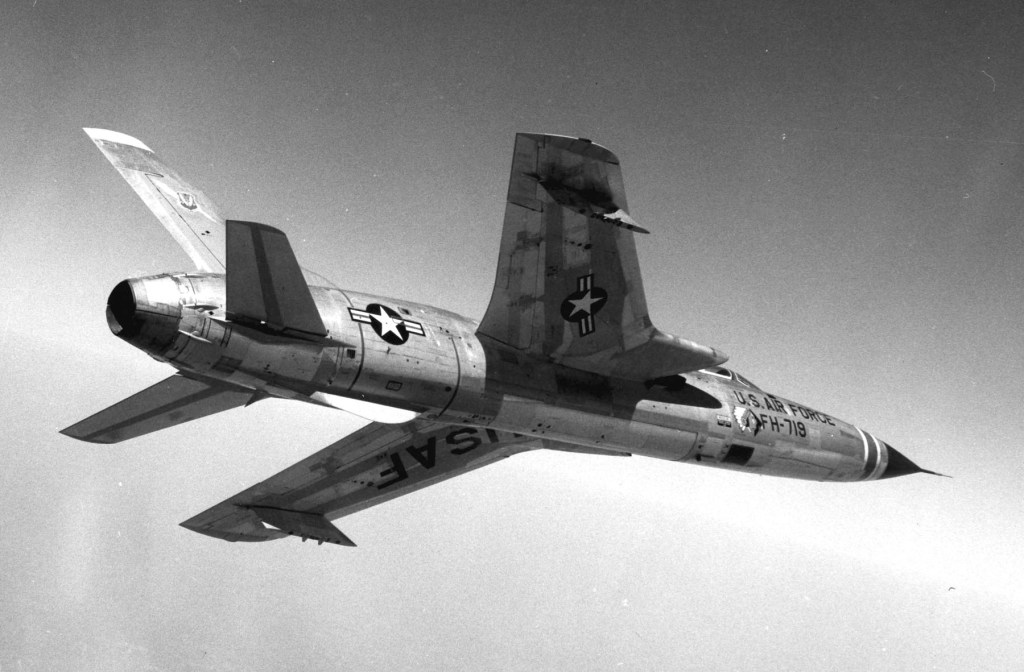
F-105F – A two-seated training version of the F-105 with a longer fuselage and a more advanced navigation system. 143 instances of the F-105F were produced.
EF-105F – The unoffical name for the F-105Fs modified for “Wild Weasel” operations, a total of 54 converted F-105Fs.

F-105G – The eventual designation name of the two-seated EF-105F. The F-105G built upon the advanced avionics and navigation systems of the EF-105F; notably more advanced radar homing and warning (RHAW) systems, more advanced missiles, and a smaller internal fuel bay.
 Waves To Jets