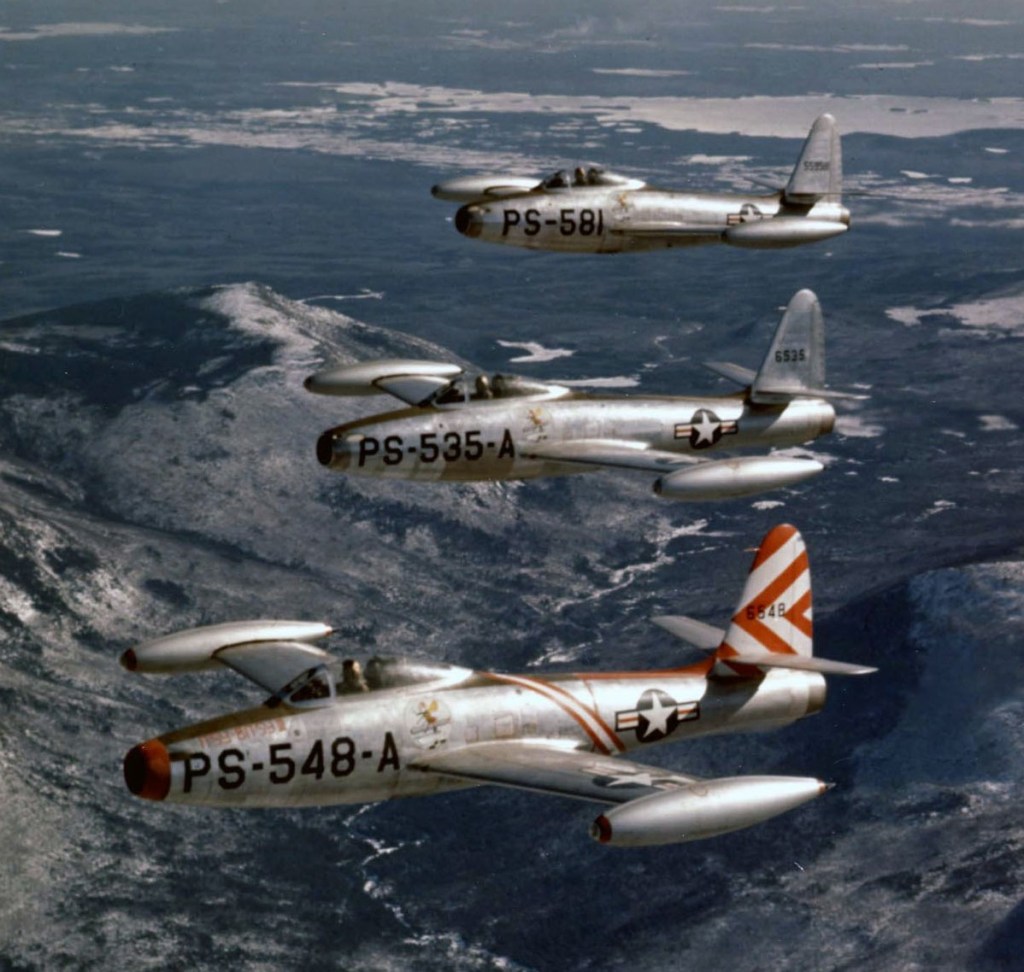
An Early Jet Fighter-Bomber
By WavesToJets
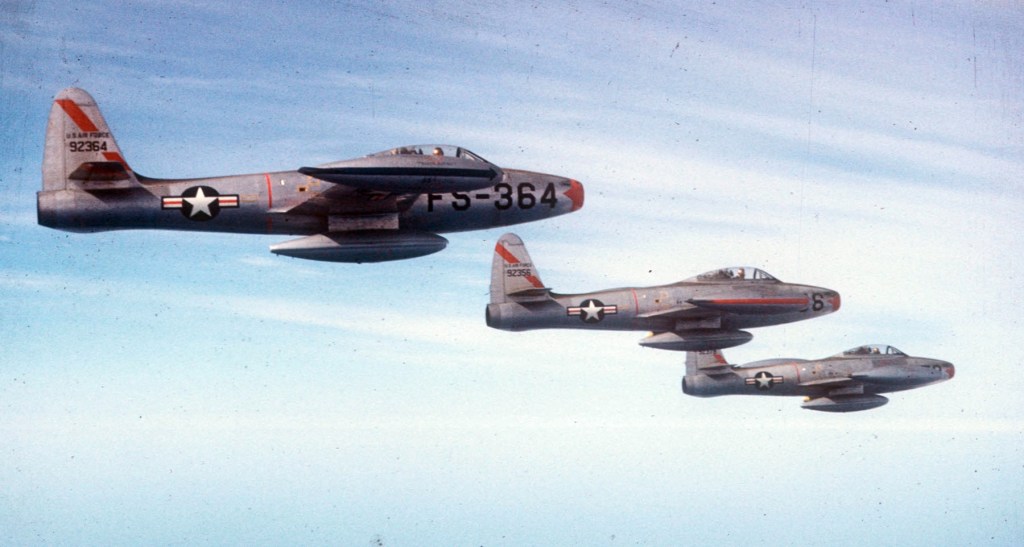
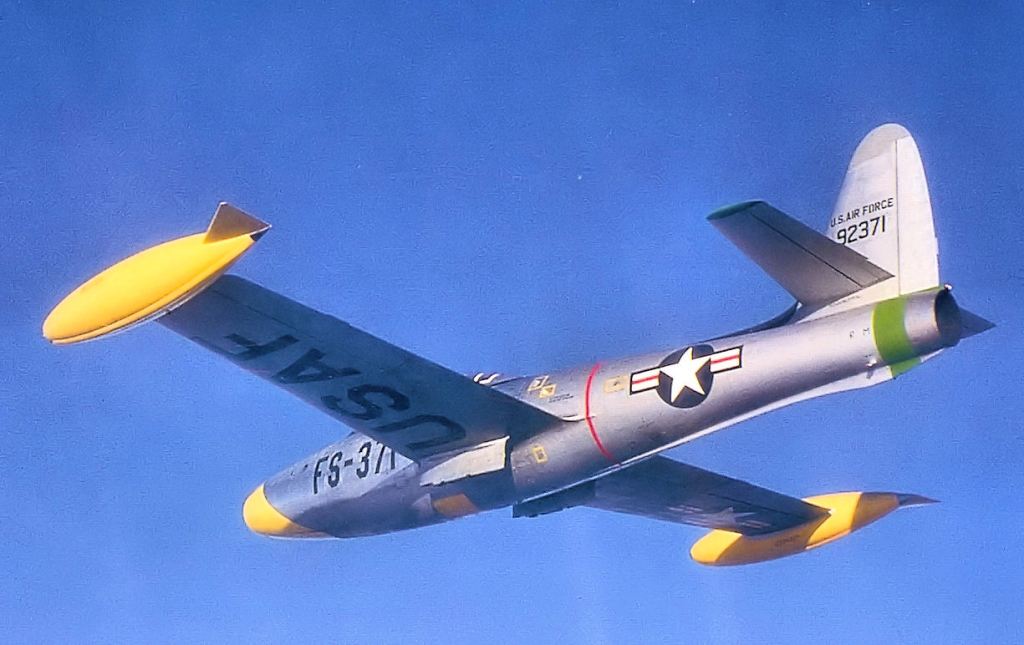
The F-84 Thunderjet was an early Cold War jet aircraft, produced for the United States by Republic Aviation. For the U.S. Army Air Forces – what would become known as the U.S. Air Force (USAF) in 1947 – the F-84 was only the second production jet fighter to go into service.
A sturdy, straight-winged jet fighter consisting of a relatively long (at least 38-foot) body, a wingspan of around 36 feet, and a powerful General Allison J35 axial engine, the F-84 Thunderbolt did not perform exceptionally in air-to-air combat. It did, however, excel in ground-attack missions, especially during the Korean War (1950 -1953).
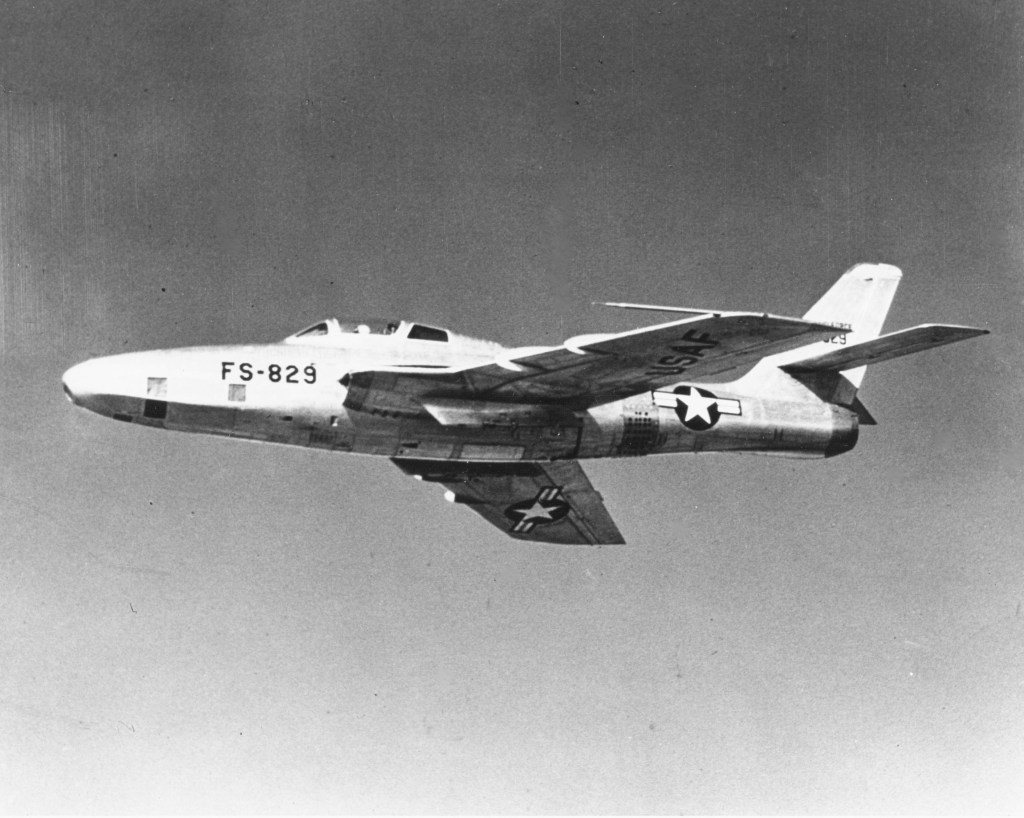
Though problems with early F-84 Thunderjets included the buckling and warping of wings due to high speeds – the F-84 could reach speeds above 600 miles an hour – many of these issues were addressed in later models. Republic Aviation eventually developed swept-wing versions of the jet known as the F-84F Thunderstreak and the RF-84 Thunderflash.
After the Korean conflict, the F-84 was introduced to and utilized by other air forces around the world, including those in Europe (such as France, Portugal, and Yugoslavia) and Asia (such as Thailand, Taiwan, and Iran).
Technological Background
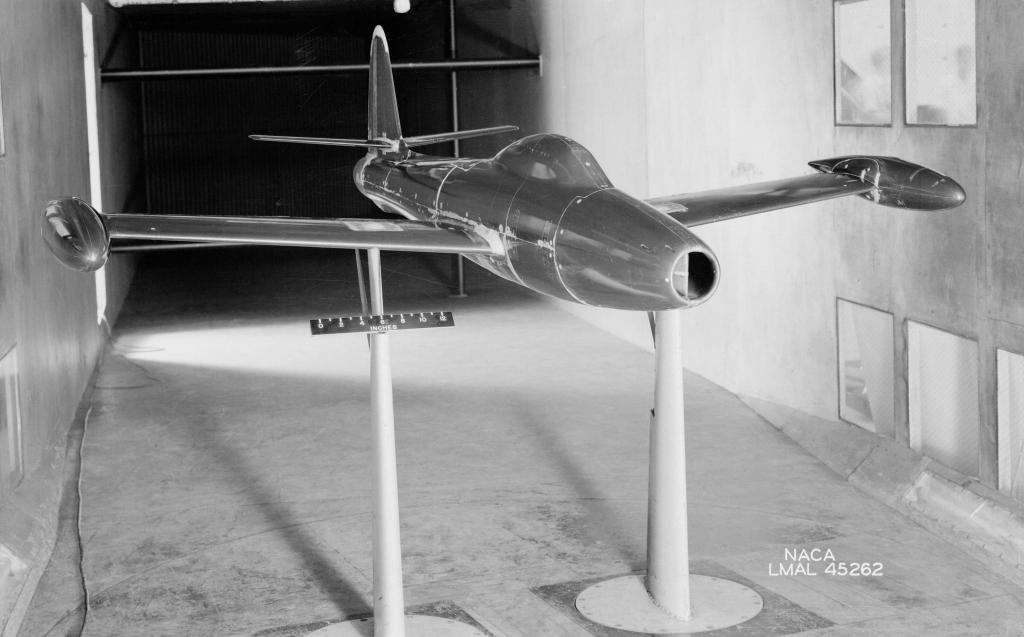
The F-84 Thunderjet has its origins in a September 1944 request from the U.S. Army Air Forces (USAAF) concerning requirements for a new fighter aircraft. This aircraft was intended to be a “day” fighter (as opposed to a fighter fitted with radar, considered a “night” fighter).
The USAAF requirements included that the new aircraft travel at a top speed of at least 600 miles an hour, have a combat range of at least 705 miles, and use an axial compressor jet engine. Other requirements included the use of six .50 machine guns per plane, or four .60-caliber machine guns.
Republic Aviation Corporation’s design team, led by Chief Designer Alexander Kartveli, had designed the propeller-driven P-47 (“P” for “Pursuit”) Thunderbolt – a fighter-bomber quite successful during the Second World War. Republic’s original proposed response to the USAAF request was to fit the axial engine (in this case, a General Electric TC-180) inside a P-47 airframe.
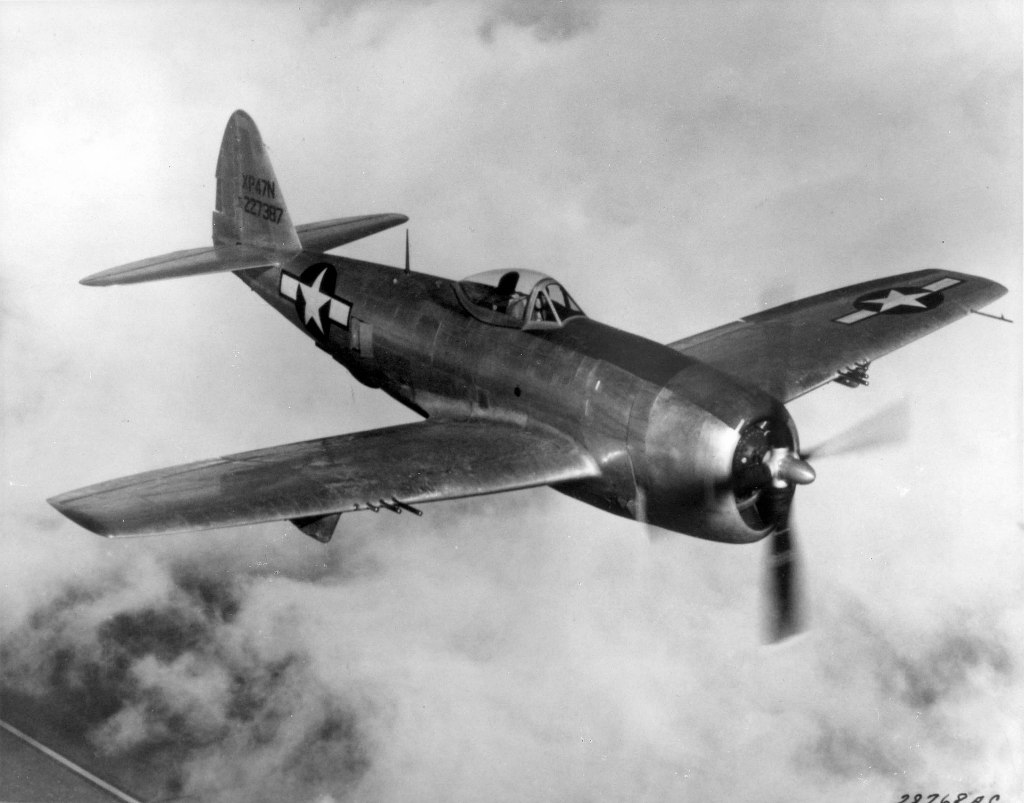
This proposal was soon found to be infeasible and Kartveli and his designers began work on an entirely new airframe. The airframe would be one that could house the General Electric TG-180 (otherwise known as the Allison J-35) engine, an axial compressor jet engine that offered 3,745 pounds of thrust.
Unlike the engines of other early jet aircraft – including Lockheed’s P-80 Shooting Star – the TG-80/J-35 was not a centrifugal compressor engine.
Whereas centrifugal compressor jet engines have a singular (or double) spinning component that pushes high-speed, pressurized air out to the edges of a main shaft, axial engines have multiple spinning components that push air back directly to a combustion area/turbine.

The axial engine configuration allowed jets such as what would become Republic’s P-84 Thunderjet to be more fuel-efficient, as well as have a potential speed and accelerative performance greater than centrifugal-engined fighters.
In addition to this, Republic designed the wings of the new jet fighter to be straight and low-set. The wings of the early prototypes were thin; this changed with the need to add drop tanks and landing gear.
On February 28th, 1946, the first flight of one of the Thunderjets’ three existing prototypes (all referred to as the “XP-84”) occurred. The prototype was flown out of Muroc Dry Lake, California, by pilot (and USAAF Major) Wallace A. Lien.
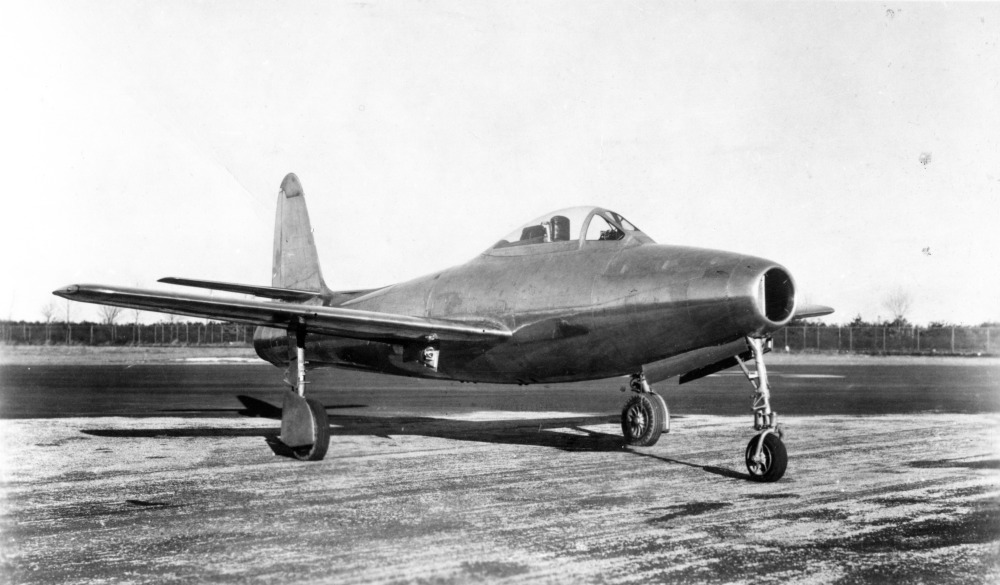
Upon tests made on the XP-84, the craft was found to reach speeds of 592 miles an hour at sea level and took 13 minutes to reach an altitude of 35,000 feet. One of the prototype versions was even able to make a United States National Speed Record of 611 miles an hour in September 1946.
Early versions of the P-84 Thunderjet included the YP-84A, the P-84/F-84B, the F-84C, and the F-84D. The YP-84A was a service test plane, and the P-84B was the first production version for USAAF use, becoming available to the military in 1947.
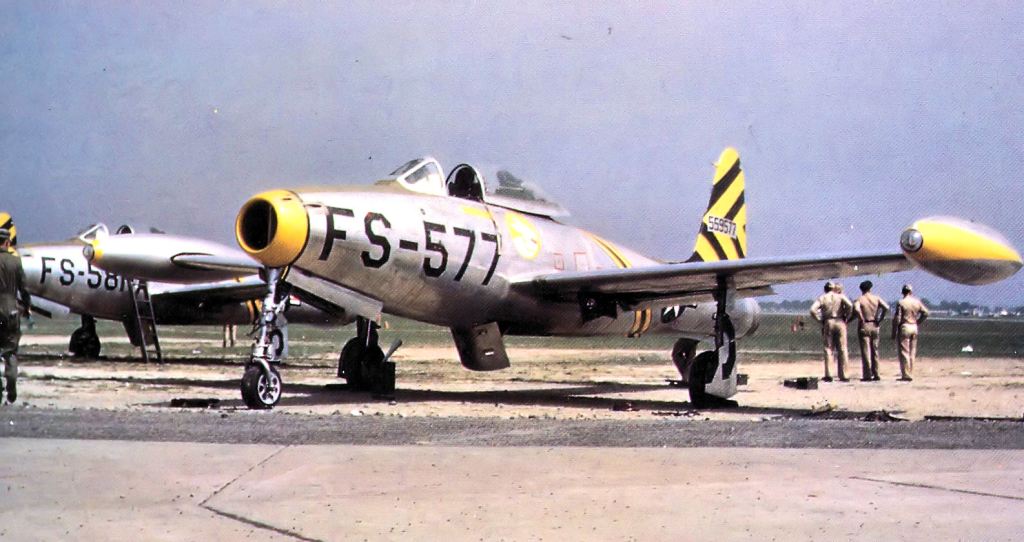
While the YP-84A and the P-84B were equipped with the General Electric/Allison J-35-A-15 engine, the F-84C and the F-84D were given the more powerful General Electric/Allison J-35-A-13 engine.
Republic Aviation made improvements to the C and D models, including new electrical systems on both – and new landing gear materials, thicker wing materials, and winter-ready jet fuel systems exclusively on the D version.
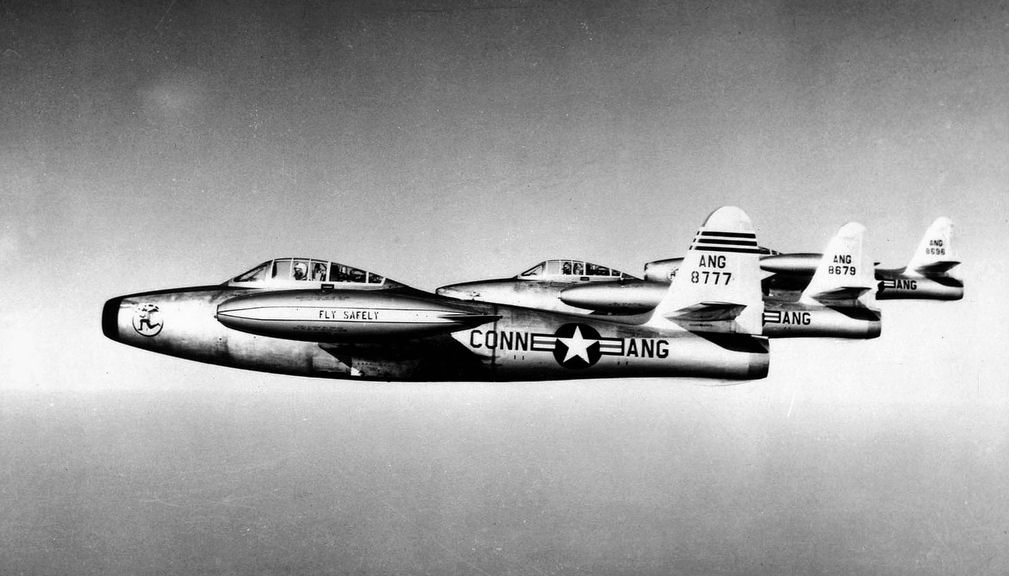
Elsewhere, the USAAF was re-designated the U.S. Air Force (USAF) in 1947; the “F” designation (for “Fighter”) was adopted by the USAF in 1948. Thus the P-84 became known as the F-84 Thunderjet.
The F-84E was given a 5,000 pound-of-thrust General Electric/Allison J-35A-17, combat-ready wingtip fuel tanks, stronger wings, and a longer fuselage. Bombing-capable shackles were added under the wings, and the combat radius was extended to 1,000 miles.

The F-84F Thunderstreak (and its photo-reconnaissance version, the RF-84F Thunderflash) was a swept-wing version of the F-84 Thunderjet. It was mostly a new aircraft, made chronologically after the straight-winged F-84G Thunderjet. The F-84F had 7,220 pound-thrust Wright J65-W-3 engines and swept-back wings at 40 degrees and an in-flight refueling system.
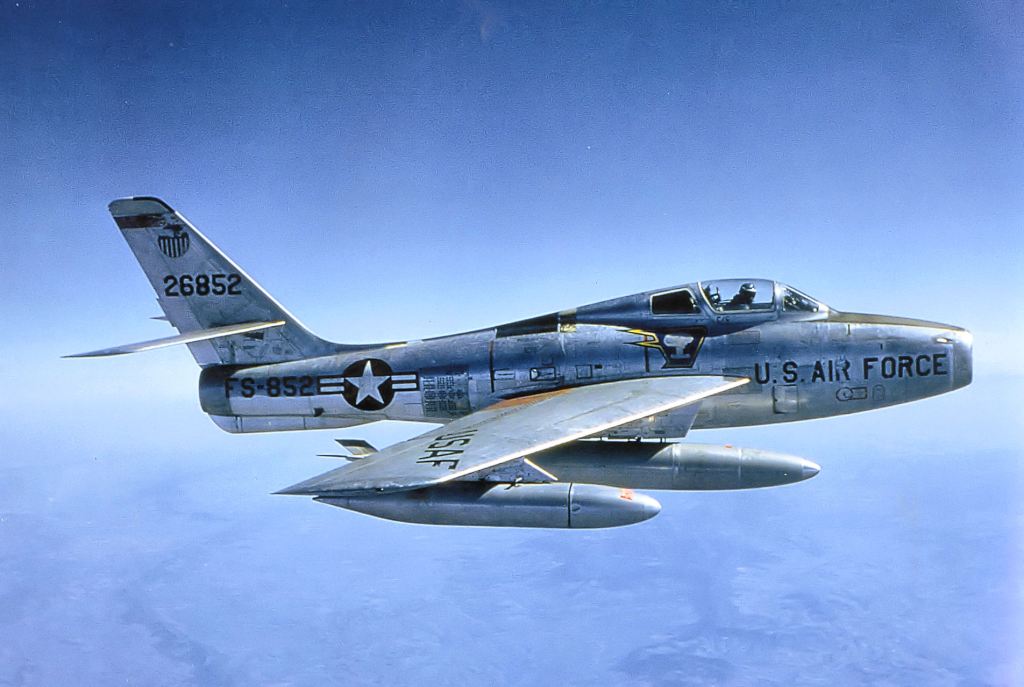
The F-84G Thunderjet was a straight-winged Thunderjet in the line of the B through E models. The F-84G was the first American-made jet fighter capable of in-flight refueling – with a fueling receptacle located at a single point in the port wing.
To connect the F-84G to larger aircraft for refueling, Boeing Corporation had developed a “Flying Boom” system – extending from bombers like Boeing’s B-29 Superfortress.
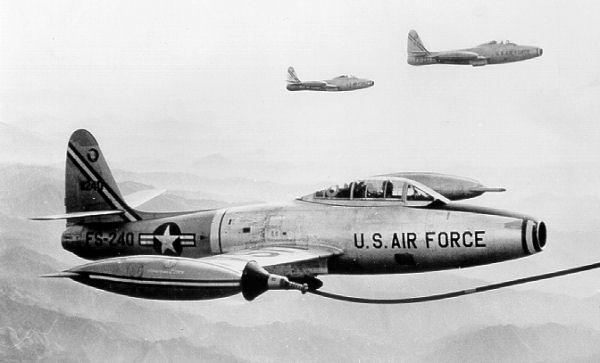
The F-84G was also fitted with an General Electric/Allison J-35-A-29 engine, a newer landing system, autopilot features, and the ability to carry up to 4,000 pounds of armaments and/or fuel externally. This Thunderjet was also the first single-seated fighter jet able to carry nuclear weapons.
First delivered to the USAF in 1951, the F-84G was the Republic Aviation’s most-produced variant of the F-84 Thunderjet, with 3,025 instances made.
In Service
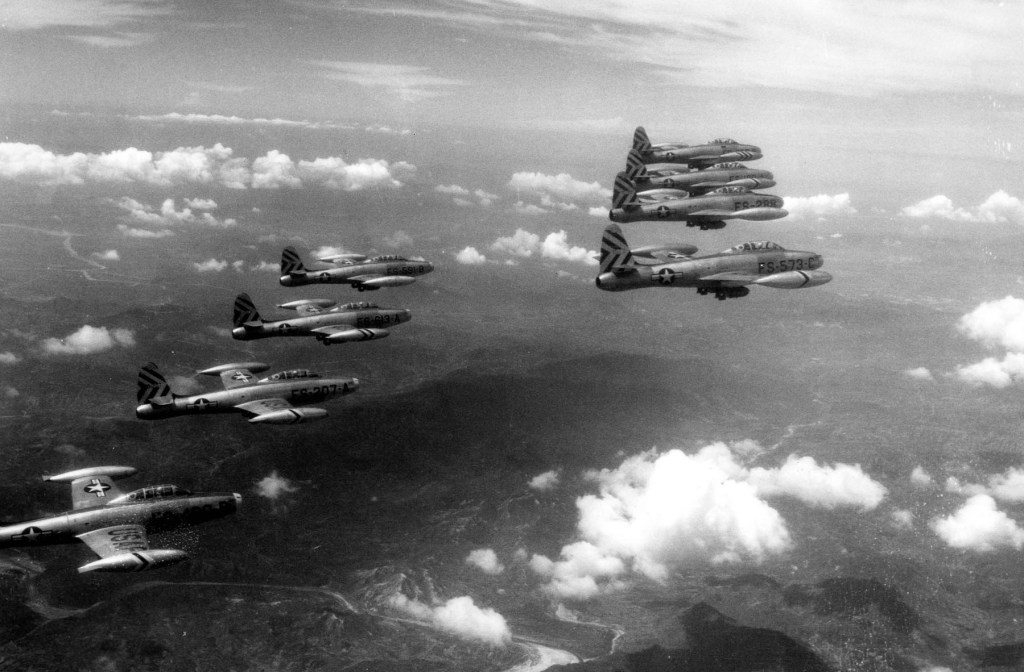
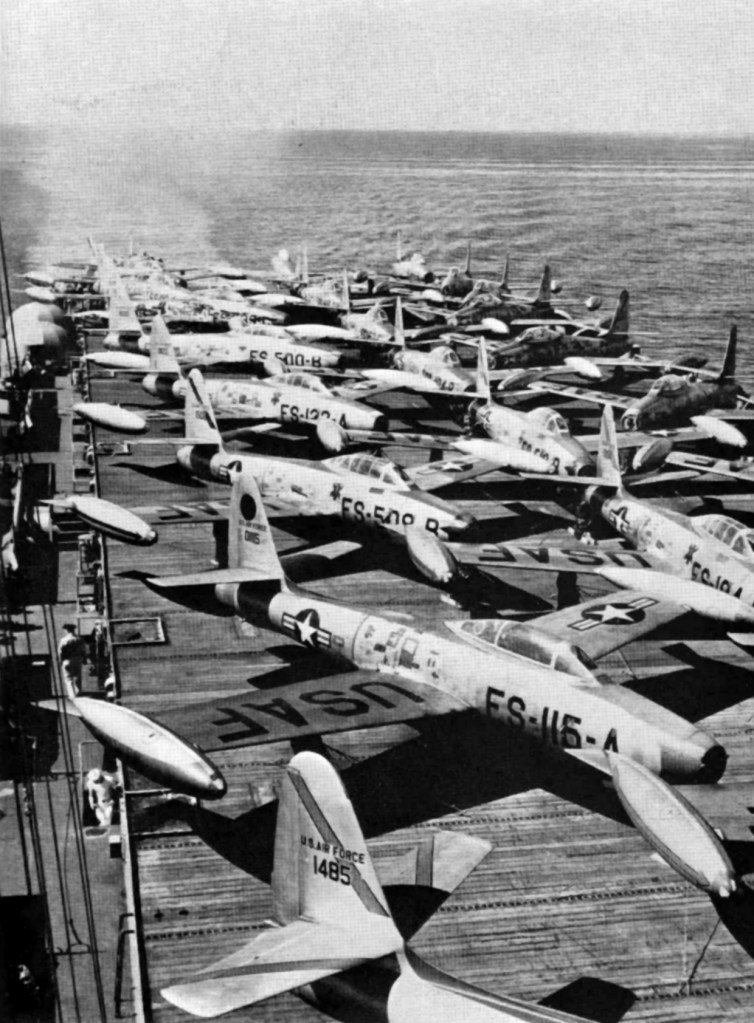
Though the F-84 Thunderjet was most associated with the Korean War (June 1950 – July 1953), it was actually deployed first to American stateside units. The P-84B, for example, was delivered to Bangor Maine’s 14th Fighter Group in December 1947.
There were numerous problems with the early P-84s including fuselage skin wrinkling, a shortage of available replacement parts, and general structural failure issues. Restrictions were made on maximum speeds (like flying at a top speed of Mach .80) and acceleration was not to exceed 5.5 times earth’s gravitational force equivalent, or “G’s”.
By May 24th, 1948, all P-84B units were grounded by the USAF because of these mechanical issues. Inspections on existing planes were executed and the P-84B, now F-84B (so designated on June 11th, 1948) soon resumed service with standardized restrictions on speed and performance.
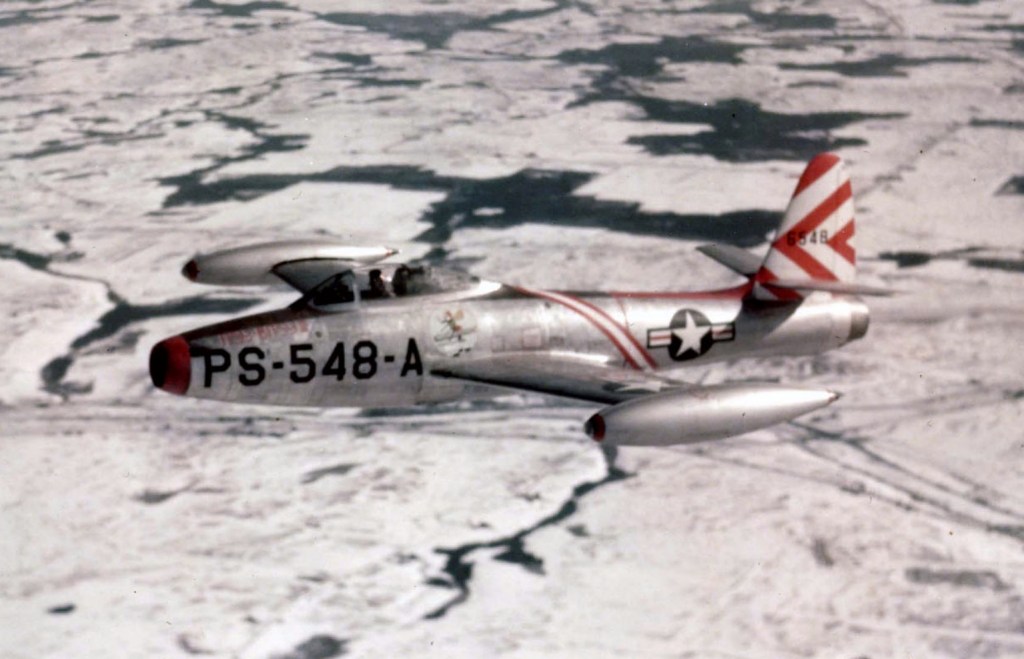
The F-84C Thunderjet was first delivered to the USAF in May of 1948. In that year alone, several air bases received the F-84C, including those in California, Georgia, South Carolina, Massachusetts, and New Mexico. The particular model, like the F-84B, was only used stateside, and was phased out of service in 1952.
The F-84D was the first version of the Thunderjet to be sent overseas, in this case, to assist in combat operations during the Korean War. By December 1950, F-84s were flying alongside F-86 Sabres, the latter of which was tasked with intercepting Manchurian-launched MiG-15s.
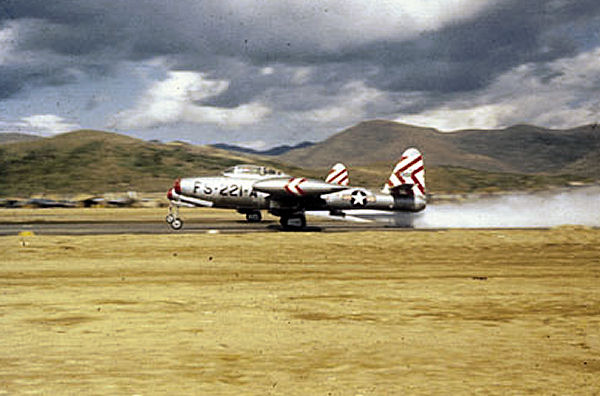
On January 21st, 1951, F-84 pilot Lieutenant Colonel William E. Bertram shot down a MiG-15, the first USAF air-to-air victory over such an enemy plane by the Thunderjet. Bertram belonged to the USAF 27th Fighter Escort Wing.
There were some early air victories over the MiG with the F-84 – including a January 23rd 1951 incident in which three MiGs were shot down by the Yalu River by an attacking group of 33 USAF Thunderjets.
These early air victories, however, did not last long – as MiG fighters gradually gained the upper hand due to their superior speed and maneuverability.
For example, on October 23rd, 1951, Mig-15s shot down an F-84 Thunderjet and three B-29 Superfortress bombers during a raid on North Korea’s Namsi Airfield. The American forces belonged to the 307th Bomber Wing. Though five enemy MiGs were shot down on this day, these types of interceptions would continue for the F-84 at least once more during late 1951.
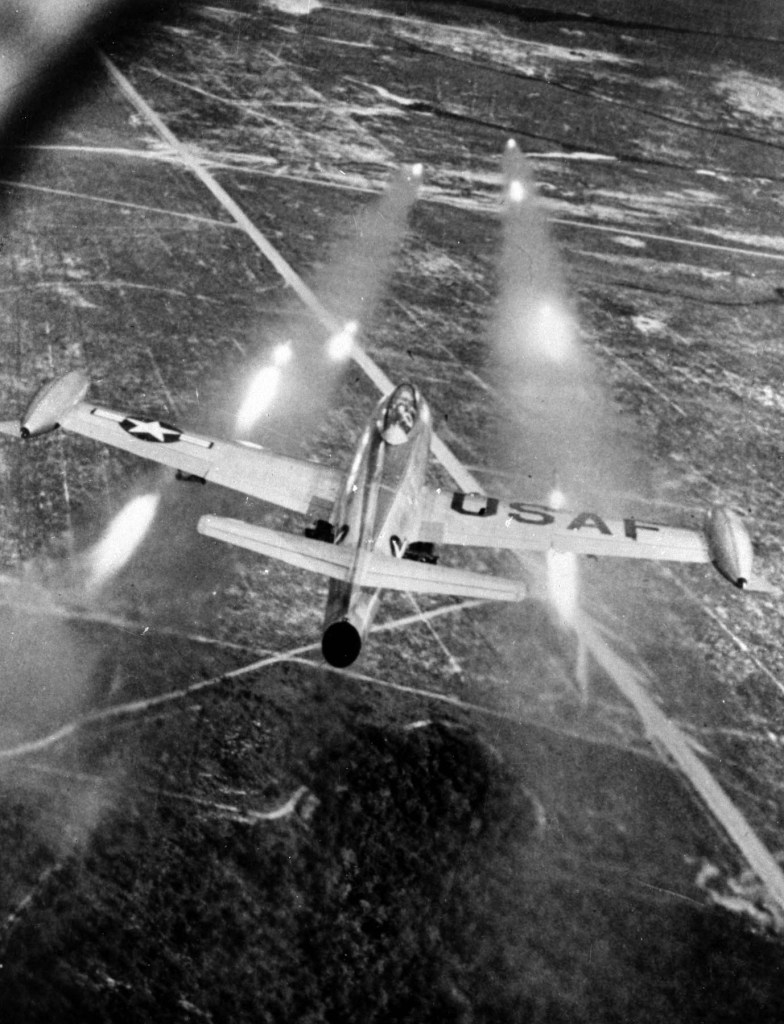
January 1952 saw increased use of the F-84 Thunderjet as a ground-attack airplane. On January 12th, a unit of F-84s destroyed two locomotives and boxcars from a supply train at Sunchon. On January 25th, F-84s strafed the enemy during a helicopter rescue of a downed pilot near the Yellow Sea.
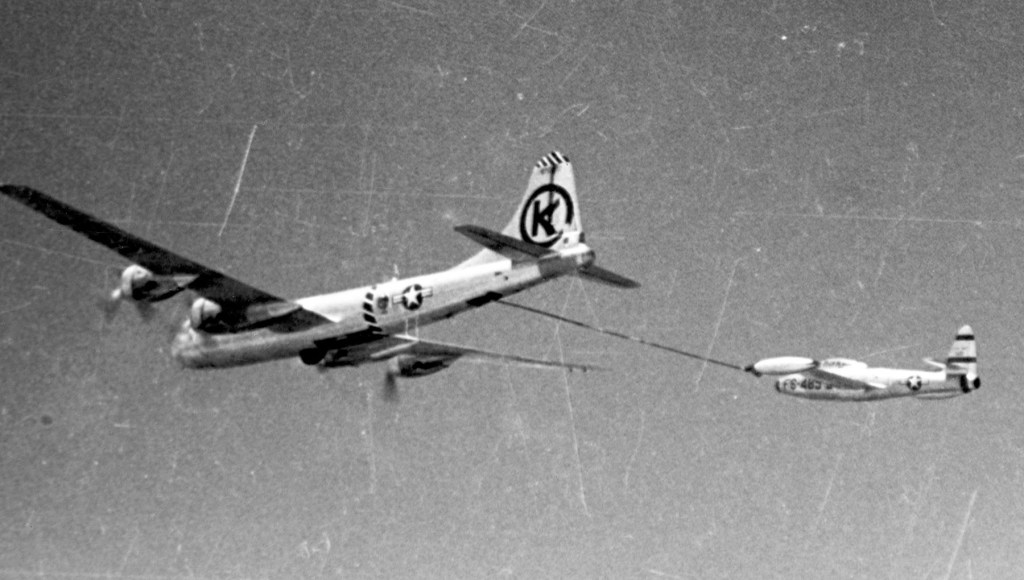
A breakthrough in F-84 use came with the possibility of in-air refueling. On June 7th, 1952, 35 Thunderjets (likely the F-84G) traveled from an air base in Japan and refueled in-air with the aid of a KB-29M bomber. These planes eventually made the trip to North Korea to attack targets there. This was part of what was considered experimental USAF project Operation High Tide, started earlier that year.
F-84 units would participate in ground-attack mission while being escorted by F-86 Sabres. Such was the case on September 9th, 1952, when Sabres covered a group of 45 Thunderjets. Attacking the North Korean Military Academy located at the northwestern county of Sakchu, the F-84s were attacked by around 64 MiG-15s. The Sabres provided cover, but three Thunderjets were lost.
The period of the war from late 1952 through July 1953 saw the F-84 almost exclusively in ground-attack missions. Targets included railway lines, airfields, dams, and industrial areas.
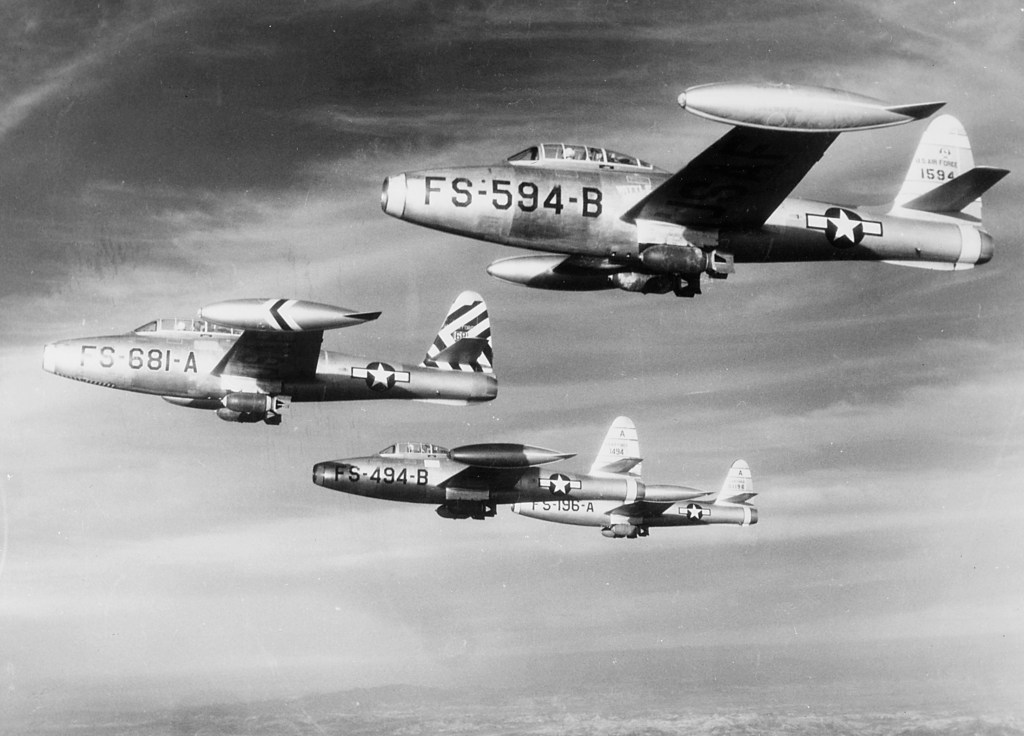
The F-84 was used to attack hydroelectric facilities, as in the February 15th, 1953 attack on the North Korean Sui-ho plant. Twenty-two F-84s of the 474th Fighter-Bomber Wing served as the bombing component of the mission. With eighty-two F-86 Sabres drawing off some thirty MiG-15s, the F-84 unit was able to drop 1,000-lb bombs on the plant, taking it out of operation for months.
The F-84G was notable for its capacity to carry nuclear weapons, as well as the ability to refuel in-air, in some cases to make overseas trips. In one August 20th, 1953 instance, a unit of seventeen F-84Gs were able to travel from Albany, Georgia to Lakenheath in the United Kingdom, a distance of 4,485 miles. Refueling with the KC-97 Stratofreighter tanker plane, this was a record first for non-stop distance flying by single-engined jet fighters.
The F-84 Thunderjet In Flight
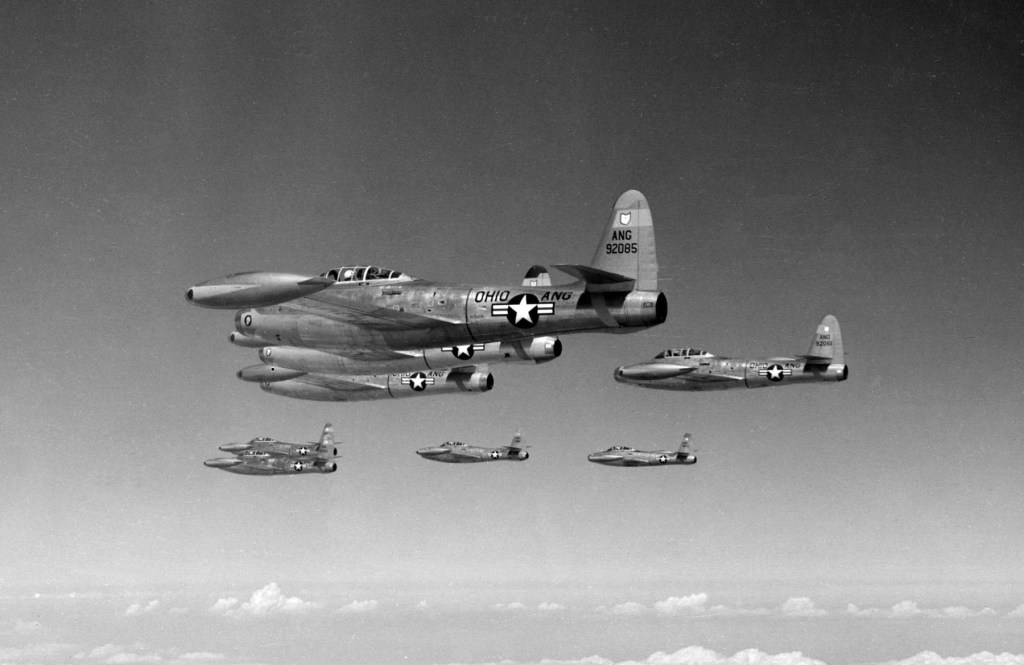
For some USAF pilots, flying the F-84 Thunderjet was their first experience with a jet fighter. Some pilots were even stunned to see an aircraft without a propeller.
In Korea, the F-84 was used to great extent in low-altitude ground-attack duties. Its main fighter opposition was from the Mikoyan-Gurevich MiG-15, a swept-wing jet capable of velocities near the speed of sound.
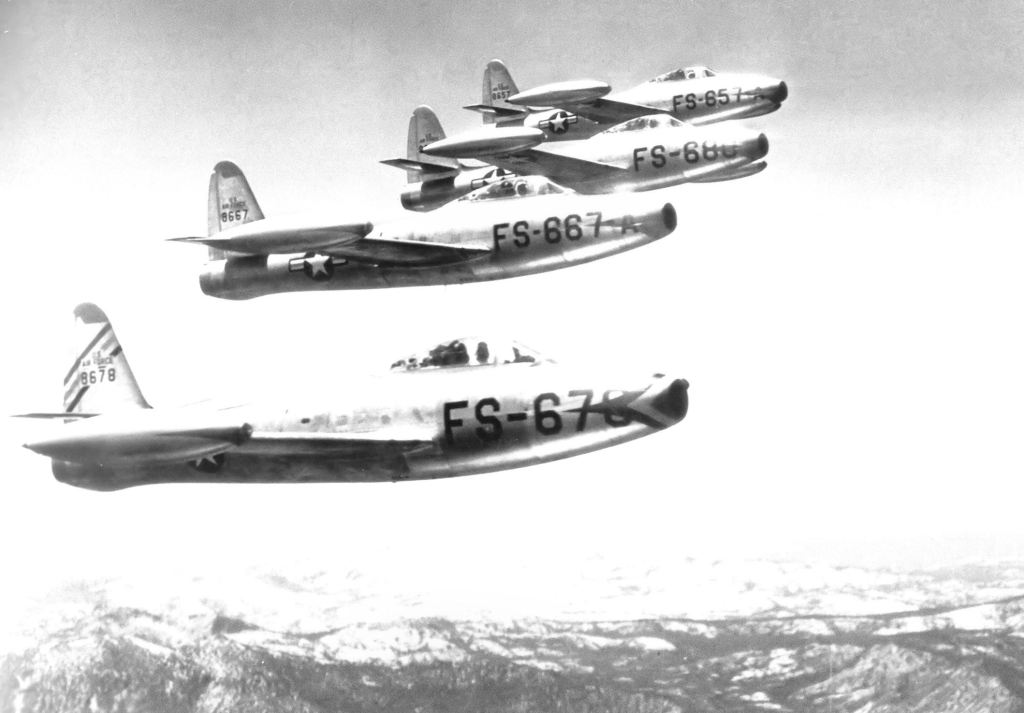
The F-84 Thunderjet flew slower than the MiG-15 at higher altitudes. It, however, was a faster, more maneuverable plane in lower-level flight. Aware of this, F-84 pilots occasionally dived to escape pursuing MiGs. The MiG pilots would reportedly either fire on the F-84s, or discontinue pursuit.
The MiG-15s were noted as being lighter, faster and capable of climbing at higher velocities. It could also make quick turns, faster than the Thunderjet. However, the F-84 had a rolling capability that some pilots suggested was better than that of the MiG.
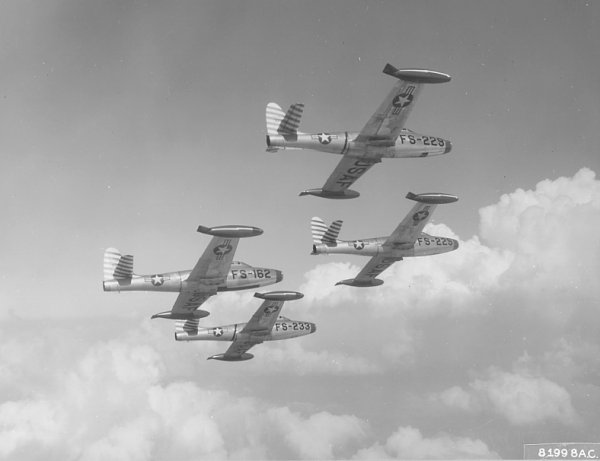
Though F-84 was often relegated to ground-attack duties, it was capable of carrying up to 4,000 pounds of bombs and made a formidable fighter-bomber. It was also capable of carrying napalm and even nuclear weapons.
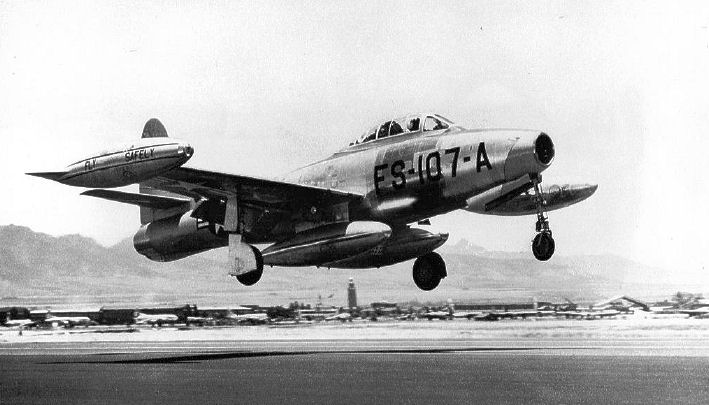
The F-84 Thunderjet was also the first USAF jet fighter that could be refueled in-air. During the mid- 1950s the plane was used to cross the Atlantic.
Flying to the northern United States, refueling in-air off the coast of Newfoundland, and landing in the Azores, F-84F units could then fly to Casablanca, Morocco, without refueling. From Casablanca they traveled to U.S. air bases in Europe.

The Thunderjet operated with what was called the “probe and drogue” system. The fighter jet was refueled in-air off a KB-29 tanker, a large modified B-29 bomber made for in-air refueling purposes.
Using a funnel attached to a 250-foot long tube (a “drogue”) the KB-29 extended this refueling system to a pipe in the F-84F located above the fuel tanks (a “probe”). The KB-29 had three such “drogues” and could refuel up to three F-84Fs in-air at once.
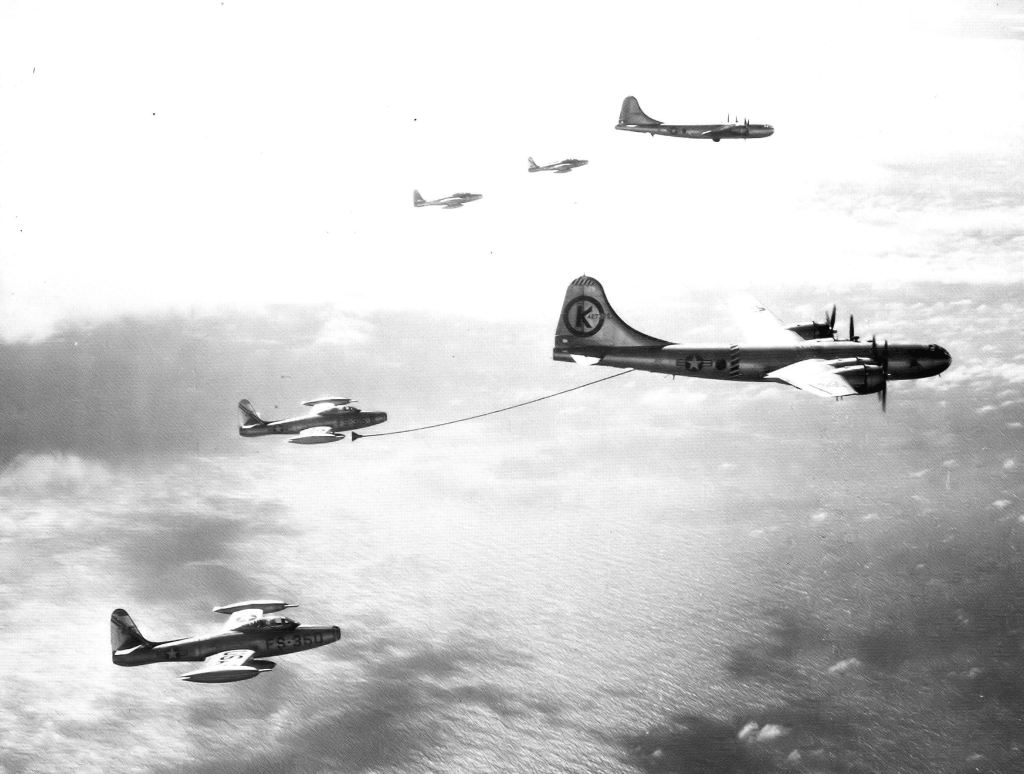
With this system, the F-84 was able to refuel in-air on trans-Atlantic trips, as well as trips across the Pacific. Combined with the F-84’s ground-attack abilities as demonstrated during the Korean War, this made the Thunderjet a formidable long-range fighter-bomber.
Model Variations
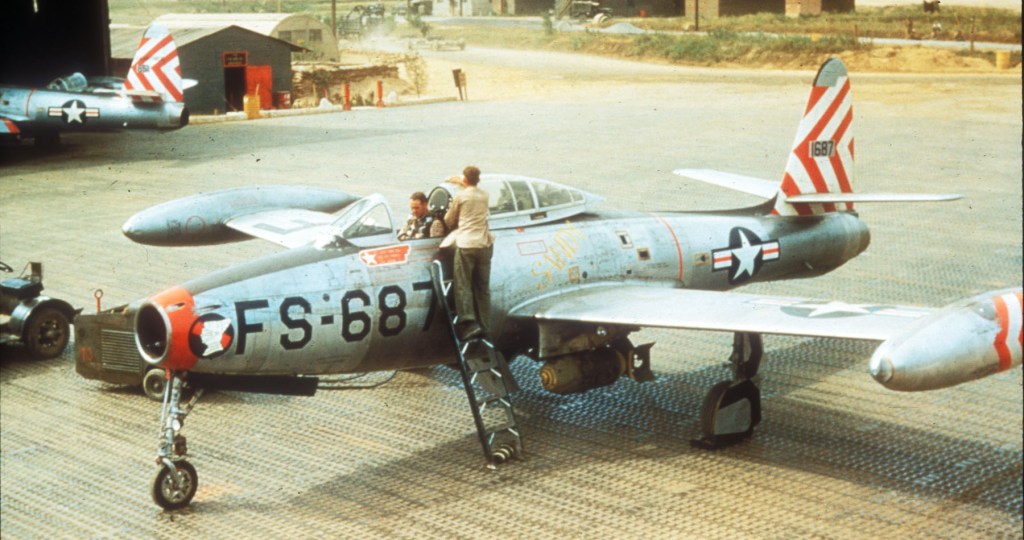
There were numerous variants of the F-84 Thunderjet, with the swept-wing versions of the plane named the Thunderstreak and Thunderflash.
Common traits among most straight-winged production F-84 planes included six .50-caliber machine guns, a length of 37 or 38 feet, and a wingspan of 36 or 36.5 feet. The dimensions of the Thunderstreak and Thunderflash were different, with a length of either 43 (Thunderstreak) or 47 feet (Thunderflash) and a wingspan of 33 feet.
Though the F-84 could be used for air-to-air fighting, it was more capable as an air-to-ground fighter. Thus, most F-84 variants were capable of carrying loads of bombs, rockets, and/or fuel tanks.
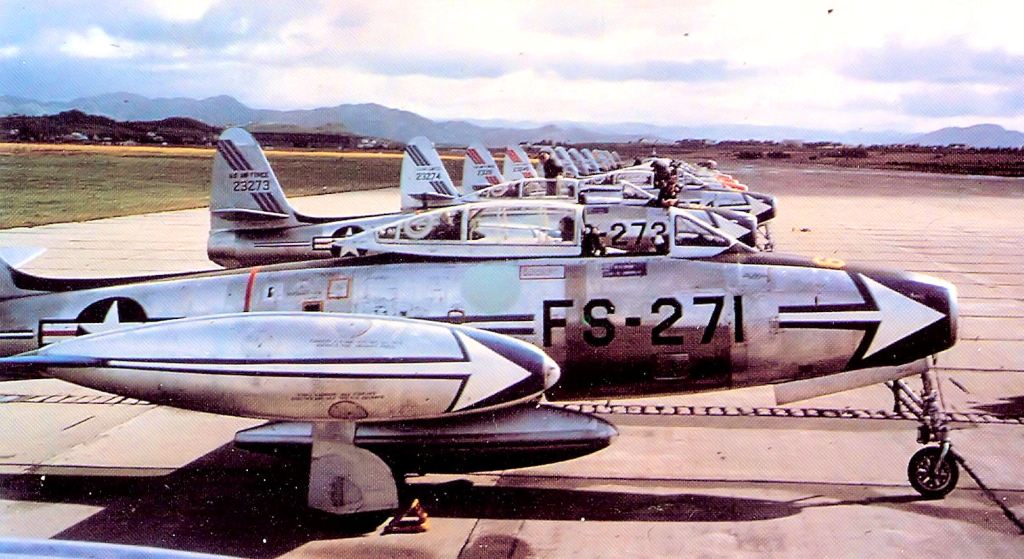
XP-84 – Republic Aviation’s prototype version of the Thunderjet, first flown on February 28th, 1946. It was equipped with a turbojet engine, the J-35-GE-7 – offering 3,745 – 3,750 pounds of thrust. Three instances were made.
YP-84A – The prototype of the F-84 Thunderjet specifically made for U.S. Government testing purposes. 15 instances were made, delivered to the U.S. Air Force in February 1947.
P-84B/F-84B – The first production version of the Thunderjet delivered to the U.S. Air Force. Powered by a 4,000 pound-of-thrust General Electric/Allison J-35-A-15 engine, the F-84B was 37.5 feet long, had a wingspan of 36.5 feet, and had a top speed of 586.6 miles per hour (509.7 nautical miles per hour). The plane was first delivered to the USAF in summer 1947; 226 instances were made.
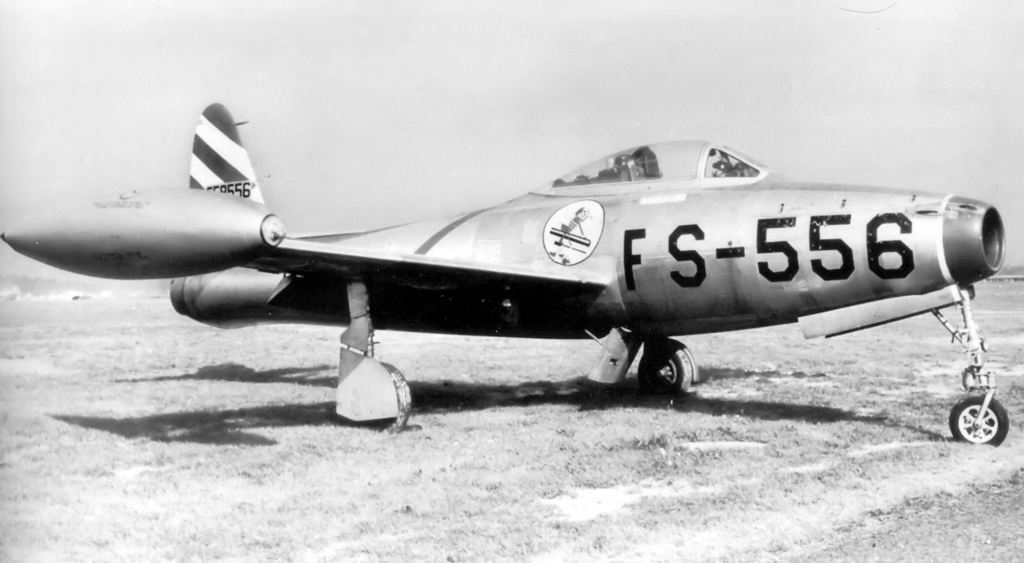
F-84C – A version similar to the F-84B, powered by the General Electric/Allison J35-A-13 engine first delivered to the USAF in May 1948. 191 instances of the F-84C Thunderjet were made.
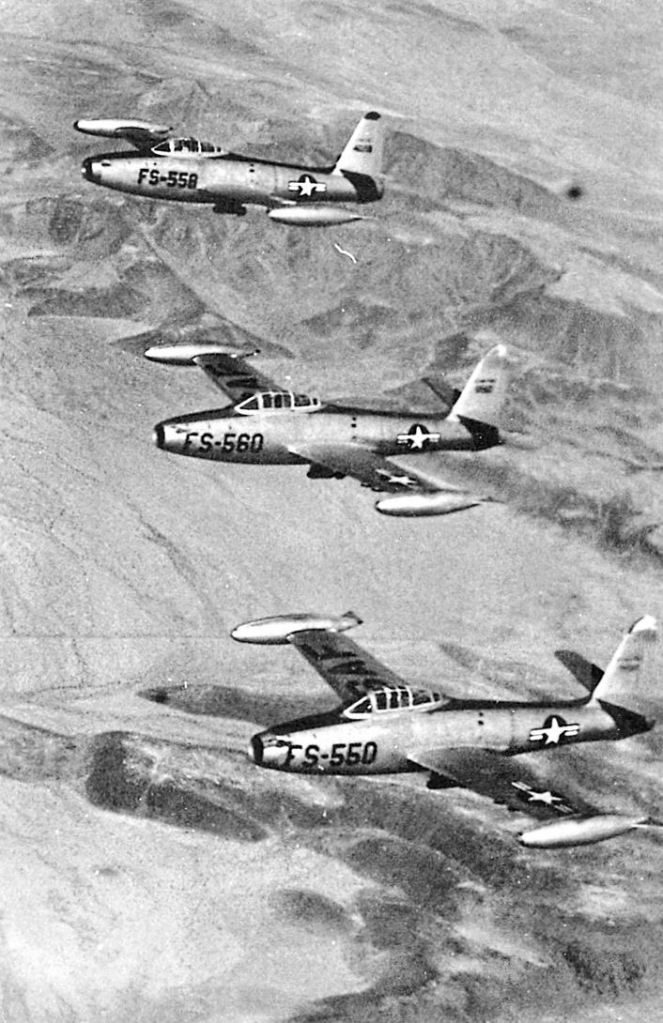
F-84D – A version with thicker wings, a winter-capable fuel system and the same engine as the F-84C. 154 instances of the F-84D were made.
F-84E – A version of the Thunderjet with a longer fuselage than previous versions, at 38 feet, first accepted in May 1949. The F-84E was equipped with a 5,000 pound-of-thrust General Electric/Allison J35-A-17 engine; it could reach a top speed of 599.6 miles an hour.
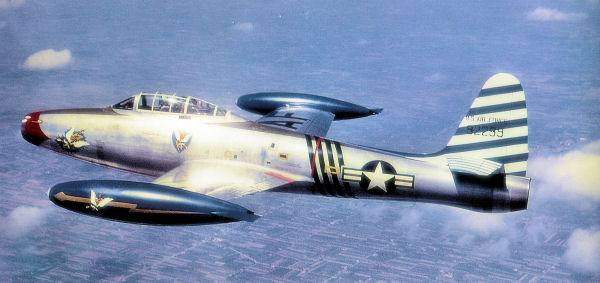
Other additions included two 230-gallon wingtip tanks which allowed an increased range (to 1,000 miles). 843 instances of the F-84E were made, 743 for USAF use, 100 for NATO use under the U.S. Department of Defense’s MDAP (Major Defense Acquisition Program).
F-84F – Also known as the F-84F Thunderstreak, the swept-wing version of the F-84, with the canopy, air brakes, and total armament weight capabilities improved. Developed actually after the F-84G Thunderjet, the first production F-84F was delivered to the USAF in November 1952.
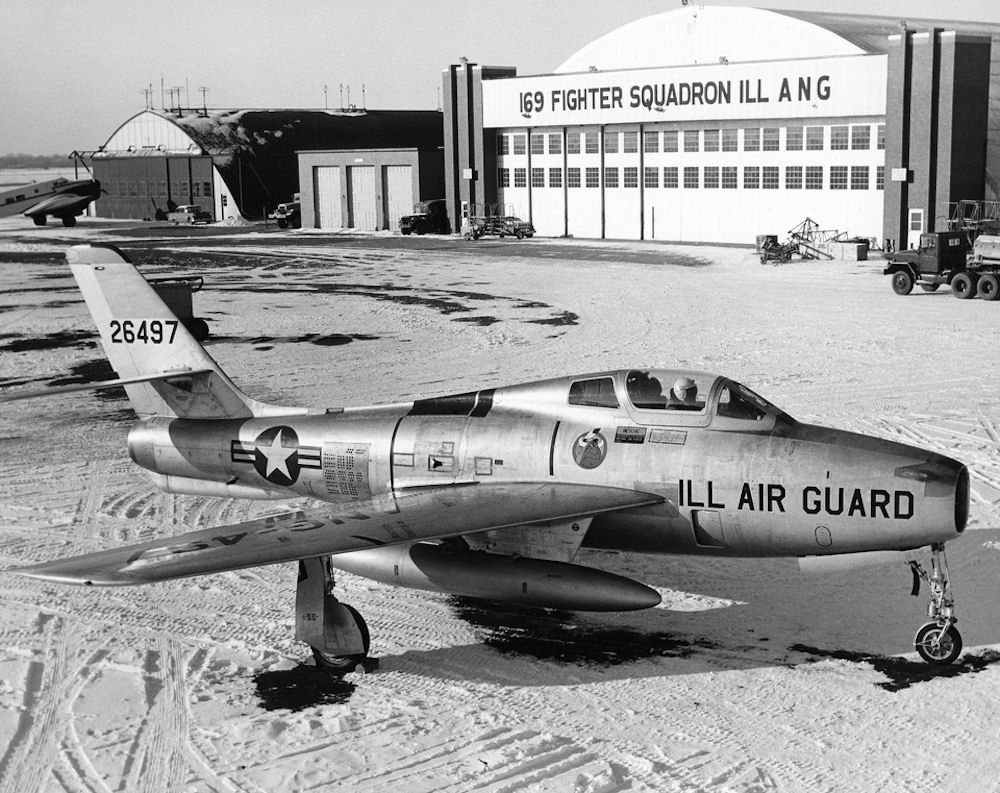
Along with the reconnaisance version RF-84F Thunderflash (at least initially), the F-84F Thunderstreak was equipped with a 7,200 pound-of-thrust Wright J-65-W-3 engine. These planes had a top speed of 616 (RF-84F) to 690 (F-84F) miles an hour.
In total, 2,711 F-84F Thunderstreaks were produced, while 715 RF-84Fs Thunderflashes were built.
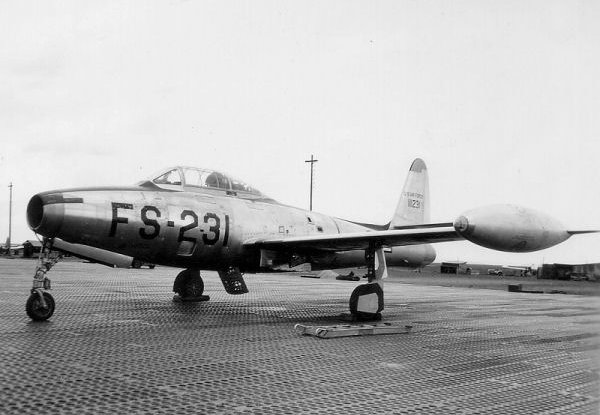
F-84G – The most-produced version of the F-84 Thunderjet, equipped with a General Electric/Allison J-35-A-29 engine, and capable of a maximum speed of 621 miles an hour. This plane was first delivered to the USAF in July 1951.
The F-84G was also fitted with a new A-4 gunsight, and had the ability to be refueled in-air. The F-84G was capable of carrying atomic tactical weapons, the first single-seat jet fighter with this ability. 3,025 F-84Gs were made, 789 for USAF use, 2,236 for NATO/MDAP use.
 Waves To Jets