The Comfort Class

By WavesToJets
(There have been numerous medical ships in service, in peacetime and war, throughout history and into the present. To illustrate them all would be a extensive endeavor – and for this reason, only one class of hospital ships, the American-made, World War 2-era Comfort class – is described here. A description of other such classes may follow in the future.)
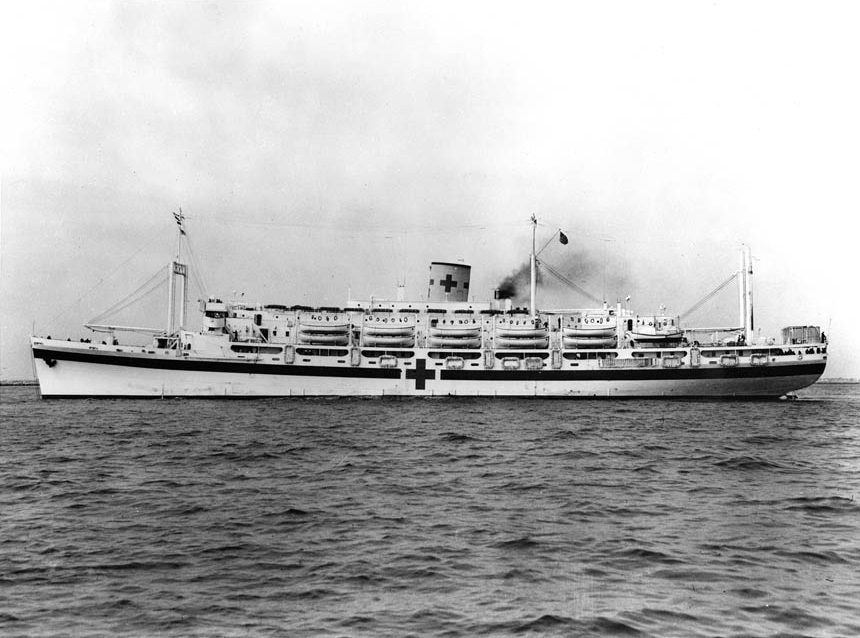
The Comfort-class ships were a group of U.S. Navy hospital ships that saw service during World War II. Commanded and crewed by U.S. Navy personnel, the Comfort class’ hospital facilities were operated by U.S. Army medical staff.
Consisting of three ships – the USS Comfort (AH-6), the USS Hope (AH-7), and the USS Mercy (AH-8) – the Comfort class aided armed forces in the Pacific Theatre. The ships operated in waters and stations in and around the Philippines, Okinawa, New Guinea, Palau, the Caroline Islands, the Marianas, and Guam.
Here are five more facts about the Comfort-class hospital ships.
1. The Comfort class ships were built in the midst of World War II.
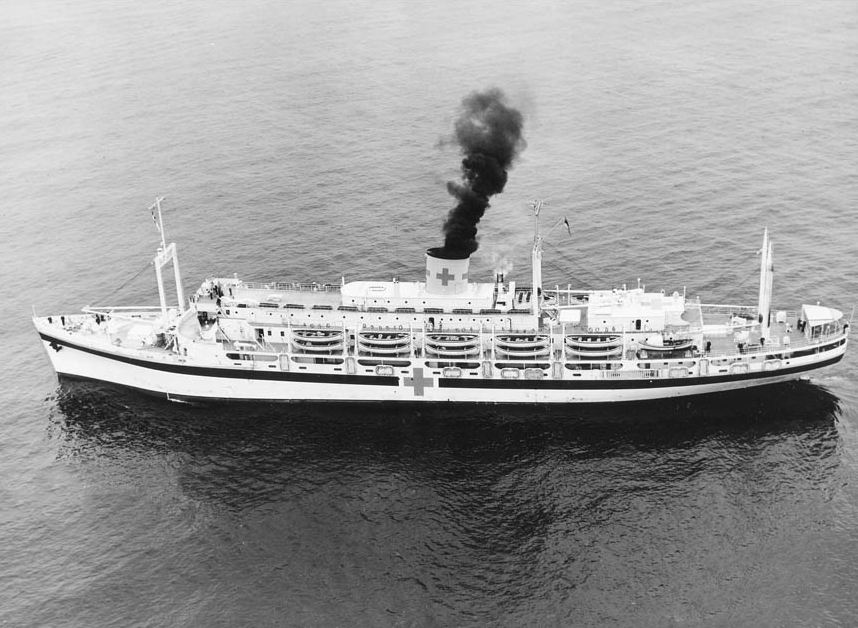
The Comfort class of hospital ships were first developed in 1943 – well into the Second World War. The Consolidated Steel Corporation was responsible for building all three ships in the class, after being issued a contract from the United States Maritime Commission (MARCOM).
The USS Mercy was laid down on February 4th, 1943 in Wilmington, Los Angeles, California. The Mercy‘s launch was on March 25th, 1943, a week later than the flagship of the class, the USS Comfort – which took place on March 18th.
The USS Hope was launched on August 30th 1943 – and all three ships were comissioned by the U.S. Navy at different times. For the Comfort, it was on May 6th, 1944. The Mercy and the Hope would be commissioned in August 1944, on the 7th and the 15th, respectively.
Each ship had a beam (width) of around 60 feet and lengths from 416 feet to 419 feet, 9 inches. The Mercy and the Hope had a complement of 516 crewmembers (the Comfort had a complement of 233 crew) and each ship was designed to treat hundreds of people, up to the USS Hope‘s capacity of over 400 patients.
The Comfort-class hospital ships could operate at speeds of 14 to 15.5 knots (16.1 – 17.8 miles per hour). The 6,000-long ton (6,720 short ton) ships would have a maximum weight of 9800 long tons (10,976 short tons) when fully loaded. With capacities such as this, the Comfort class was ready to enter mid-war service.
2. The Comfort class moved frequently.
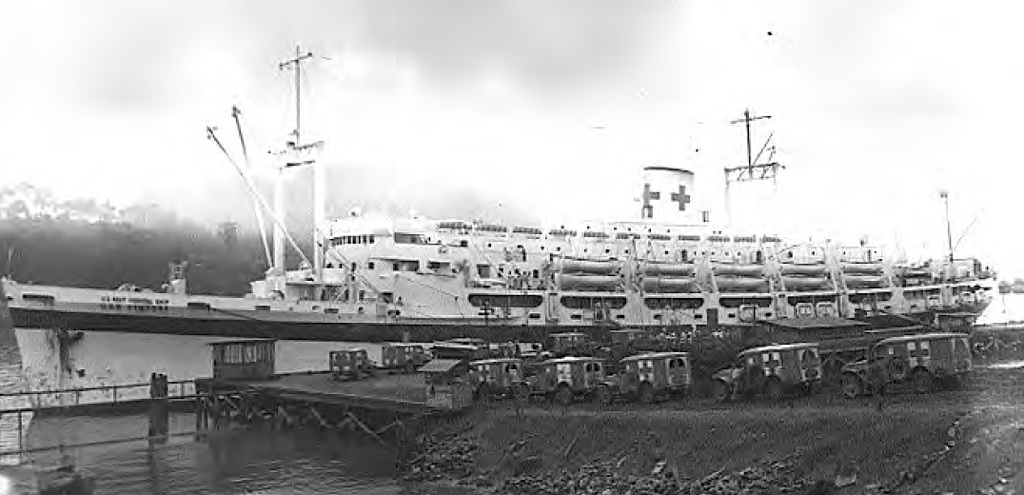
Though the Comfort-class ships would see service relatively late in the war, they did manage to travel to numerous locations in the Pacific Theatre.
The flagship USS Comfort, for example, left San Pedro, Los Angeles, California on June 21st, 1944. It headed to the southwest Pacific, specifically the ports of Hollandia, New Guinea and Brisbane, in Queensland, Australia.
The Comfort was based in Hollandia for a time, then the ship moved to the island of Leyte in the central Philippines – and then back to San Pedro, California, by December 1944. The Comfort then traveled back to Leyte Island, and reached Hollandia again on February 6th, 1945.
The ship then traveled in March 1945 to the northern Philippines, specifically to Lingayen Gulf and Subic Bay off the country’s main island of Luzon. In early April 1945, the Comfort was located off of Okinawa and traveled to Guam, Micronesia, later that month.

The Comfort moved back to Okinawa in late April 1945, and was damaged in an enemy attack. From here, the ship traveled to Guam and then to Los Angeles, California by late May 1945.
In September 1945, the Comfort was back in Subic Bay, Philippines – and by early October 1945 was traveling to ports at Okinawa, Yokohama (Japan), and Guam. It returned to San Pedro, California in December 1945.
The Comfort‘s postwar travels were limited – it did, however, travel to Manila (Philippines), Yokohama, Japan, Incheon, Korea, and Okinawa in early 1946 – before finally traveling to San Francisco. The USS Comfort was decommissioned on April 19th, 1946.
Similarly, the USS Hope and USS Mercy traveled frequently between ports and U.S. stations in the Pacific, including Pearl Harbor, Hollandia, the Caroline Islands, Kossol Roads (a strait off of Palau), the Admiralty Islands (including the island of Manus), Tacloban (on Leyte Island in the Philippines), Saipan (in the Marianas Islands), Tarakan (off of Borneo, Indonesia), Biak (off of northern New Guinea), Okinawa, and Incheon, Korea.
3. The Comfort class usually conducted evacuation and transport duties.
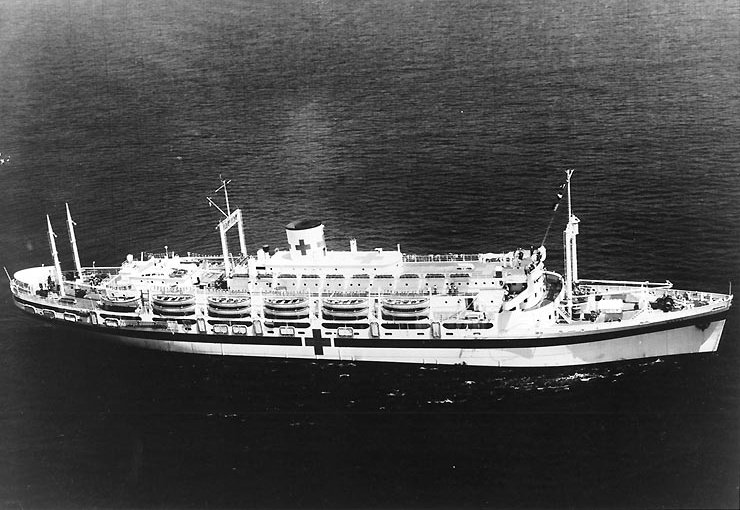
The U.S. Navy operated the Comfort class during the Second World War, but these ships usually served injured U.S. personnel in an evacuation capacity. Other craft designated as U.S. Navy-specific hospital ships, such as the USS Solace (AH-5) or the USS Relief (AH-11) – normally took injured U.S. personnel directly from medical stations at battle areas and used small landing craft to embark these personnel for treatment.
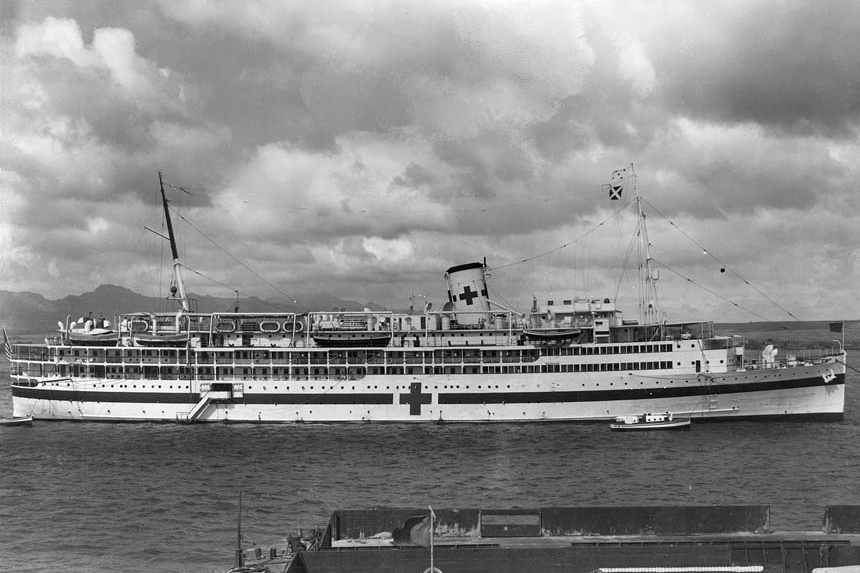
The ships of the Comfort class, in contrast, were originally meant to take injured personnel who had already been given primary treatment, and transport them to somewhat safer locales. The ships of the Comfort class would spend months at ports such as Hollandia and Leyte Island, for example, before leaving for ports at Guam and San Francisco.
There were, of course, exceptions to this – the USS Hope, for example, directly rescued sailors from ships that had undergone damage during the U.S.-led invasion operation of Okinawa on April 9th, 1945.
4. The staff on the Comfort class consisted of Army and Navy personnel.
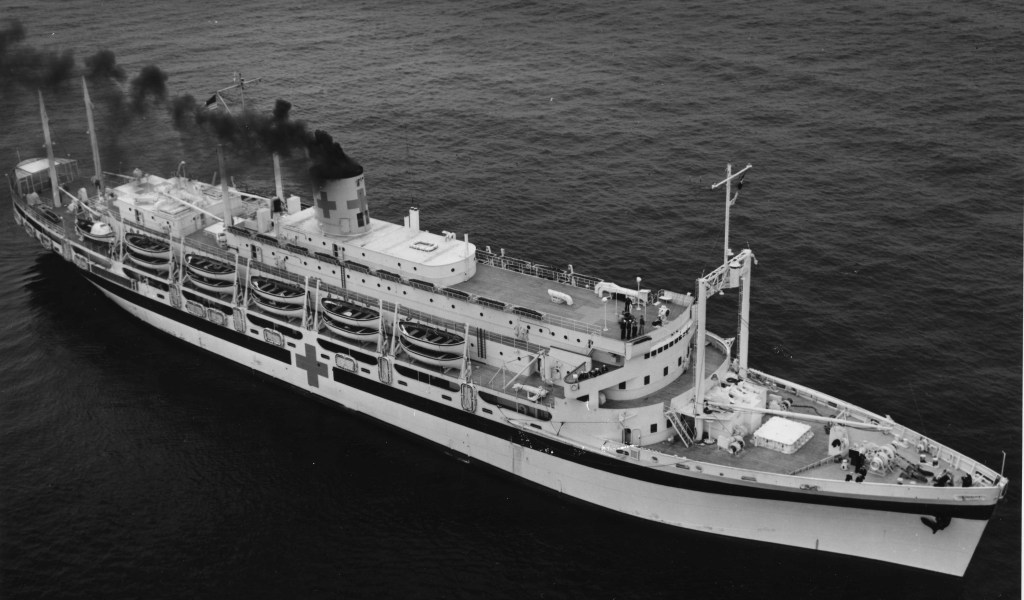
The Comfort class were commissioned as U.S. Navy ships, and at command were Navy officials. For the USS Comfort, at the helm was Commander Harold Farnham Fultz, for the USS Mercy, it was Captain Thomas A. Esling (U.S. Naval Reserves), and for the USS Hope it was Commander Albert E. Richards.
The crews of these ships were of the U.S. Navy as well – with full complements of the class ranging from 233 (for the USS Comfort) to over 500 people (for the USS Hope and USS Mercy).
The medical staff of the Comfort class, however, consisted of U.S. Army personnel – with a management structure that accomodated the provisional backing of such medical teams if the ships ever aided amphibious invasions. Medical equipment was also supplied by the Army as well.
5. The Comfort class encountered attacks during service.

Though the ships of the Comfort class were often stationed in places relatively farther away from Pacific Theatre battle locations – compared to other Navy craft – they were sometimes targets of enemy attacks.
One such instance involved a direct kamikaze attack on the USS Comfort near Okinawa on April 28th, 1945. The damage sustained in this attack involved three decks and loss of patients and medical staff. The crash caused by the Japanese plane caused 28 deaths – among them six nurses – and wounded 48 others.
The USS Mercy was also exposed to the dangers of air raids when it was stationed off of Hagushi Beach, Okinawa in April 1945. Finally, the USS Hope was unsuccessfully attacked by a torpedo plane on December 3rd, 1944 while traveling between Leyte, Philippines, and Hollandia, New Guinea.
 Waves To Jets