The Supersonic Fighter
By WavesToJets
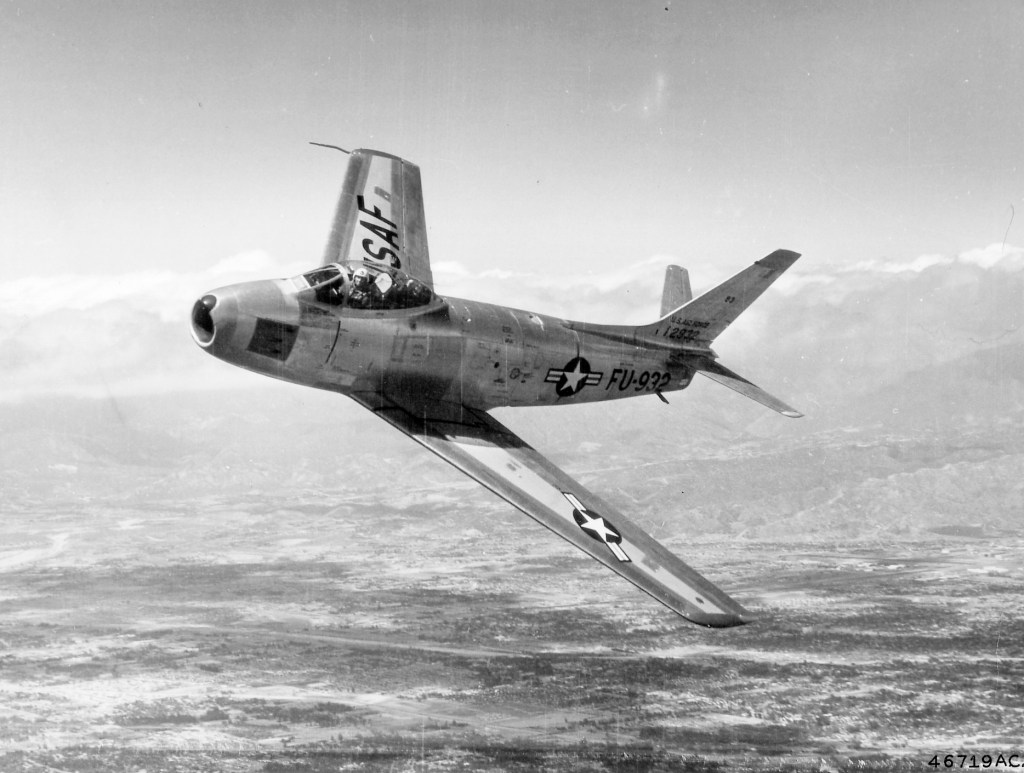
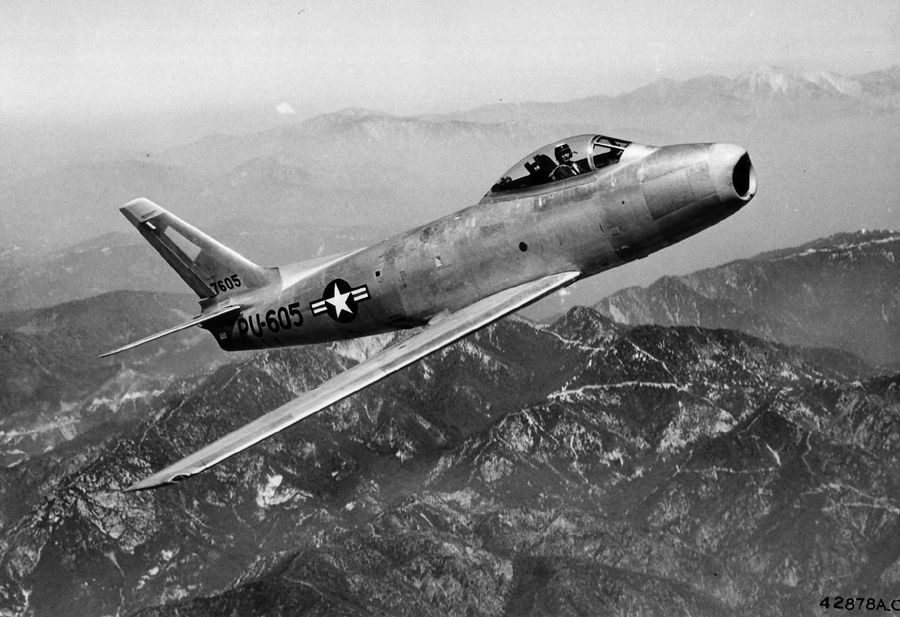
The F-86 Sabre was an early Cold War-era jet fighter aircraft. Designed and tested in the mid-1940s, the Sabre was engineered by North American Aviation – the same company that had produced the Second World War’s famed P-51 Mustang fighter.
As a jet fighter, the Sabre was capable of speeds that neared – and at times surpassed – the speed of sound. The craft’s transonic capabilities, however, would not be possible without its swept-wing design, a first for American-made jet fighters at the time of its development.
Breaking speed records in the late 1940s, the Sabre became even better known for its role in the Korean War in the early 1950s. The F-86’s development paralleled the Soviet-produced MiG-15 fighter, and the two types of planes would face each other over the Korean peninsula, especially in the northwestern North Korean region that became known as “MiG Alley”.
During and after the Korean War, production and innovation on the F-86 Sabre designed continued, both in the United States and elsewhere. Some models were built under license in other countries, such as Australia, Japan, and Canada.
The F-86 Sabre was also sold to several air forces worldwide, and has been used in a number of regional conflicts. Among these air forces were those of India, Taiwan, Pakistan, Indonesia, Portugal, Japan, Argentina, the Philippines, South Africa, Norway, and Peru, among others.
Technological Background
North American Aviation (NAA) was an aircraft engineering and production company that had achieved much success in developing fighter aircraft during the Second World War.
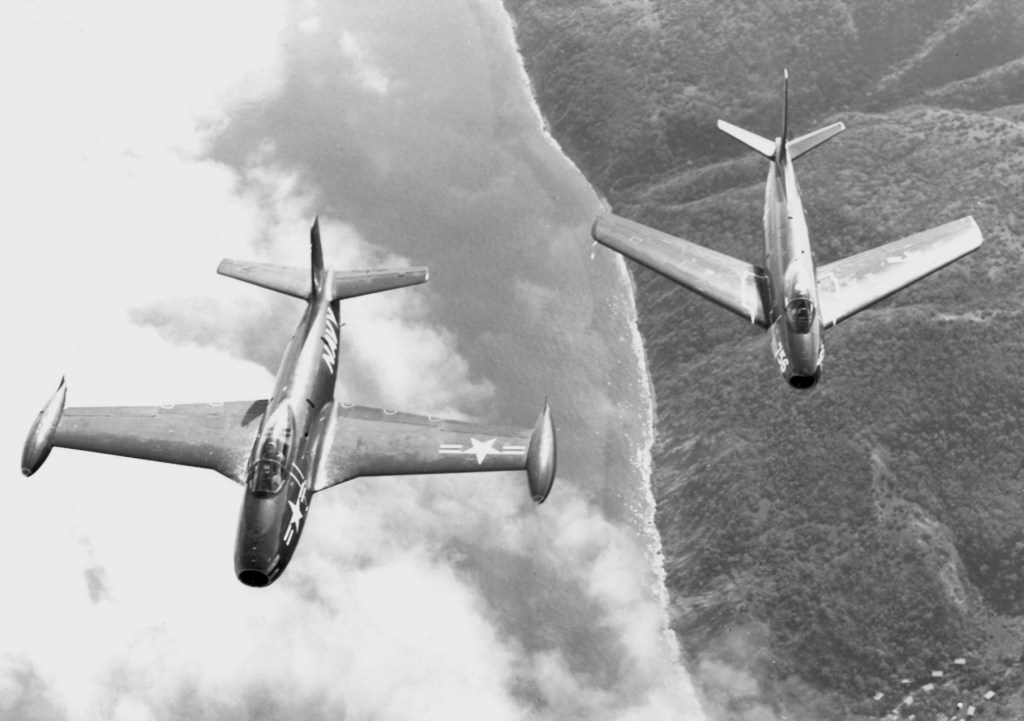
NAA had proposed the U.S. Navy’s first jet fighter, a design that would eventually become the branch’s FJ-1 Fury, by the end of 1944.
The Navy would order a prototype of the FJ-1 Fury (what the branch would refer to as the XFJ-1 Fury) from NAA in late 1944 and the early months of 1945.
After testing, the XFJ-1 Fury was deemed suitable for U.S. Naval use. The Navy ordered production versions of the craft (which the branch would henceforth refer to as the FJ-1 Fury), and NAA delivered these to the branch starting in October 1947.
The FJ-1 Fury was a stout-bodied, straight-winged jet aircraft with low-set wings. Elements of its design had been inspired by North American’s P-51 Mustang, including its bubble canopy and straight wings.
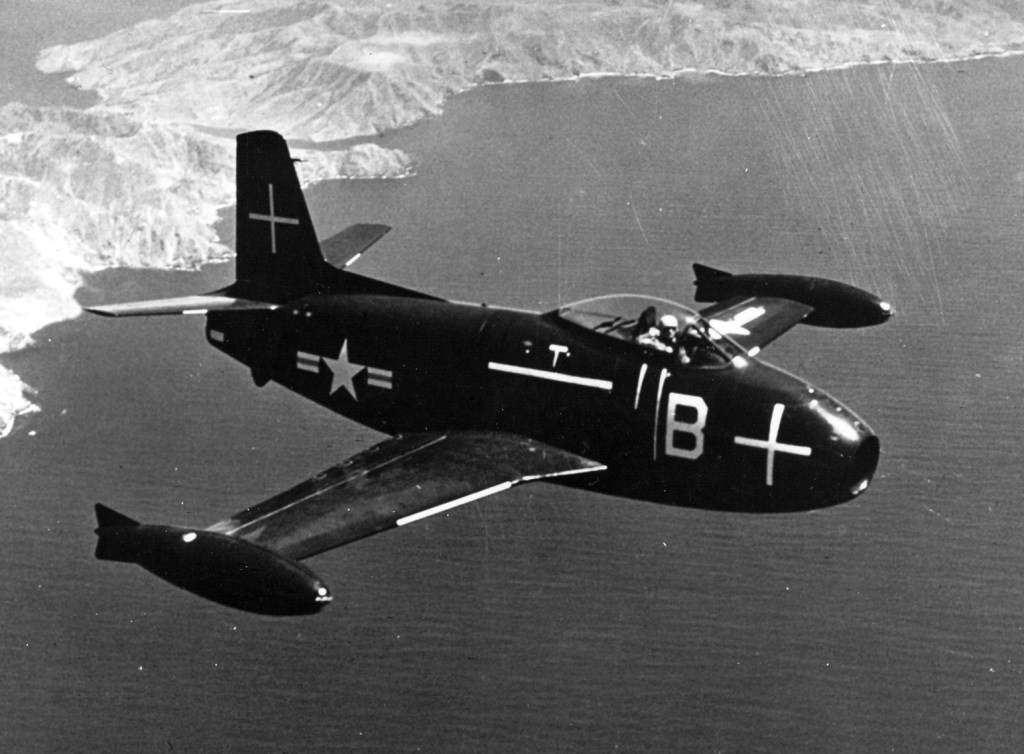
The Fury used a General Electric/Allison J35-A-2 engine, a turbojet engine that was based on the concept of axial-flow: that the air in the air intake runs parallel to the engine’s axis of rotation.
This J35 engine was encased in the FJ-1’s fuselage, which took in air through the plane’s nose and expelled exhaust (and thrust) through its tail. At any rate, this design would serve as an inspiration for what would eventually become the (U.S. Air Force’s) F-86 Sabre.
In mid-1944, the United States Army Air Forces (USAAF) drafted requirements for a single-seated, jet-powered, medium-ranged and high-altitude capable airplane – one suited for escort fighter and fighter-bomber roles.
NAA took up the chance to meet these requirements, and submitted four designs to the USAAF starting in 1945. Among the designers of the eventual F-86 was Edgar Schmued, designer of the P-51 Mustang.
The NAA designs were patterned after those made in the development of the FJ-1 Fury – including straight wings that jutted out perpendicularly from the fuselage.
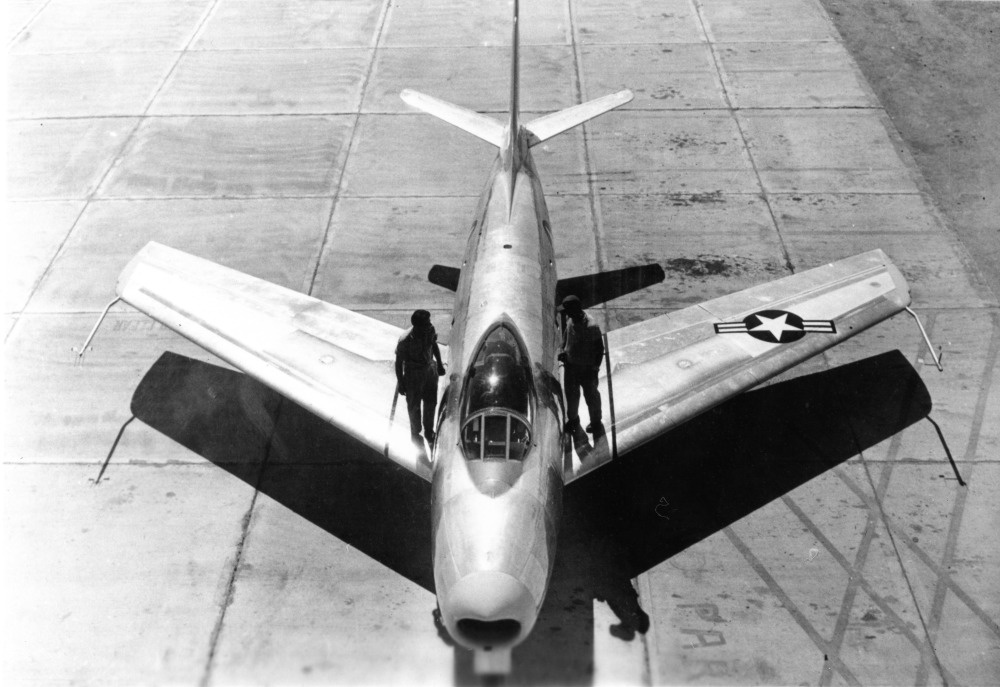
By May 18th, 1945, the USAAF had ordered three prototypes from NAA based on a single chosen design – and these prototypes would become what the USAAF would refer to as the XP-86.
The early version of the XP-86 (known in the NAA company as the NA-140), however, was not expected to perform at levels suitable for USAAF use.
For example, although the NA-140’s top speed was anticipated to be 582 miles per hour – far over the FJ-1’s top speed of 547 miles per hour – but very much below the USAAF’s requirement for its new aircraft to reach 600 miles per hour.
These types of setbacks may have cost NAA their contract with the USAAF, leaving other companies (like Lockheed and Republic Aviation) better suited to develop a new pursuit (fighter) plane.
But this was not to be the case: because of then-recently recovered jet technology information from defeated Nazi Germany, North American Aviation was able to improve upon the NA-140.
This was evidenced in the aircraft’s wing design – which were eventually (approved by the USAAF November 1st 1945) patterned after those of the German Messerschmitt Me 262 jet fighter, which had swept wings.
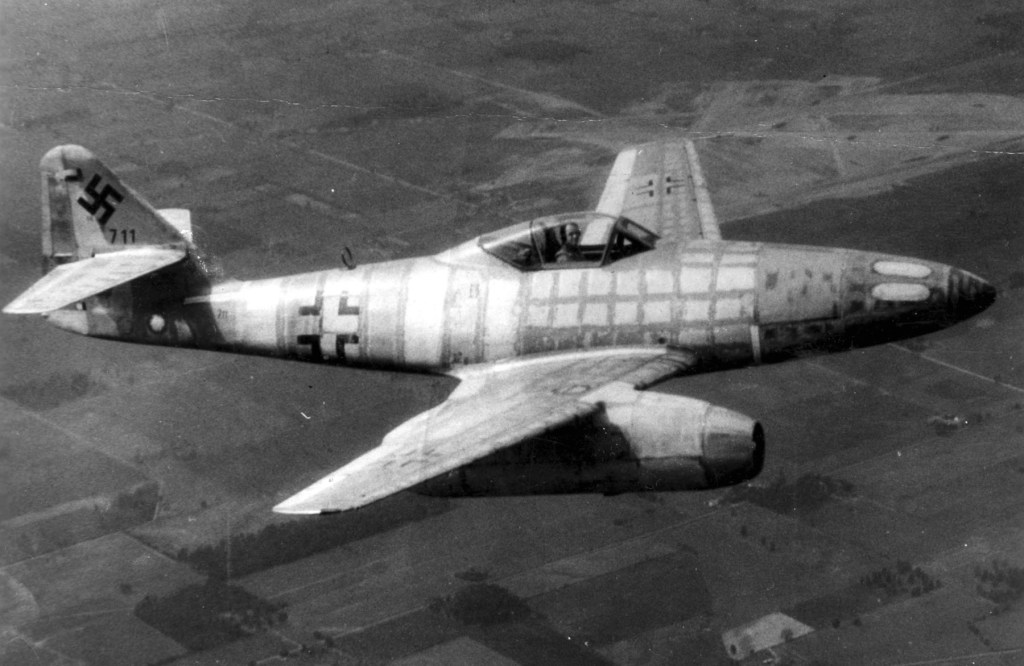
Although the Germans had initially used swept wings for reasons more related to balance than speed, the engineers at NAA found that a swept wing angle of 35 degrees (to the fuselage) would reduce the chance of compressibility and shock wave issues associated with speeds approaching the sound barrier.
With swept wings (as well as swept vertical and horizontal tail components), the NA-140/XP-86 would therefore be able to travel at much higher speeds. NAA’s first XP-86 prototype would be complete by August 8th, 1947.
The USAAF, meanwhile, was long willing to become an independent military branch of its own. It officially became the United States Air Force (USAF) – with the swearing-in of businessman and former U.S. Army Second Lieutenant William S. Symington as Secretary – on September 18th 1947.
On October 1st, 1947, test pilot and former USAAF Major George S. Welch flew the XP-86 prototype for the first time at Muroc Dry Lake in Kern County, California (this location is now known as Edwards Air Force Base).
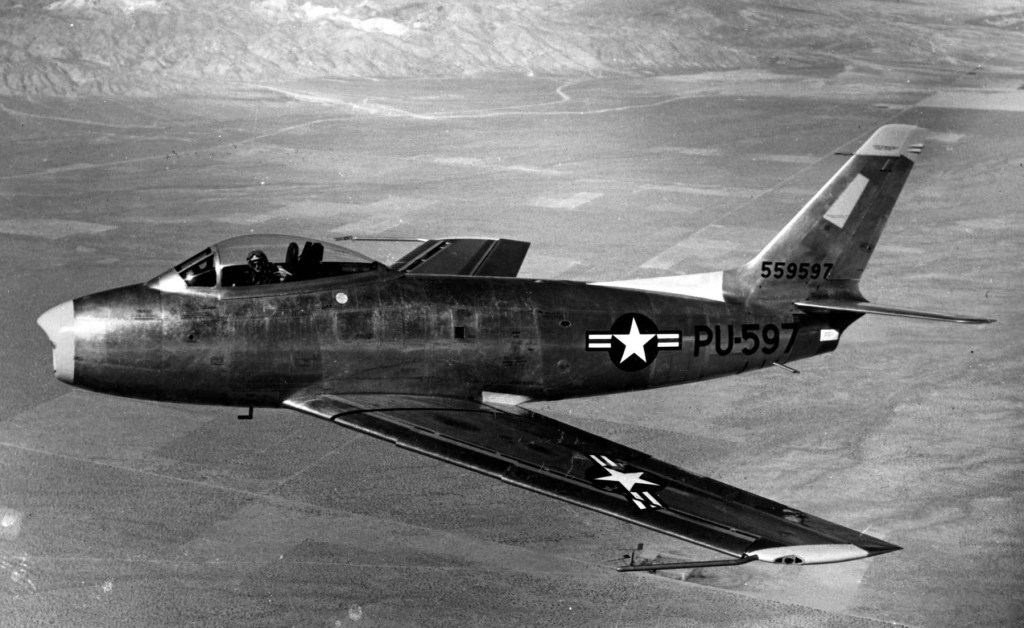
According to some sources (including test pilot and engineer Al Blackburn) the XP-86 was purported to break the sound barrier in a dive on October 1st – which would make it the first manned vehicle to successfully do so – but this has been disputed.
USAF Secretary Symington had reportedly requested the XP-86 not break the sound barrier (since the USAF’s Bell X-1 was already on track for doing so) and this request was apparently respected.
It is now widely accepted that Brigadier General Chuck Yeager first successfully broke the sound barrier in a level flight with the Bell X-1 on October 14th 1947.
Still, the XP-86, and the later F-86 Sabre, were poised to make make history in their own right. On April 26th 1948, the XP-86 officially broke the sound barrier, and in May 1948, the first production model, the F-86A, had flown.

On September 15th, 1948, the F-86A set a world speed record of 670.9 miles per hour. This particular record was made by USAF Major Richard L. Johnson flying out of Muroc Dry Lake.
The first woman to break the sound barrier, Lieutenant Colonel (later Colonel) Jacqueline Cochran, did so flying a Royal Canadian-built F-86 Mk. 3 on May 18th, 1953. She did so flying out of Rogers (formerly Muroc) Dry Lake , Kern County, California, and had been coached and accompanied (in a wingman position) by Chuck Yeager.

Later versions of the F-86 – like the F-86D – were known to break air speed records in later years, with the F-86D flying at a record of 698 miles per hour on November 18th, 1952, and the F-86D breaking its own record on July 16th, 1953, reaching a speed of 715 miles per hour.
The F-86F, the most-produced main version of the Sabre, was 37 feet, 1 inch long, had a wingspan of 39 feet, 1 inch, was 14 feet, 1 inch in height, and had an empty weight of 11,125 pounds.
The F-86F was equipped with six .50 M3 Browning machine guns (located in the front sides of the forward fuselage), and had four hardpoints on the wings for carrying (usually) up to two 1,000-pound bombs and two drop tanks.

Additionally, the F-86F had a range of 1,525 miles (441 miles was the combat range) and had a maximum speed of 599 miles per hour at 35,000 feet.
Finally, the F-86F could reach speeds between 678 to 687 miles per hour at sea level, or with lower weight loads. All of these qualities would make the F-86 a formidable airplane – a fighter and fighter-bomber – in combat.
In Service

The F-86 Sabre was originally assigned to U.S. Air Force units stateside, in the late 1940s. It later took a crucial role in Korean War, first arriving to the Korean peninsula in November 1950 and used first in combat there on December 15th, 1950.
During the war, the F-86 was involved in air-to-air combat with MiG-15 fighters. As the earlier F-80 Shooting Star airplanes and F-51 Mustangs could not handle MiGs adequately, the faster speed of the F-86s proved to be more suitable for this task.
On December 17th, 1950, U.S. Air Force Lieutenant Colonel Bruce H. Hinton (of the 4th Fighter-Interceptor Group) was responsible for the first F-86 Sabre victory against a MiG-15 jet.

Using F-80 Shooting Star radio code names and flying at the same speeds and altitudes as previous F-80 units (in a tactical ruse), Hinton’s group of F-86 Sabres encountered a group of lower-flying MiG-15s. Hinton dove in on one of the MiGs and shot it down.
Starting on January 17th 1951, the F-86 Sabre was used for ground attack, troop air support, and reconnaissance duties. Ground-attack duties were more frequent for the F-86 Sabre in January and February 1951, but ceased until their resumption in May 1952.
Air-to-air combat against MiG-15s, however, would continue. On February 10th 1952, Major George A. Davis Jr. of the 4th Fighter-Interceptor Group’s 334th Squadron ambushed a group of twelve MiG-15s flying near the North Korean/Manchurian border.
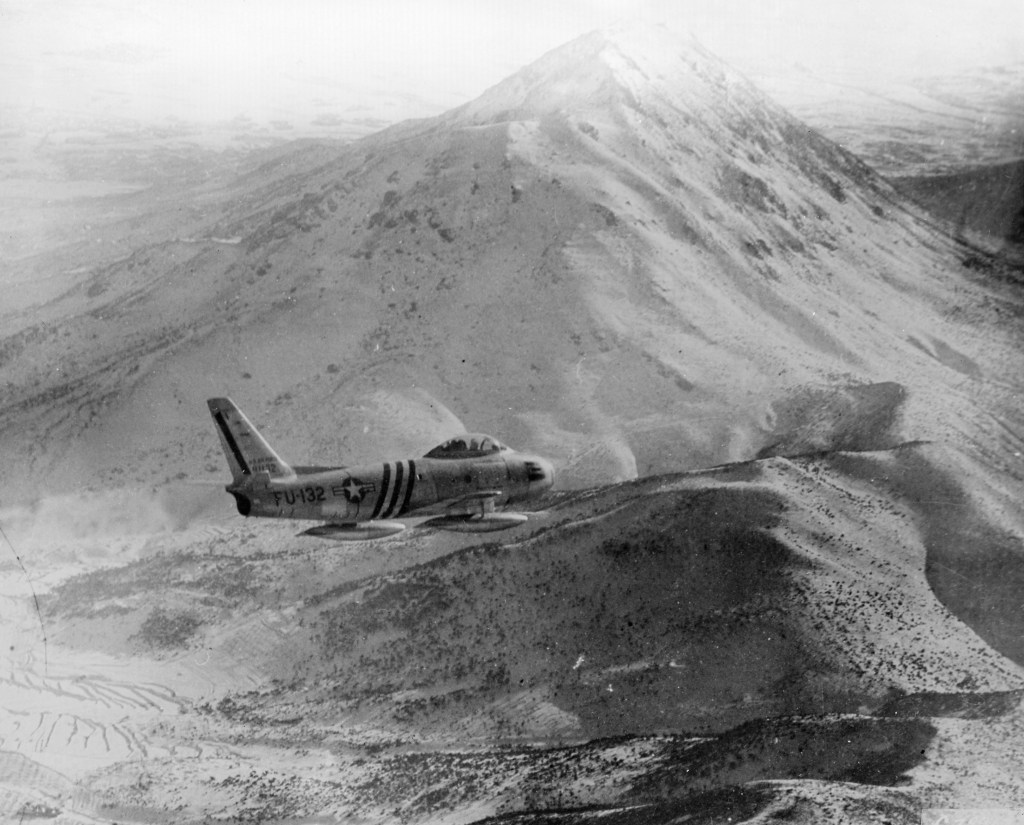
The Chinese-piloted MiGs were flying in a V-formation lower than Davis and his wing, 1st Lieutenant William Littlefield – who were flying at about 38,000 feet.
Davis dived in after what he thought was the last MiG of the formation, and shot it down, before downing another, as Littlefield watched and followed his lead.
The pair of F-86s had apparently managed to overtake the majority of the MiG-15s as Davis prepared to go after a third MiG. But before he could do so, he was hit by enemy fire on his left side, near the cockpit.
Davis’ plane smoked and went down as Littlefield made several attempts to maintain communication with him. Davis did not respond; his F-86 crashed somewhere south of the Yalu River (around 30 miles south of it) and his body was never recovered. Littlefield managed to escape the remaining MiGs.
Davis was posthumously awarded the Medal of Honor (received on May 14th 1954) for these actions. A World War II and Korean War fighter Ace, Davis was eventually credited with 21 confirmed victories.
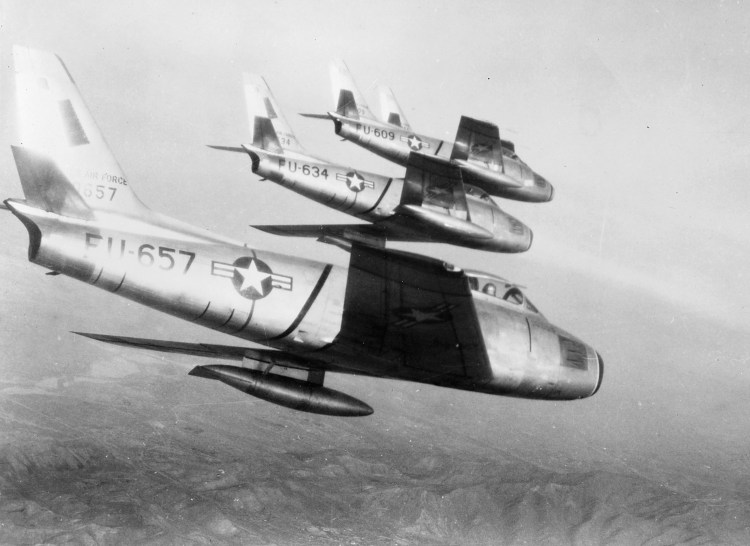
In an example of the Sabre’s ground attack capabilities, on May 4th, 1952, a group of F-86s ran a machine-gunning ground-attack mission on Sinuiju Airfield, North Pyongan Province, North Korea. The attack destroyed five parked enemy Yakovlev Yak-9s; a similar F-86 attack on Sinuiju and Uiju Airfields occurred on May 13th.
The F-86 Sabre was used to escort heavy bombers, notably the B-29 Superfortress. As the propeller-driven B-29 was susceptible to attacks from MiG-15s – especially in the northwestern North Korean area referred to by American forces as “MiG Alley” – the Sabre was thought to be a more capable defensive jet fighter for the B-29, even away from the northwest.
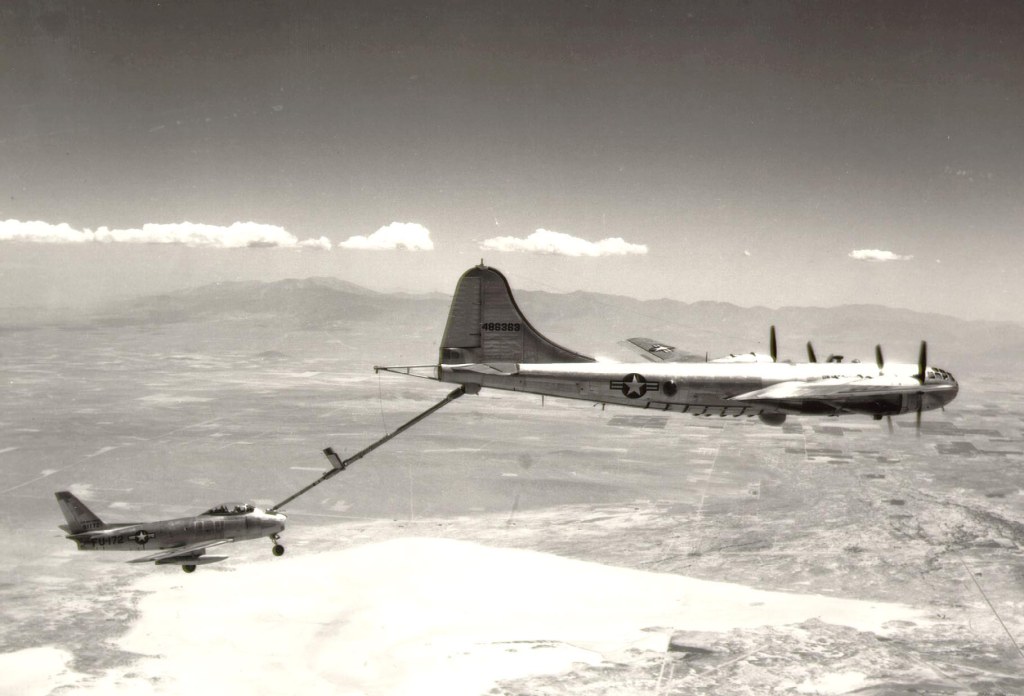
Such was the case on September 19th, 1952, when F-86 Sabres successfully escorted a group of 32 B-29 Superfortresses to bomb two supply areas and one barrack area near the central-eastern North Korean city of Hamhung. This was a daylight bombing raid, somewhat of a rarity – considering (because of enemy jet encounters) many B-29 missions occurred during night hours at latter stages of the war.
The F-86 also took part in escorting fighter-bombers (such as the F-84 Thunderjet) to destroy railway lines, power plants, military facilities, and attack enemy troops.
This was the case, for example, on February 15th, 1953, when F-86 Sabres – 82 planes – escorted F-84 Thunderjets – 22 planes – to destroy the Sui-ho hydroelectric plant.
The Sabres managed to stave off about 30 MiG-15s while the Thunderjets bombed the target. The attacking Sabres and Thunderjets suffered no losses – and for months afterwards, the power plant was rendered unproductive.

In March 1953, the F-86F was delivered to the USAF forces in Korea. This version of the F-86 had a solid forward wing (no slats on the leading edge of the wing for low-speed flying, as in earlier F-86 models), higher-speed landing capabilities, and an increased arms capacity. On April 13th 1953, the F-86F was used for the first time in an air-to-ground role.
The Korean War armistice was signed on July 27th, 1953 – and up to that date, the F-86 Sabre was still actively performing in some of the last of the war’s engagements.
After the conflict, American forces used the Sabre for Air Defense capacities in Europe, Asia, and the United States. Multiple other nations, such as India, Pakistan, Japan, Canada, Colombia, and others, used the F-86 for purposes including defense and several different international conflicts.
USAF Units Equipped With The F-86
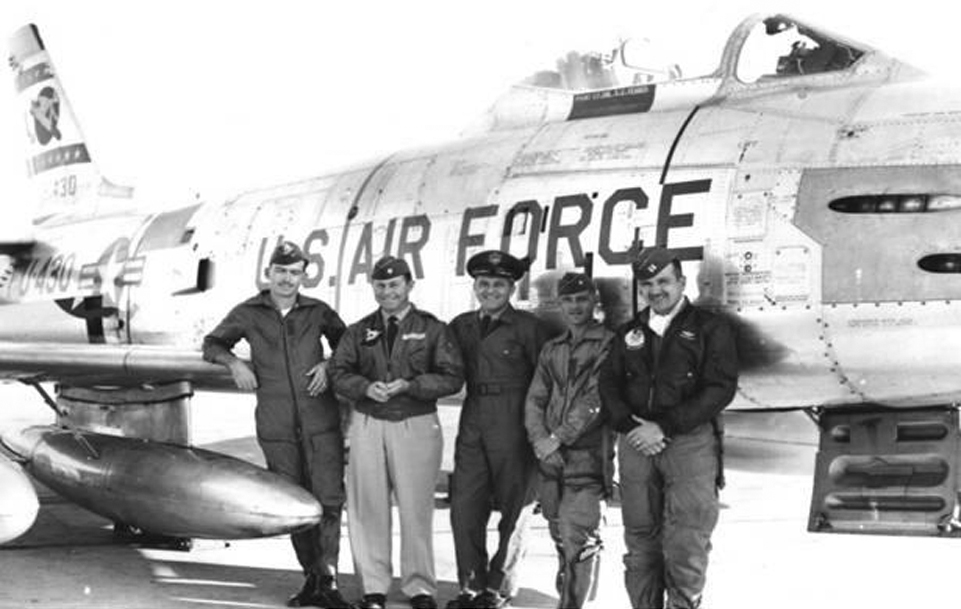
This is a list of some USAF units that were equipped with the F-86. Though not an exhaustive list, it illustrates units that were involved in the Korean War and some involved in United States (as well as European and Asian) defense afterwards.
Though the use of the F-86 – even in U.S. Continental defense capacities – was phased out by the 1970s, this list attempts to make note of the starting use of the F-86 by unit. These units each phased out use of the plane at different times, with most units ending use by the early 1960s.
The 1st Fighter Group – Also known (and still known) as the 1st Fighter Wing, received F-86 Sabres on February 15th, 1949. These planes were assigned to its 94th Fighter Squadron.
The 1st Fighter Wing was broken off from the 22nd Bombardment Wing (itself equipped with F-86 fighters from 1949 to 1950) in April 1950, and was re-designated the 1st Fighter-Interceptor Wing on April 16th, 1950.
The 1st Fighter-Interceptor Wing did not end up fighting in Korea, but operated F-86s based at Selfridge Air Force Base, Michigan, starting in 1955.
The 4th Fighter Group – Originally flying the P-80 Shooting Star, the 4th Fighter Group began flying F-86 Sabres in 1949. It was designated the 4th Fighter-Interceptor Group early in 1950 (January).
Starting in November 1950 (and into the following month) the 4th was transferred to Japan. On December 15th, 1950 the Group started to operate from Japan – and by March 1951 it had relocated to the Korean Peninsula.
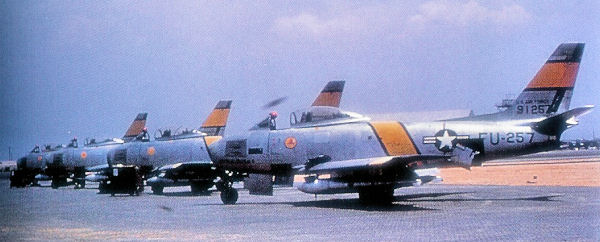
The 4th Fighter-Interceptor Group was active in the Korean War, performing armed reconnaissance duties, escorting bombers, defending airspace, attacking enemy fighters and targets on the ground, patrolling airspace, supporting ground troops, and destroying enemy communications lines.
The 4th Fighter Squadron eventually transitioned from the F-86 to other aircraft (starting with the F-102A Delta Dagger); it remains in service to this day.
The 8th Fighter Group – was assigned the F-86 after previously using the F-80 (P-80 Shooting Star) in the spring of 1953.
The 14th Fighter Group – used the F-86 in a defensive capacity (starting in 1955) at Ethan Allen air Force Base, Vermont.
The 18th Fighter Group – was originally assigned the F-51 in Korea, but had been reassigned with the F-86 in 1953.
The 21st Fighter Group – was stationed at George Air Force Base, California, in January 1953. It was assigned the F-51 originally, but was assigned with the F-86 soon afterwards. It did not serve in Korea, but it was moved to Europe (Chambley Air Base, France) in late 1954.
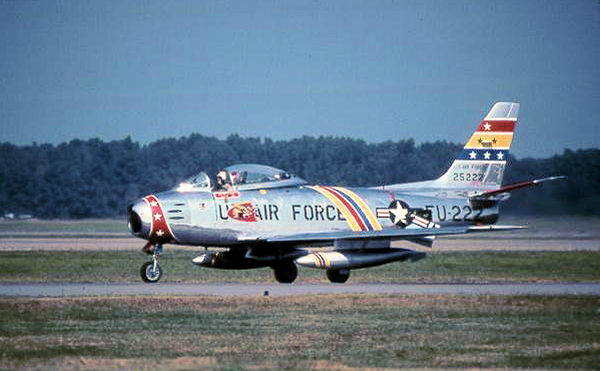
The 23rd Fighter Group – As the 23rd Fighter-Interceptor Group, operated as part of the Air Defense Command out of Presque Isle Air Force Base, Maine starting in January 1951. Used the F-86 until inactivated in February 1952, then reactivated in 1955 with other aircraft.
The 33rd Fighter Group – Operated out of Otis Air Force Base, Massachussetts, from November 1948 and used the F-86 starting in February 1949.
The 35th Fighter Group – Based in Japan during the Korean War and engaged in combat in that conflict; tasked with the defense of Japan as well. Flew the F-86 Sabre starting in 1955.
The 36th Fighter Group –Active in Germany (Furstenfeldbruck Air Force Base and Bitburg Air Base) since August 1948; flew F-86s in addition to other early jet aircraft.
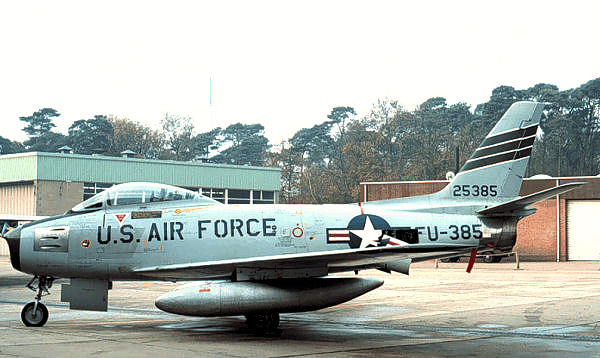
The 48th Fighter Group –As the 48th Fighter-Bomber Group, flew F-86’s out of Chaumont Air Base (France) from July 10th 1952.
The 50th Fighter Group – Operated out of Clovis Air Force Base, New Mexico, then Hahn Air Base Germany – both in 1953 – used the F-86 Sabre starting in the same year.
The 51st Fighter Group – Based in Suwon, Korea, from July 27th, 1951, operated F-86s starting in November 1951. Performed patrol, reconnaissance, ground force support, interception, and escort duties during the Korean War; moved to Naha, Okinawa in August 1954.
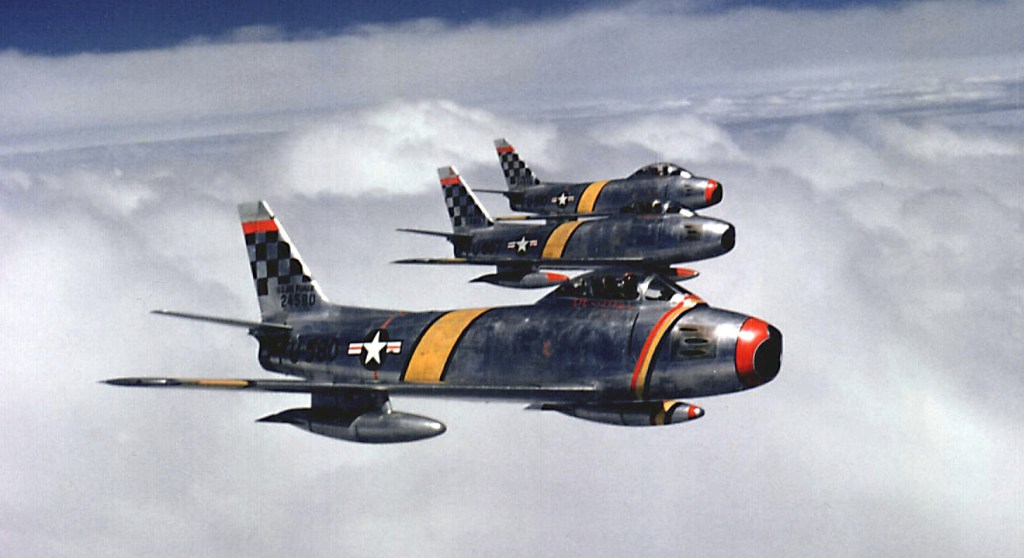
The 52nd Fighter Group – In Air Defense Command duties, operated the F-86 Sabre out of Suffolk County Air Force Base, New York, starting in August 1955.
The 54th Fighter Group – Operated F-86s as part of the Air Defense Command out of Greater Pittsburgh Airport, Pennsylvania, starting in August, 1955.
The 56th Fighter Group – Was a training unit during World War II, assigned to Air Defense Command in August 1955 and operated F-86s out of O’Hare International Airport, Illinois.
The 58th Fighter Group – Used F-84s in Korean War, operated out of Taegu and Osan-Ni, Korea, using the P-86 Sabre starting in 1954.
The 67th Reconnaissance Group – Activated during World War II and served in the Korean War, operated out of Taegu, Korea starting in March 1951. Flew the RF-86, the reconnaissance version of the F-86 Sabre. Active during Korean War taking photos of enemy and enemy facility positions, front line positions, and bomb locations, until armistice.
The 81st Fighter Group – Fought in Europe and Asia during World War II, inactivated in 1945 and then reactivated in 1946, based in the United States, then England. Flew the F-86 Sabre, inactivated in 1955.
The 84th Fighter Group – Took on Air Defense Command duties from August 18th 1955; was equipped with F-86 Sabres and operated out of Geiger Field, Washington State.
The 86th Fighter Group – Active during World War II, stationed in Germany starting in August 1946. As the 86th Fighter-Interceptor Group, operated F-86s out of Landstuhl Air Base, Germany after 1954.
The 312th Bombardment Group – Made part of the Tactical Air Command in 1954; began using F-86 Sabres in 1955 out of Clovis Air Force Base, New Mexico.
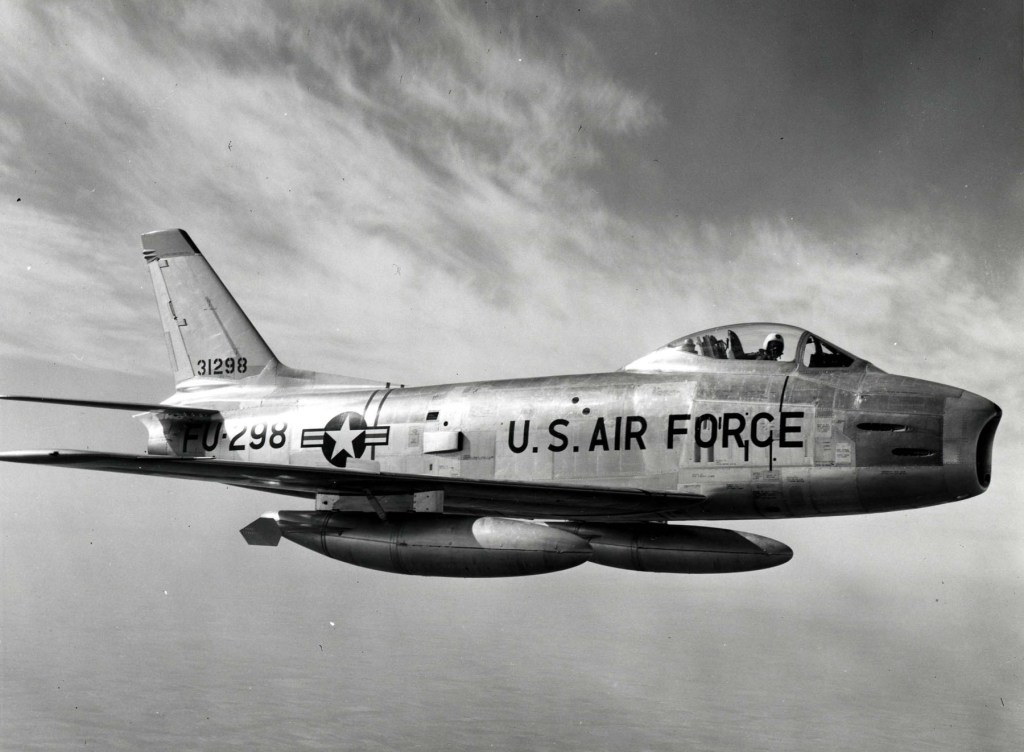
The 322nd Bombardment Group – As the 322nd Fighter-Day Group, operated the F-86 Sabre in Tactical Air Command duties (starting in July 1954) out of Foster Air Force Base, Texas.
The 325th Fighter Group – Active during World War II but disbanded in 1944. Reactivated as an Air Defense Command Group in 1955 and operated F-86s out of McChord Air Force Base, Washington State.
The 326th Fighter Group – Assigned to Air Defense Command on August 18th, 1955 and operated F-86 Sabres out of Paine Air Force Base, Washington State.
The 327th Fighter Group – Operated F-86s as part of the Air Defense Command starting in 1955 out of Truax Field, Wisconsin.
The 328th Fighter Group – Active during World War II, but disbanded in 1944; re-designated an Air Defense Command Group in 1955 and operated F-86s out of Grandview Air Force Base, Missouri.
The 337th Fighter Group – On August 18th, 1955 this unit was assigned to the Air Defense Command – and was using F-86s out of Portland International Airport, Oregon.
The 355th Fighter Group – Active during World War II, the unit was de-activated in 1946 but reactivated in 1955; it used the F-86 in its role in Air Defense Command at McGhee-Tyson Airport in Tennessee.
The 366th Fighter Group – As the 366th Fighter-Bomber Group (activated as such on January 1st 1953), the unit served in the Tactical Air Command and used the F-86 for training.
The 371st Fighter Group – As the 142nd Fighter-Interceptor Group (so designated in April 1951) this unit assisted squadrons that were training with F-86s.
The 388th Bombardment Group – Active during World War II but inactive during the Korean War, the unit was reactivated as the 388th Fighter-Bomber Group on November 23rd, 1953. Used the F-86 in training; the unit was moved to Europe (Etain Rouvres Air Base, France) in late 1954.
The 401st Fighter Group – As the 401st Fighter-Bomber Group (activated on February 8th, 1954) used the F-86 in its role in Tactical Air Command at Alexandria Air Force Base, Louisiana.
The 406th Fighter Group – WWII-era unit that was inactivated and reactivated during the Korean War – on July 10th, 1952 – but was stationed in Europe (Manston, England); used the F-86 Sabre starting in the latter part of 1953. The unit started using the F-86D Sabre in 1956.


The 413th Fighter Group – Inactive during the Korean War, but used the F-86 Sabre as a training craft out of George Air Force Base, California, starting on November 11, 1954.
The 450th Bombardment Group – As the 450th Fighter-Bomber Group (activated on July 1st, 1954), used the F-86 as a training aircraft.
The 474th Fighter Group – Used the F-84 Thunderjet in the Korean War, and was assigned the F-86 Sabre as a training craft in Taegu, Korea, and Clovis Air Force Base (in New Mexico) in 1953-1954.
The 479th Fighter Group – Assigned the F-86 after the F-51. Was stationed at George Air Force Base, California, starting in December 1952.
The 554th Fighter-Bomber Squadron – Was assigned the F-86 in 1956, operated out of Bunker Hill Air Force Base, Indiana.
The F-86 In Flight

The F-86 Sabre – especially the most-produced F-86F – was capable of speeds well over 600 miles per hour at sea level (some 688 to 695 miles per hour) and could move between 604 and 608 miles per hour at 35,000 feet.
As such, later versions of the F-86 were capable of reaching supersonic speeds – as evidenced, for example, by Jacqueline Cochran’s breaking of the sound barrier flying a Canadair Mk. 3 Sabre on May 18th, 1953. The speed of sound at 35,000 feet is 663 miles per hour, while at higher altitudes it is 659 miles per hour.
During the Korean War, the F-86 was used in multiple roles, but its combat roles were mainly in air-to-air fighting and fighter-bomber roles.

F-86 pilots were usually deployed in what was referred to as the “Finger Four” formation. This arrangement consisted of four planes flying next to each other, but in staggered positions, close to the appearance of four fingertips on a hand.
This technique had been in existence since before the Second World War, but it was promoted to the U.S. Air Force by U.S. Army Major General Claire Chennault – the former leader of the legendary Sino-American “Flying Tigers” air volunteer group.
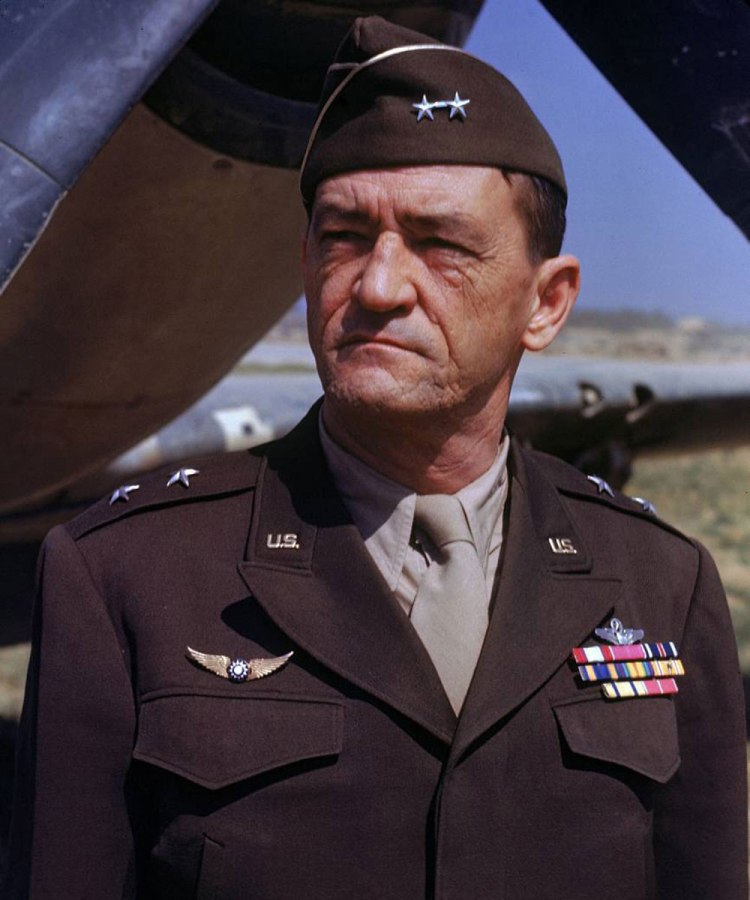
F-86 Sabre units in the Korean War. (Z)
The lead plane of the Finger Four would have a wingman on his port side, slightly aft. Similarly, the second lead of the Finger Four would be to the starboard of the main lead, and slightly aft.

The second lead of the Finger Four would their own wingman. This wingman would be on the second lead’s starboard side, once again slightly aft. The formation, and variations of it, would essentially be four fighter planes flying adjacent to each other in a line, though staggered to make use of ideal attacking and defensive positions.
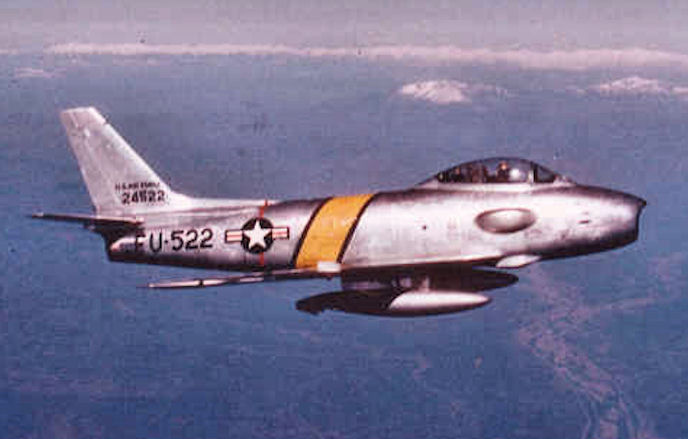
Other pilots mentioned their F-86s could fly from Kimpo Air Base to what was known as “MiG Alley” – the area over the Yalu River in northern North Korea – and back to Kimpo at speeds of over 600 miles an hour.
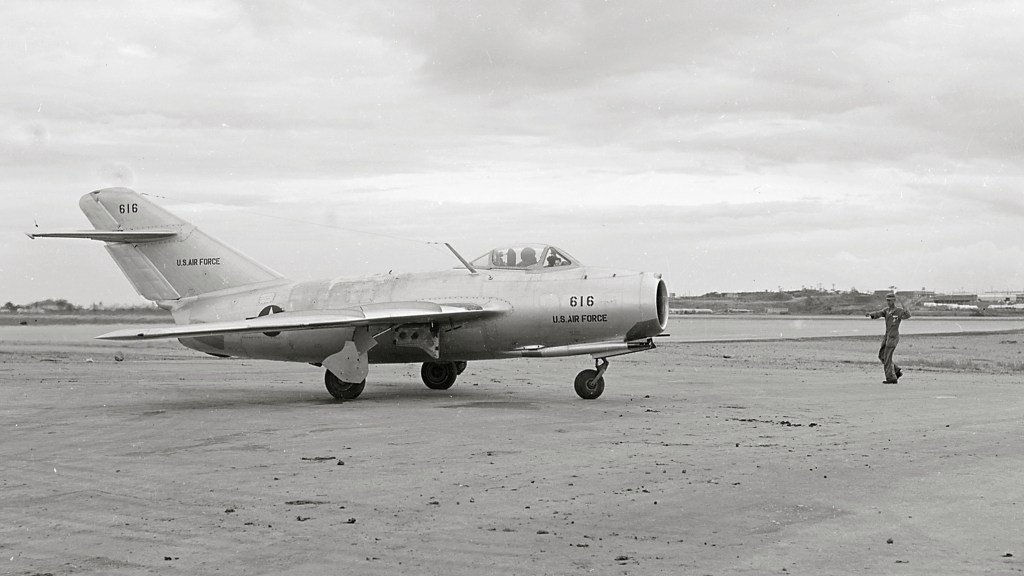
Still other pilots mentioned the semi-automatic capabilities of the Sabre’s gunnery system. The F-86 instruments that could measure the angular velocity of their targets, making hitting them – when compared to other American fighter planes of the era – a relatively easy task.
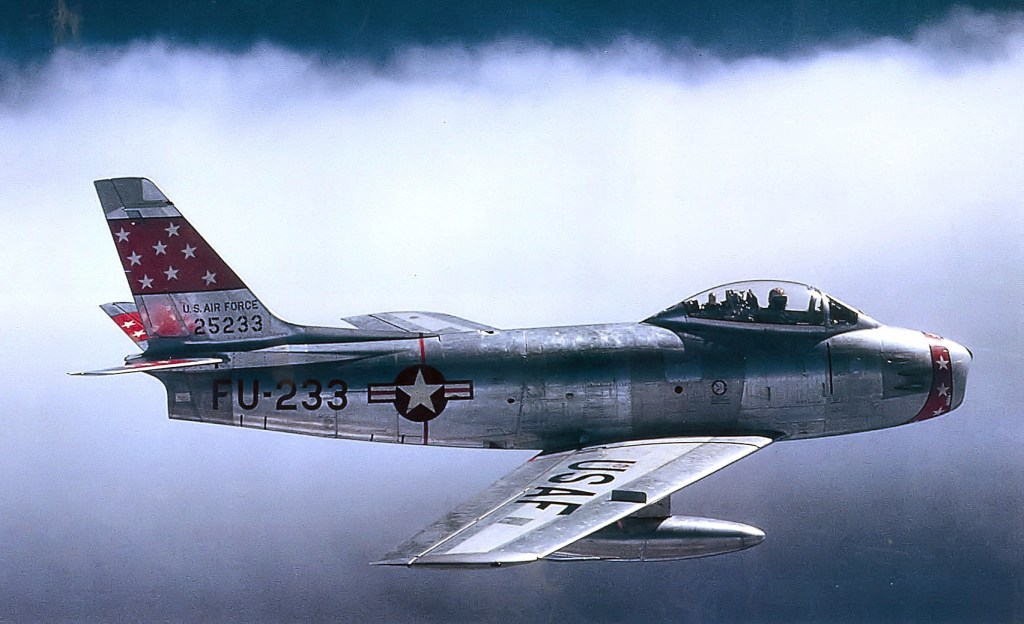
Finally, some pilots noted the Sabre’s speeds of Mach 1.02. Considered just above supersonic, pilots noted the Sabre’s powerful sonic boom.
Model Variations
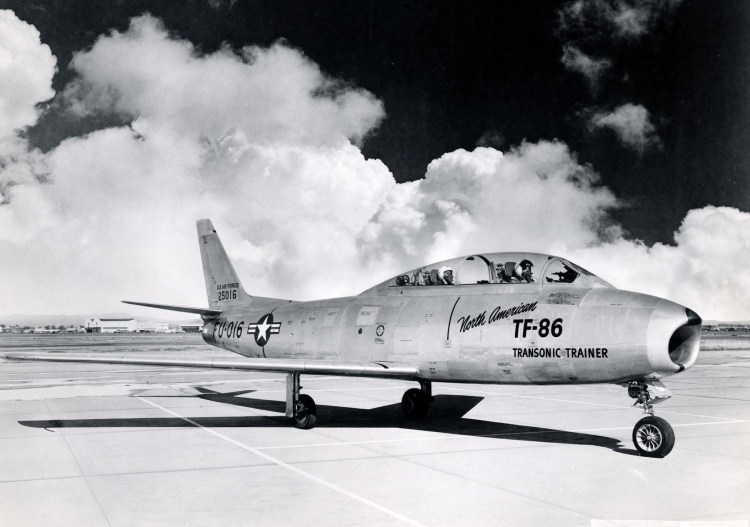
The F-86 Sabre came in numerous variations, from its early prototype versions, to North American Aviation-produced versions – to versions built under license in countries such as Canada, Japan, and Australia. The following is a non-comprehensive list of Sabre variants with some information about each type.
Produced by North American Aviation, United States
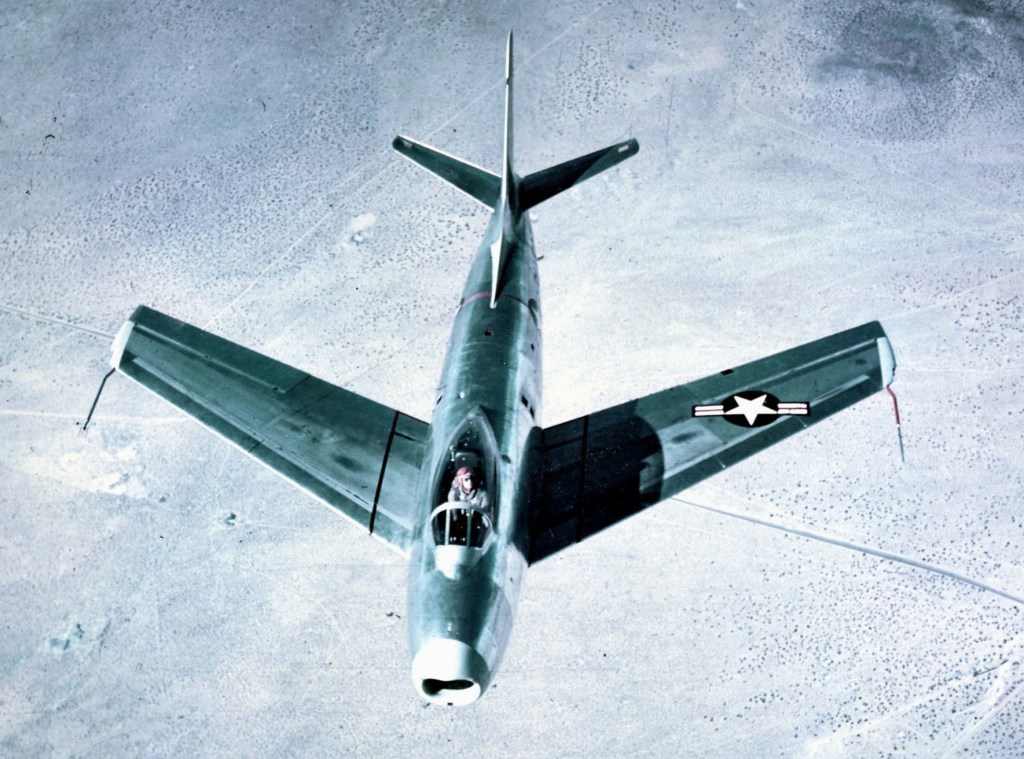
XF-86 – Originally known as the XP-86, this was the prototype of what would later become the F-86. The XP-86 was a straight-winged aircraft; later data seized from German engineers during the summer of 1945 caused a re-design (to a swept-winged craft) to occur. Three prototypes were made and designated the XF-86 in 1948.
F-86A – The first production version of the F-86 Sabre, this plane was powered by a 5,000 lb.-thrust General Electric TG-190B or J47 jet engine. A total of 554 were built.

RF-86A – A reconnaissance version of the F-86A, fitted with three cameras.
F-86B/F-86A-5 – North American’s attempt to make a better-landing F-86 with larger tires and fuselage about seven inches wider was originally named the F-86B, however, as higher-pressure tires and better brakes could be more easily fitted to F-86A models, work on finishing and delivering the USAF’s order for 190 F-86Bs was discontinued – and 188 F-86A-5s (with the better tire/brake adjustments) would be delivered in their place.
F-86C – Also known as the YF-93A, this was a longer (at 44 feet rather than the F-86A’s 37.54 feet) and generally larger F-86-based airplane with a pointed nose and a more powerful engine. Though intended for long-range bomber escort, production of this variant was cancelled after two instances were made.

F-86D, F-86K, F-86L – Technically a version of the F-86, this series of planes, starting with the F-86D, only had about 25 percent in common with other F-86 models. Differences included a hinged canopy (instead of a sliding one), a large radar dome in the nose, and a tail that was horizontal instead of angled upwards in relation to the fuselage.
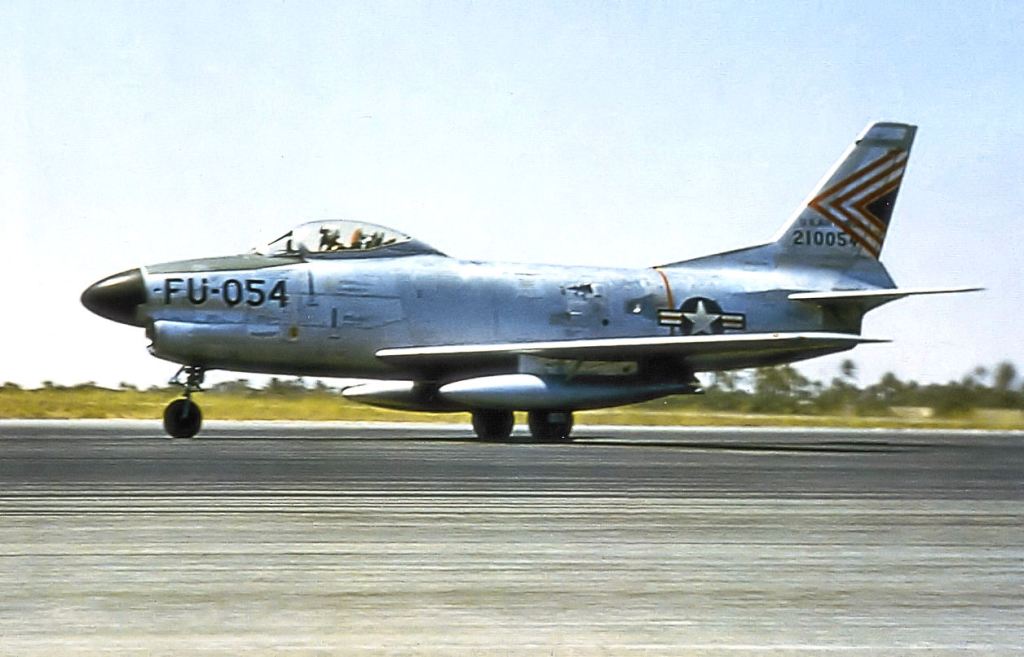
Equipped with different armaments (specifically in a retractable tray of 24 Folding Fin Aircraft Rockets (FFAR) located in the ventral fuselage) and a more powerful General Electric J-47 engine, there were 2,847 instances of these planes built.
F-86E – A version of the F-86A/B lineage with improved controls and tail. 456 instances were built.
F-86F – The most-produced version of the F-86 Sabre (discounting the heavily modified D/K/L versions), with 2,239 instances built. Previously-built features, such as wing-slats – for low-speed flight maneuvering – on the fore of the wings, were discarded and replaced by a solid straight-edged wing.

The chord of wing – the distance between the leading edge (the forward edge) and the trailing edge of the wing – was six inches at the wing root and three inches at the wing tip. This was known as the “6 – 3” wing configuration, a feature of the F-86F. This allowed for the plane to fly faster both at sea level and altitudes of 35,000 feet. The “6 – 3” wing also allowed the plane to become more agile at high altitudes and speeds.
The F-86F could reach speeds of over 600 miles per hour at 35,000 feet and 688 miles per hour at sea level. Gunsights were improved, and the plane was capable of carrying up to a 12 kiloton nuclear bomb. Its wings could also accommodate two 200-gallon drop tanks, up to two 1,000-pound bombs, two 750-pound tanks of napalm, and/or eight five-inch high velocity aircraft rockets (HVAR).
TF-86F – A two-seated version of the F-86F, built for training purposes. Two instances of this plane were made.
F-86H – A larger (the plane was about a foot longer than previous F-86A/B/E/F variants), heavier version of the F-86 Sabre intended for ground-attacking as well as air fighting.
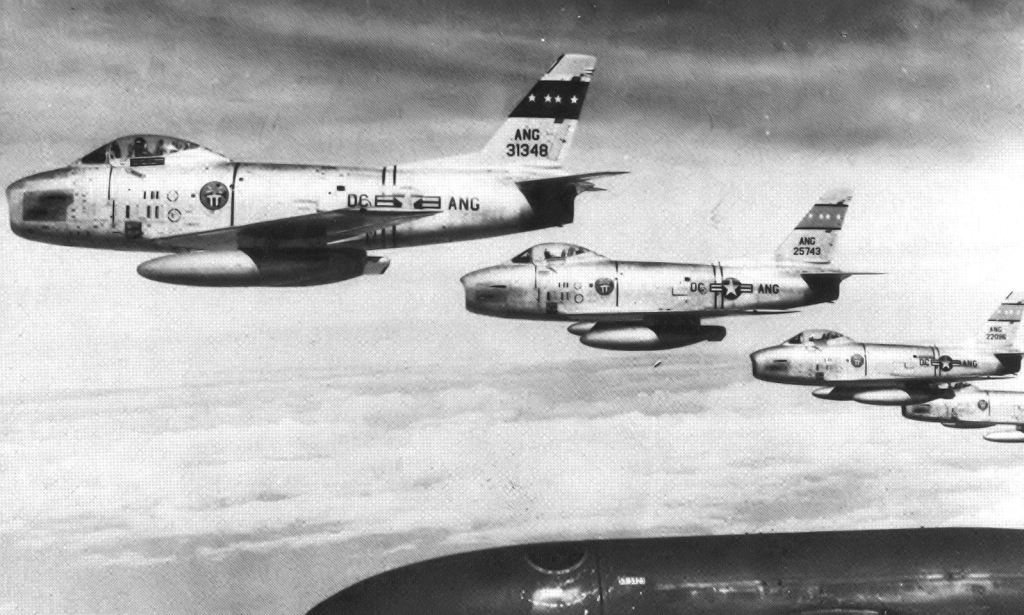
Equipped with a powerful General Electric J-73 engine, the plane was provided with some 8,920 to 9,070 pounds of thrust. Though the plane was generally faster and had a better range than the F version, it was considered less maneuverable.
The F-86-H’s airframe construction did not allow for improved maximum speeds – unless at altitudes over 35,000 feet. 473 instances were made; the plane was also capable of delivering nuclear weapons.
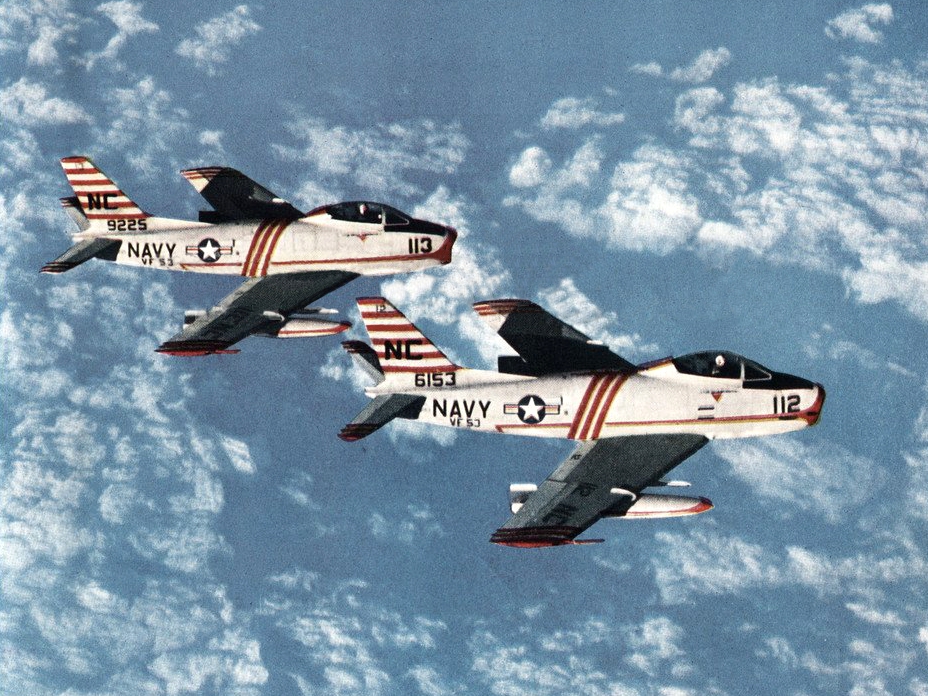
F-J2 – A U.S. Naval (and Marine Corps) version of the F-86 specifically designed to land on aircraft carriers. For this, adjustments such as an arrestor hook, folding wings, more durable landing gear, and attachments for catapult launches were made. 200 instances of this plane (also known as the “Fury”) were produced, although it was not particularly favored for long by the Navy.
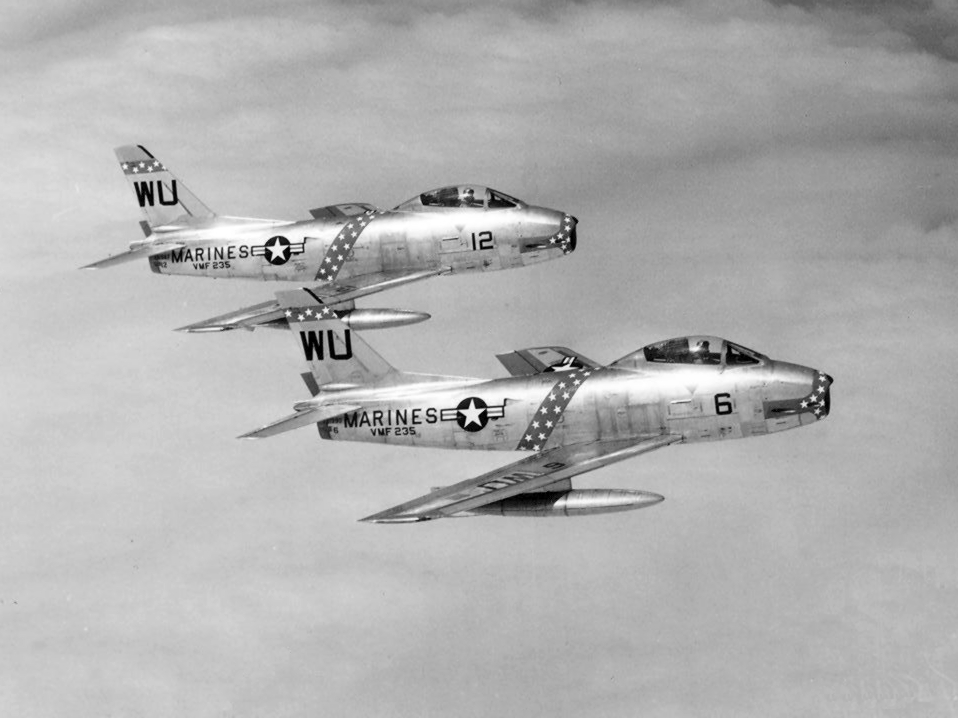
F-J3 –A version of the F-J2 that used the Wright J65 Engine, a 7,800 pounds of thrust engine that was built by Curtiss-Wright under license from the British manufacturer Armstrong Siddeley. This version had an expanded air intake in the nose, more wing surface area, and eventually more hardpoints for bombs and drop tanks. A total of 389 instances of this plane were built.
Produced by Commonwealth Aircraft Corporation (CAC), Australia
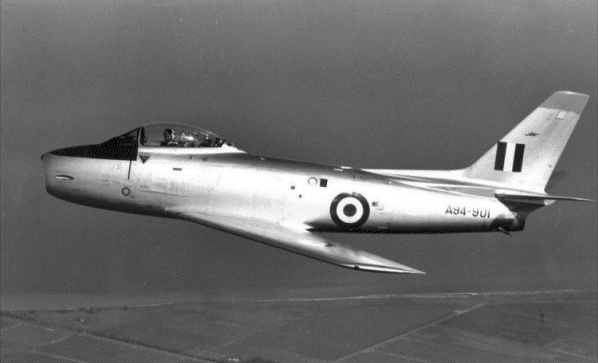
Commonwealth Sabre – The Australian-built version of the North American F-86 Sabre that was built under license from North American Aviation by the Commonwealth Aircraft Corporation. This version used the 7,500 pounds of thrust Rolls-Royce Avon 26 engine. The engine was lighter and had to be situated in a more aft position in the fuselage. The Commonwealth Sabre could reach speeds of 700 miles per hour at sea level and 607 miles per hour at 38,000 feet. 112 instances of the Commonwealth Sabre were built.
Produced by Canadair Ltd., Canada
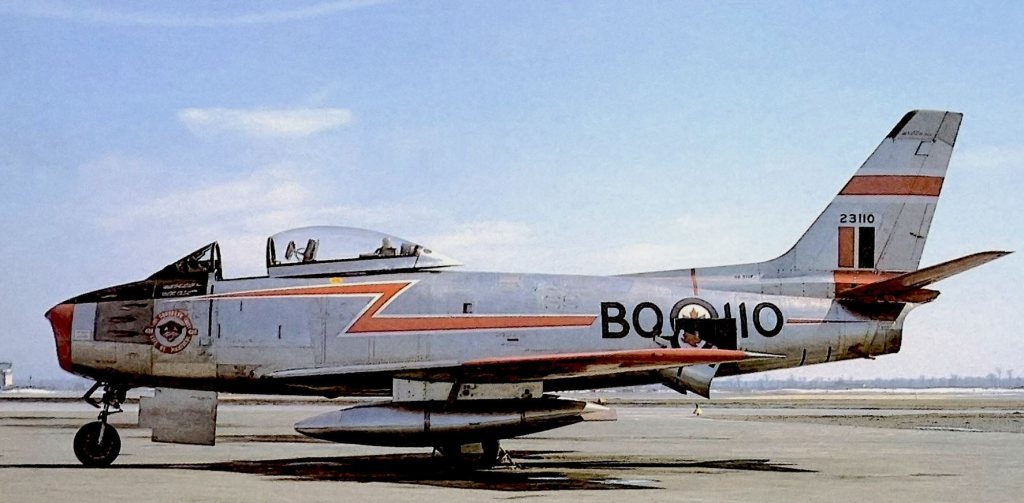
Sabre Mk. 1 – A prototype model of the Canadian license-built North American Aviation F-86, produced by Canadair Ltd. It featured the General Electric J47 (GE-13) engine.
Sabre Mk. 2 – A Canadian-built Sabre similar in capabilities and make as the F-86E, some 350 were built, with some delivered to the United States for use in the Korean War.
Sabre Mk. 3 – The first Canadair model to use the 6,000 pound-thrust, Canadian-built, Avro Canada turbojet, known as the Orenda engine. The engine was fixed to a Sabre Mk. 2, it necessitated the need to build a wider-diameter fuselage. Only one was built; it was piloted by Colonel Jacqueline Cochran to break the sound barrier (the first woman to do so) as well as other speed records.
Sabre Mk. 4 – A Canadair-produced Sabre that retained the original J47 engine, but also included new features such as cockpit pressure/air conditioning controls and a new way to release the canopy. 438 instances were built.
Sabre Mk. 5 – The first production version of the Canadair-made Sabre to feature the Avro Canada Orenda engine. In this case, it was the Orenda 10 engine, giving the plane some 6,355 pounds of thrust. This plane was very much based on the F-86F design; 370 of this instance were built.
Sabre Mk. 6 – This version used the Orenda 14 engine giving it some 7,275 pounds of thrust. It could reach a top speed of 710 miles per hour and could perform at 55,000 feet (its service ceiling). 655 instances of this plane were built.
Produced by Mitsubishi, Japan
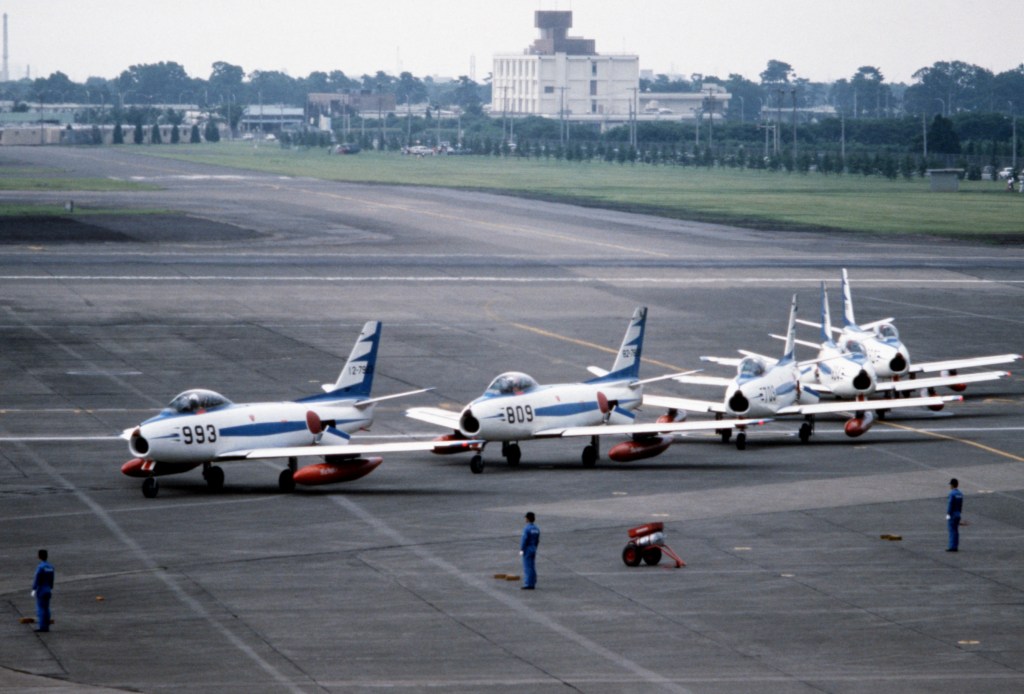
F-86 – The F-86F was produced under license from North American Aviation by Mitsubishi Heavy Industries in the late 1950s and early 1960s. A total of 300 were built.
U.S. Air Force (USAF) Command Units
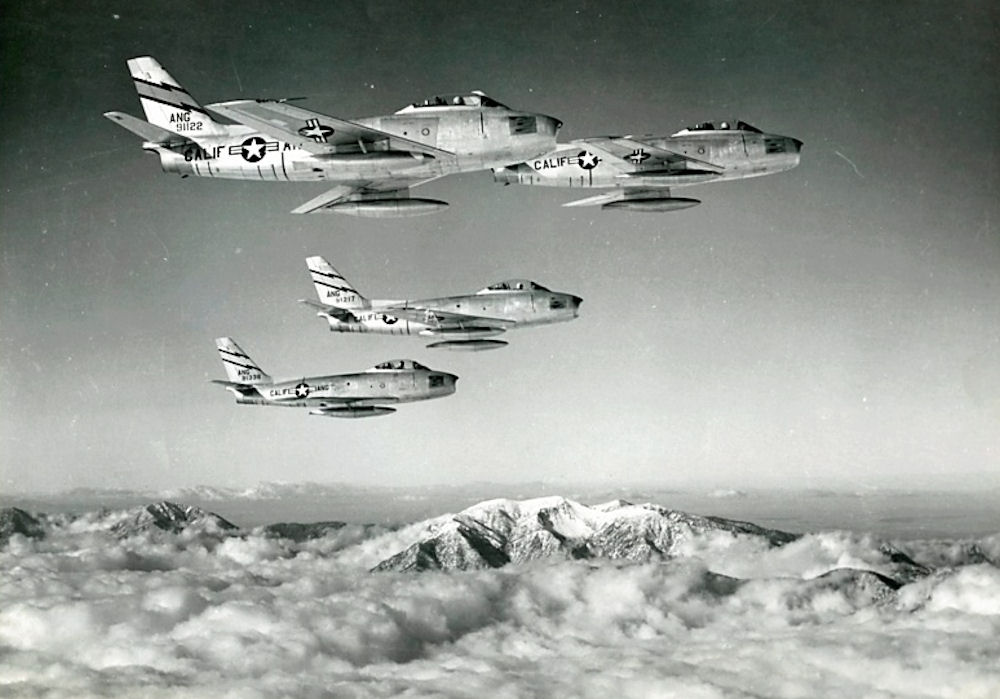
Tactical Air Command (TAC) – An originally continental command unit, the TAC was formed in 1946 for the purpose of training, organizing, and equipping light USAF units; eventually doing so internationally. Many units performing TAC duties (both in the U.S. and abroad) were – at one point or another – equipped with the F-86. The TAC was made inactive on June 1st 1992 – when it was made part of the U.S. Air Combat Command (ACC).
Air Defense Command (ADC) – A USAF command unit tasked with the defense of the airspace of the continental United States. This defense included detection of aircraft and missiles. As such, in the early instance of the ADC (1946-1950), there were some U.S.-based radar stations associated with the command.
Once re-activated on January 1st, 1951, the ADC’s radar networks had increased in scope, and its military units increasingly included aircraft such as the F-86. In 1968, the ADC was re-designated the Aerospace Defense Command; the command unit was ultimately disbanded in 1980.
Strategic Air Command (SAC) – Formed in 1946, a U.S. Army Air Forces (USAAF) and later USAF command unit that oversaw Intercontinental Ballistic Missiles (ICBM), land-based nuclear bombing aircraft, reconnaissance aircraft, in-air refueling aircraft and in-air command centers. The command was broken into several parts in 1992; it was reactivated as the Air Force Global Strike Command (AFGSC) in 2009.
 Waves To Jets