
A Naval And Marine Fighter

By WavesToJets
The Vought F4U Corsair was a World War II and Korean War-era fighter and fighter-bomber airplane.
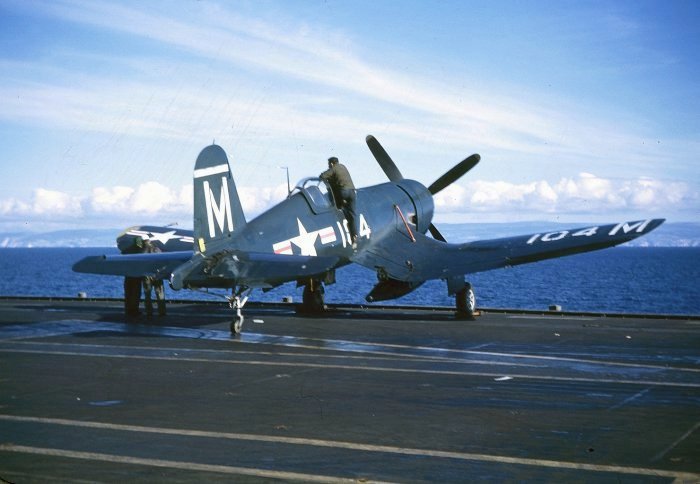
Characterized by its folding inverted gull-shaped wings, long nose, and large radial engine, the Corsair was used primarily by the United States Marines and Navy forces, especially in the Pacific theater of World War II.
Although the United States made great use of the Corsair in these conflicts, the British used this airplane in World War II as well. The Corsair was also used in British and French colonial conflicts in the period following the war, in North Africa and Southeast Asia, respectively.
The Corsair was known for having high speeds, a heavy armament capacity, an effective machine gun arrangement, a powerful engine and a long range for a late-war propeller-driven craft.
Technological Background
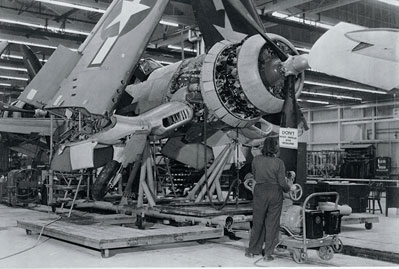
The Corsair was developed by engineer Rex Biesel of Chance Vought (also known as Vought, Vought Aircraft, or Vought-Sikorsky) in 1938. Vought’s prototype of the craft, known as the XF4U-1, was first powered by a 1,500-horsepower Pratt & Whitney R-2800 X-2 radial engine.
Later versions of the actual production Corsair would use more powerful incarnations of the Pratt & Whitney R-2800, and their output would exceed 2,000 (sometimes over 2,300, even up to 3,000) horsepower.
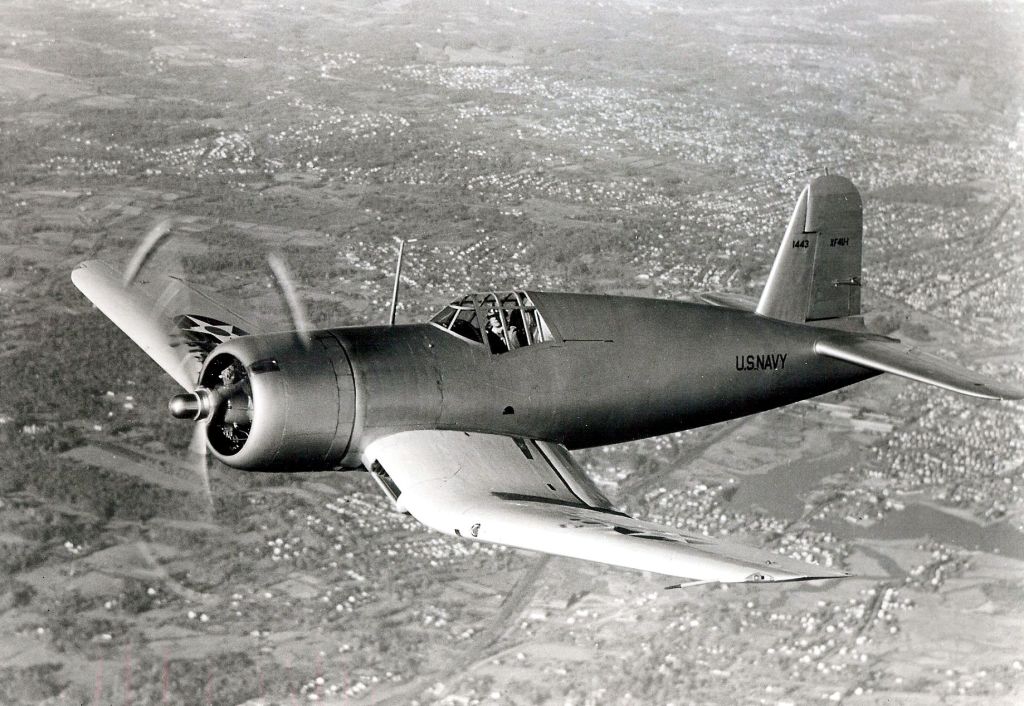
The XF4U-1 was first flown in Bridgeport, Connecticut on May 29th, 1940 by test pilot Lyman A. Bullard Jr. In the test flight, the prototype exceeded speeds of 400 miles per hour, quite impressive (though not record-breaking, as sometimes reported) for a single seat, single-engine fighter plane.
The test also demonstrated the XF4U-1’s appearance – its inverted gull-shaped wings, a design added to give clearance to the plane’s propeller, some 13 feet in diameter. The prototype was 30 feet long and had a wingspan of 41 feet; production versions of the Corsair would be slightly longer (around 33 feet) with a similar wingspan (around 40 – 41 feet).
The Navy approved of the prototype and ordered production units of the plane to be made. Over the course of the next twelve years, over 12,000 Corsairs would be manufactured. Three companies would produce the Corsair: Vought, Brewster, and Goodyear (Brewster and Goodyear were given a license to produce the airplane). Under Vought, the plane was designated the F4U, under Brewster, the F3A, and under Goodyear, the FG.
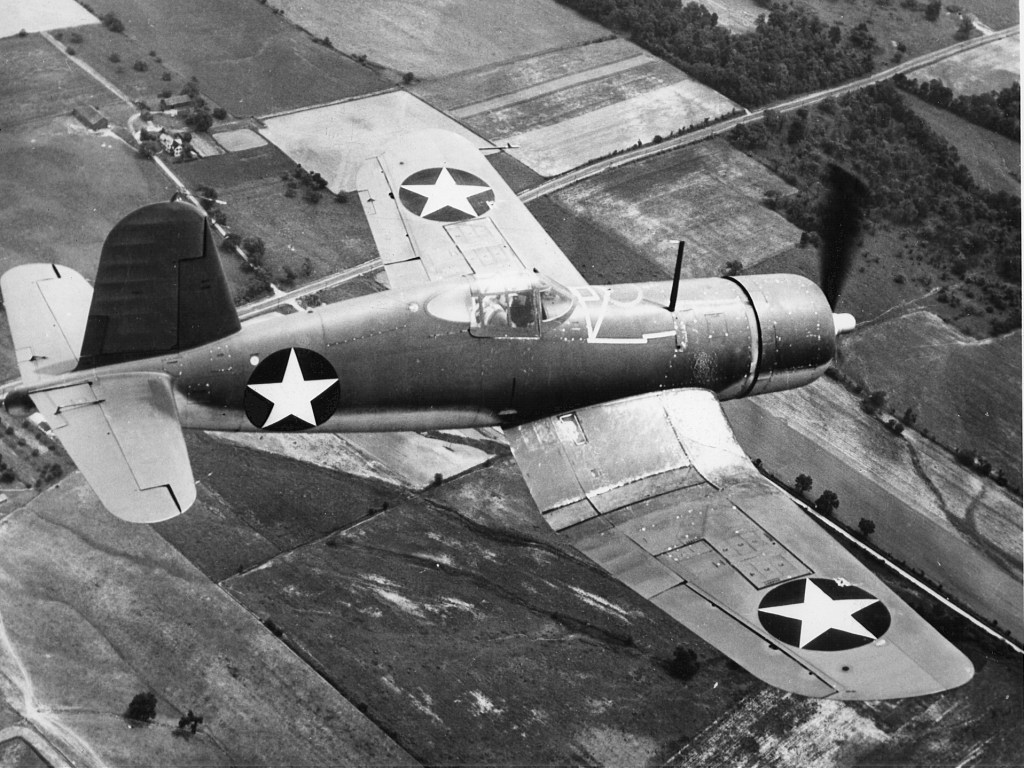
The Corsair was usually equipped with six .50-inch M2 Browning machine guns, three located in a line in each wing. Other versions included those with four 0.79-inch (20 mm Hispano) cannons. At the later stages of development, the Corsair could carry 8 rockets or up to 4,000 pounds of bombs.
With a operational range of 1,000 to 1,500 miles – depending on the variant – the Corsair would be utilized as a long-range escort and fighter, and sometimes in strafing and bombing missions.
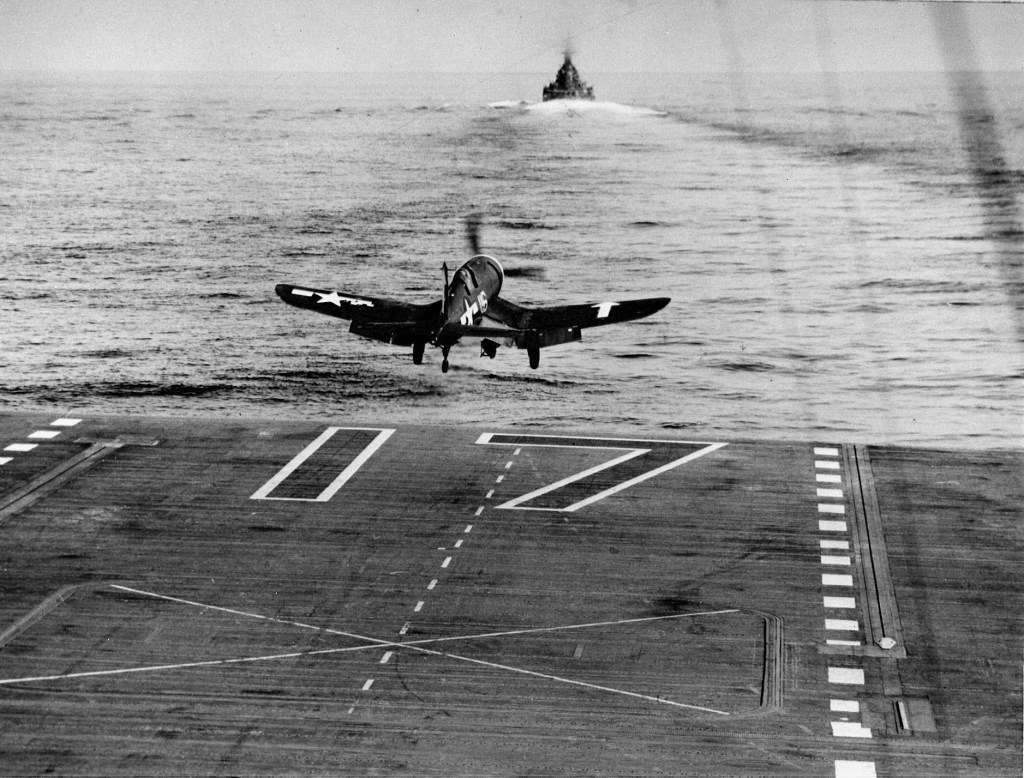
Though the Corsair could land on aircraft carriers, the U.S. Navy felt the Grumman F6F Hellcat was better suited for carrier-based operations, at least for part of World War II. It was for this reason that many Corsairs were taken up by the Marines, operated out of land (usually island) bases in the Pacific.

It was not until 1944 that the Corsair would be completely approved for carrier-based use by the U.S. Navy, owing to the British (Royal Navy’s) success with carrier-based landings.
In Service
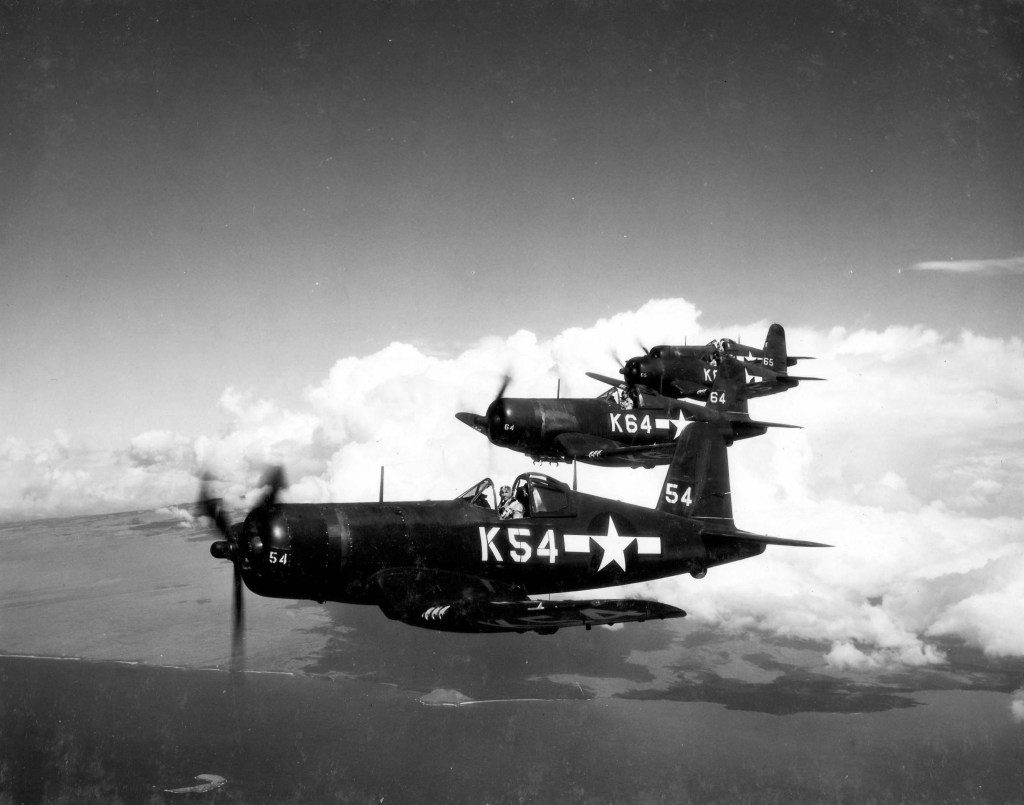
The Corsair was used in the Western Pacific, tested first by the U.S. Navy and then in actual combat missions by the Marines. The F4U’s first combat mission was with the Marine unit VMF-124 on February 12th, 1943. This mission was escorting a PB2Y-2 Coronado to Vella Lavella (in the Solomon Islands) to rescue downed pilots. The F4U’s took off from the American airfield on Guadalcanal.
Days later, on February 14th, 1943, VMF-124’s F4Us, along with P-40s, P-38s, and B-24 bombers, encountered Japanese Zeroes during a strike on a Japanese airfield on Bougainville. The Americans lost 10 aircraft with two F4Us lost. However, one Corsair was able to take down a Zero (out of three Zeroes downed) – albeit in a collision.
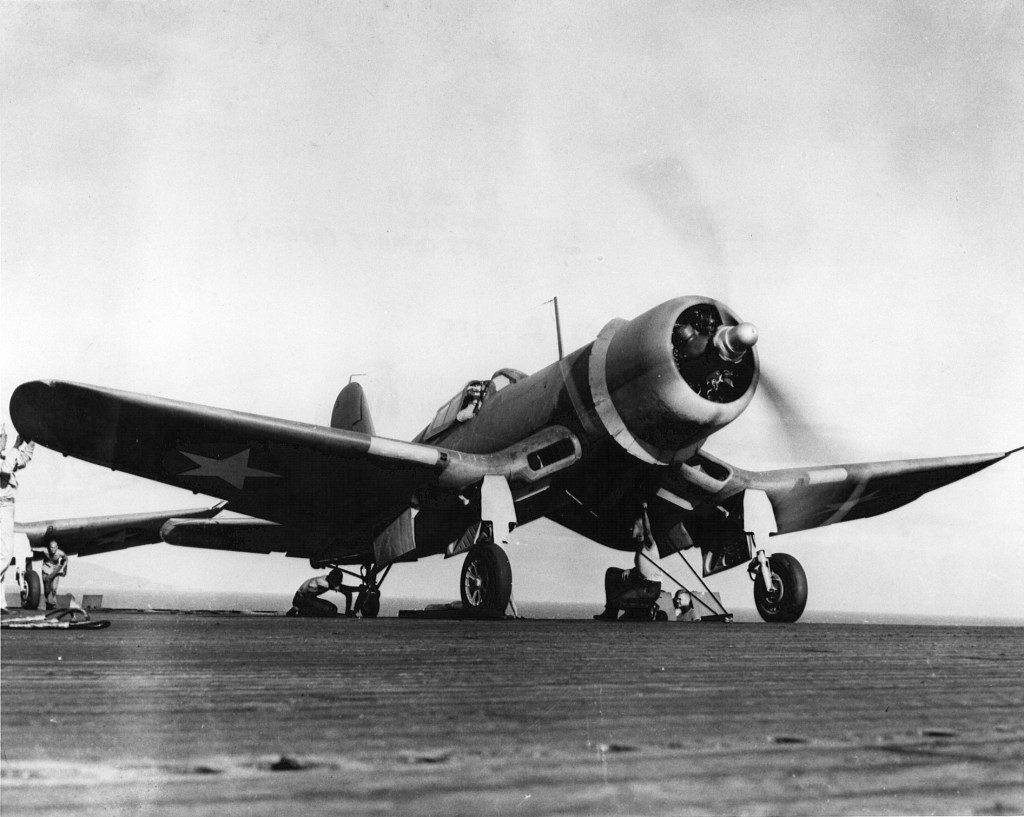
Marine F4U pilots of VMF-122 , 211, and 221 would only increase their proficiency with these planes as they escorted torpedo and heavy bombers to strike Japanese naval craft off the coast of Bougainville Island on July 17th, 1943. Facing Japanese fighters, the bombing attack ultimately sank the Japanese destroyer Hatsuyuki and damaged two other destroyers and a minesweeper.
On August 15th 1943, Marine F4U units (VMF-123 and 124) assisted in the Allied landing at Vella Lavella. Marine Corps Second Lieutenant Kenneth A. Walsh of VMF-124 downed three Japanese planes that day – one Zero and two Aichi D3A1 “Val” dive bombers.
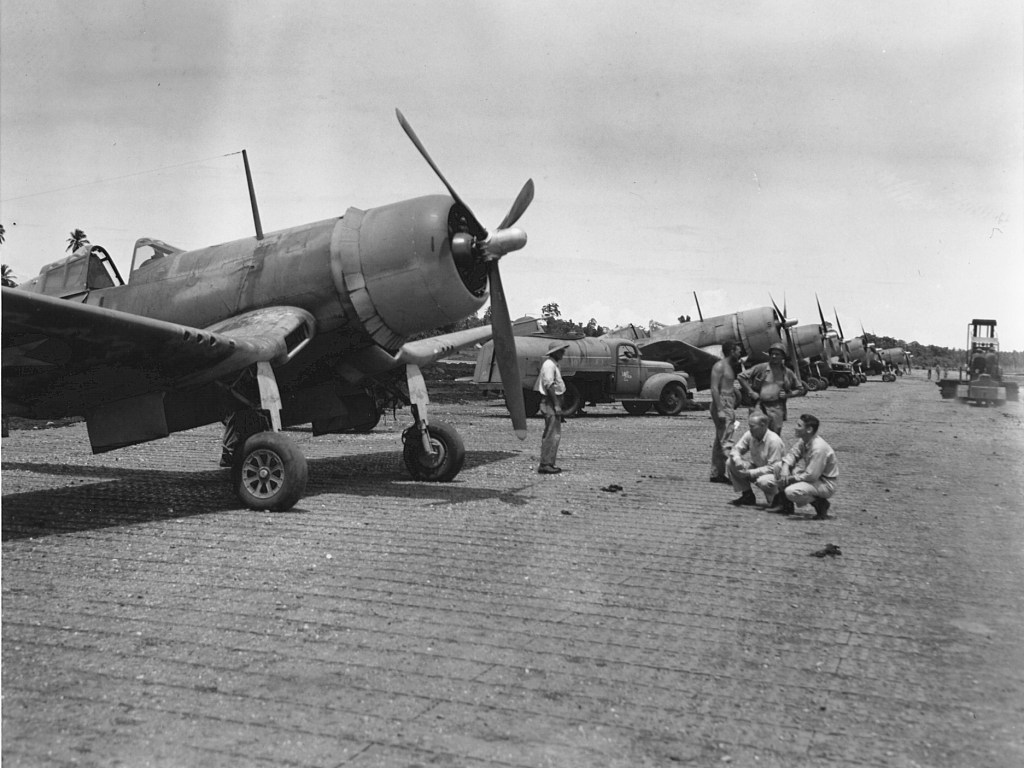
On August 30th, Walsh shot down four more Japanese planes during an attack on the Japanese Kahili Air Force Base (Bougainville). An F4U flying ace, Walsh was awarded the Medal of Honor. Marine F4Us would later be used in strafing and escort missions later in the war, in the attack on Okinawa and the bombing of mainland Japan.
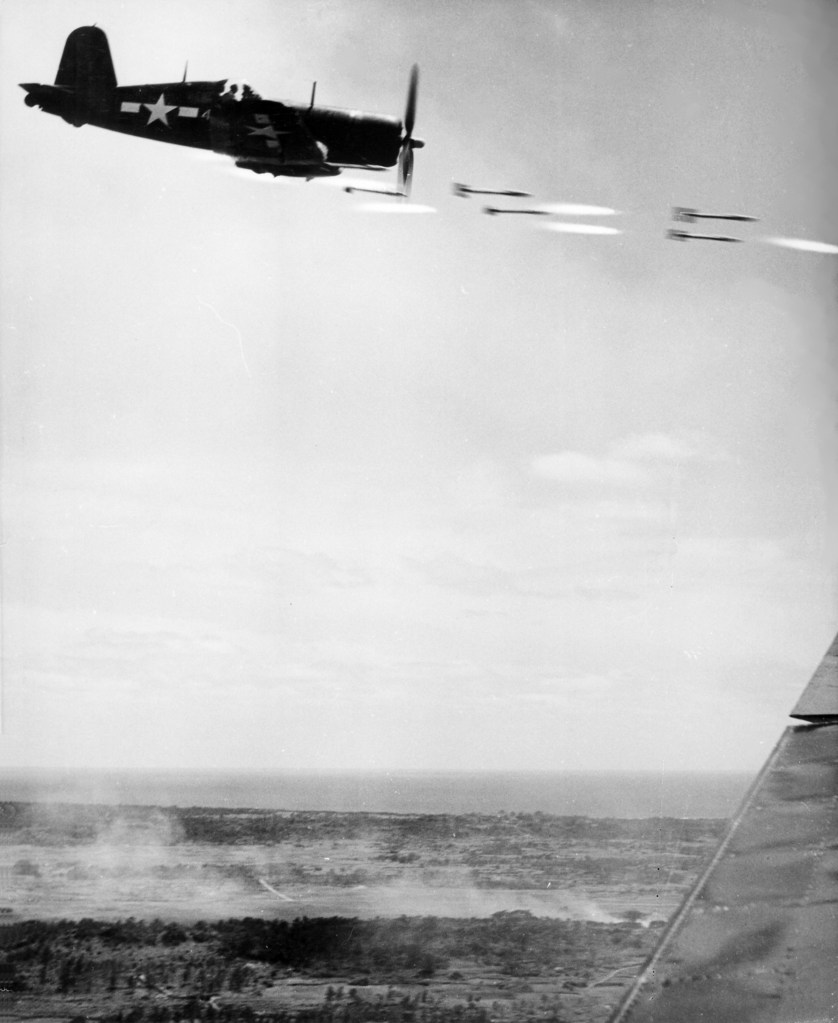
The Navy is also recorded as using the F4U in early October 1943 strafing the Japanese airfield on Bougainville Island, as well as strafing barges, transport ships, and military installations on and around the Solomon Islands and New Britain. In February 1944, Navy F4U’s targeted a Japanese air field on the eastern part of New Britain (Vunakanau). Naval F4U missions also included those in the Marshall and Marianas islands.

During the Korean War, the F4U was used by both U.S. Navy and Marine forces. Early combat saw the F4U matching other propeller-driven aircraft, until the Corsair was outclassed by jet-propelled planes. The F4U was also used in close ground-support roles and strafing missions.

The Netherlands, the United Kingdom and New Zealand used the F4U during World War II; some of these countries adopted the plane for a number of years afterwards.
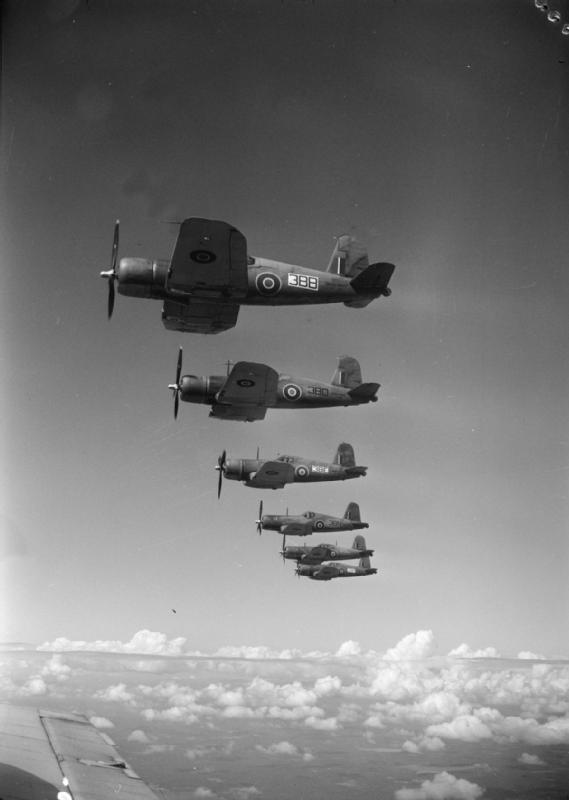
France and the UK used the Corsair in colonial wars following World War II, in Egypt, Algeria, Tunisia, and French Indochina. The F4U was also sold to a number of South and Central American countries including Argentina, Honduras, El Salvador, Peru, Uruguay, and Chile.
The F4U Corsair In Flight

The F4U-1 Corsair was a powerful fighter with a 2,000-horsepower Pratt & Whitney R-2800-8 engine. As such, it could reach a maximum speed of 417 miles per hour and a maximum altitude of 19,400 feet.
This was used to great effect in combat, with pilots using greater altitudes to command combat engagement. The plane could not turn as quickly as the Mitsubishi Zero, so low-speed dogfights were avoided.

There were several Corsair aces, including Second Lieutenant Kenneth A. Walsh, Captain Wilbur J. Thomas, and the legendary Gregory “Pappy” Boyington – a Corsair Ace with 28 confirmed kills in combat.
Model Variations

There are several variants of the F4U Corsair, including those produced by Vought, as well as types manufactured by Goodyear (designated the “FG”) and Brewster (designated the “F3A”) under a license from Vought. These include the:
F4U-1 – The first production variant of the experimental XF4U-1 (a Corsair prototype), a 2,000-hp Pratt & Whitney R-2800-8 engine with 6 .50-caliber Browning machine guns in the wings. Also had “birdcage” canopy and low pilot seat. 2,469 produced, also known as Brewster’s F3A-1 and F3A-1D (and Goodyear’s FG-1 and FG-1D). The first service deliveries of this type were in July 1942.
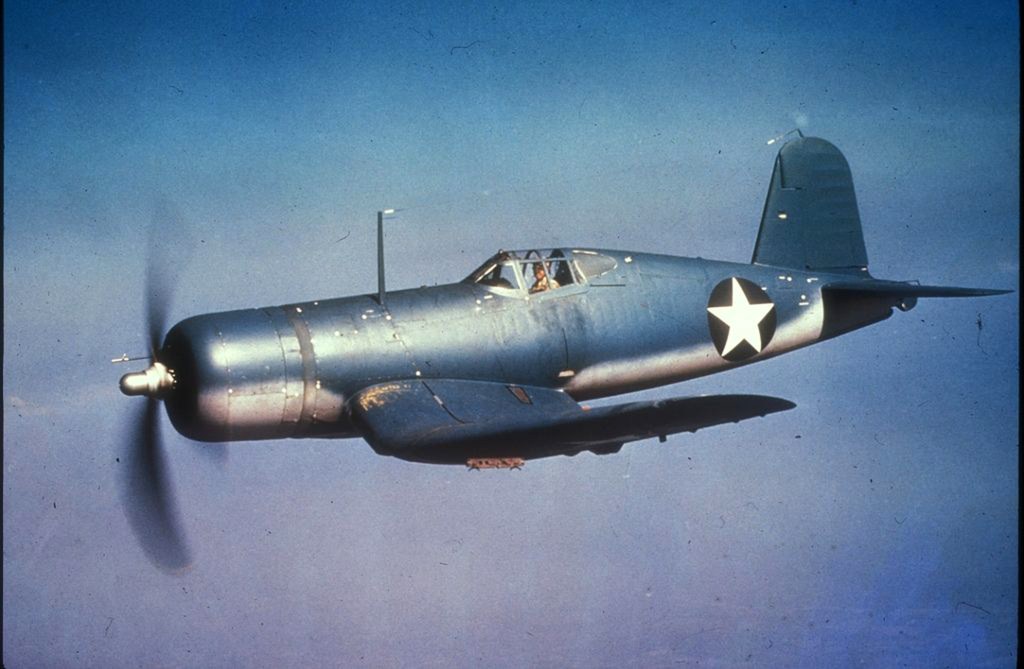
F4U-1A – The middle to late-stage production version of the F4U-1. Characterized by a “Malcolm Hood”-type canopy, a higher seat (to combat landing problems), and a maximum speed of 417 miles per hour, this version was first delivered for service in April 1943 with 3,861 built.

F4U-1C – A version with four 20-mm cannons (instead of six .50-inch machine guns). Produced starting in July 1944, this version was used in ground attack missions on the Allies’ approach to Japan. A total of 200 of these craft were built, first delivered for service in April 1945.
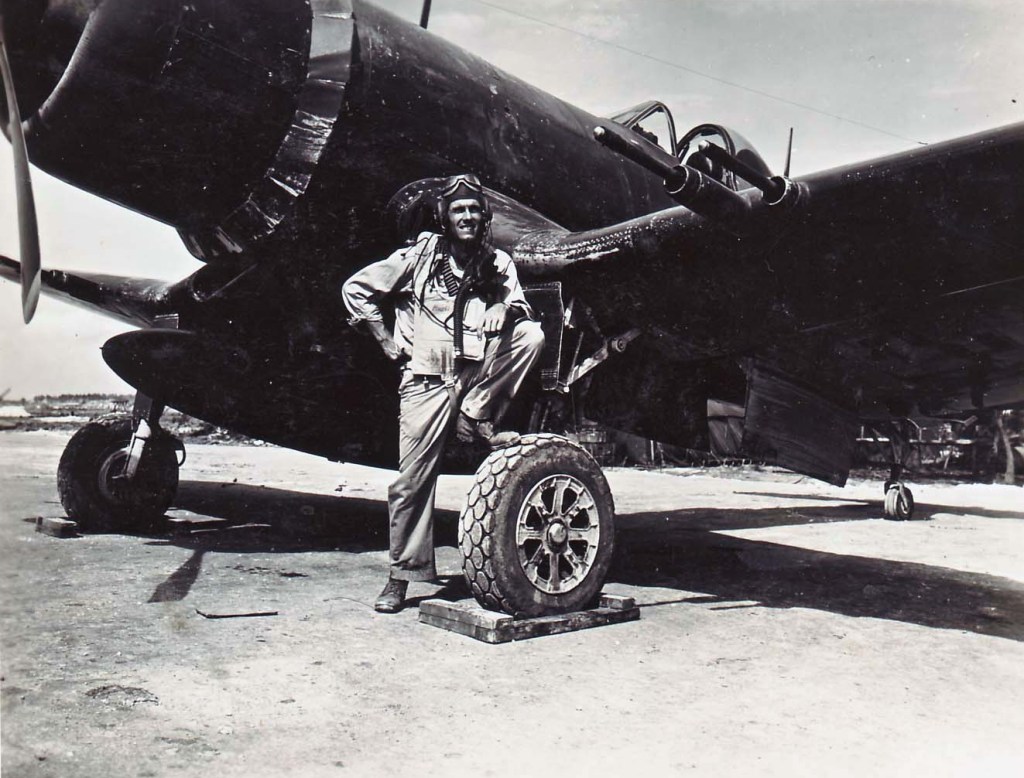
F4U-1D – This version had a “blown” dome-shaped canopy consisting of a single-piece windshield – a characteristic that would be shared by all Corsair types to follow. A new engine, the Pratt & Whitney R-2800-8W Double Wasp, gave the F4U-1D 2,250 hp with a top speed of 425 miles per hour. A version designed specifically for ground-attack use, the F4U-1D could carry eight five-inch rockets and had pylons for bombs and drop tanks. A total of 2,800 F4U-1Ds were built, with the first service deliveries made in March 1944.
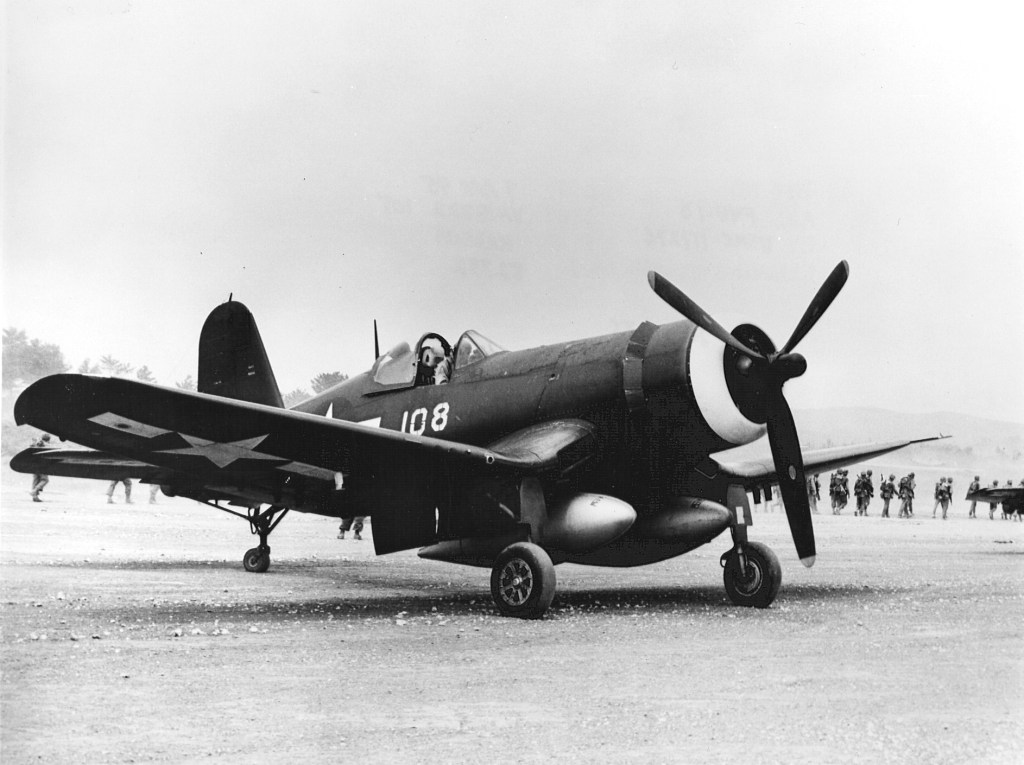
F4U-2 – The F4U-2 was a converted F4U-1 equipped with radome (a “bump” that housed radar equipment) in the right wing. This was done with the intention of making the F4U-2 a night fighter. Only 32 F4U-2s were built, with the first service delivery made in January 1944.
F4U-4 – This variant had a 2,350-hp Pratt & Whitney R-2800-18W engine with a maximum speed of 448 miles per hour. A total of 2,360 F4U-4s were built, with the first deliveries made in October 1944. This was the last Corsair variant to be used during World War II.
F4U-5 – A variant introduced in December 1945. The F4U-5 was based on the F4U-4, but was fitted with a 2,350-hp (to a maximum 2,760-hp, with fuel injection) Pratt & Whitney R-2800-32W engine. It had a maximum speed of 470 miles per hour, it also had improved rear wheel bays, more automated cockpit controls, heated gun bays, and solid metal outer top wing panels (in earlier variants, these were fabric-covered). A total of 223 F4U-5s were produced.
AU-1 or F4U-6 – This was a ground-attack variant of the F4U Corsair designed for the U.S. Marines during the Korean War. It had a 2,300-hp (to 2,800-hp with fuel injection) Pratt & Whitney R-2800-83W Double Wasp engine. It had the potential to carry up to 10 rockets and well over 2,000 pounds of bombs. It was delivered first starting in January 1952, with 111 delivered by the end of that year.


F2G – The F2G was an experimental variant of the F4U Corsair manufactured by Goodyear. It was equipped with a 2,400 to 3,000-hp Pratt & Whitney R-4360-4 Wasp Major engine and at 16,400 feet was capable of a maximum speed of 431 miles per hour. It also had four .50-caliber Browning machine guns. The F2G-1 was a land-based version, and the F2G-2 was the carrier-based version – five of each were produced starting in 1945. This version was used in several air races postwar.
Other variants included night-fighter, experimental drone, photo reconnaissance, and winter-ready F4Us. A total of 16 variants were produced; the above list only describes the most prominent versions.
Military Unit Designation Guide

VF (Navy) = V(Heavier-than-air aircraft) Fighting Plane Squadron or Fighter Squadron
VT (Navy) = V(Heavier-than-air aircraft) Torpedo Squadron
VMFA = V(Heavier-than-air aircraft) Marine Strike Fighter Squadron
VMF = V(Heavier-than-air aircraft) Marine Fighter Squadron
 Waves To Jets