
The Straight-Winged Marine And Naval Jet
By WavesToJets
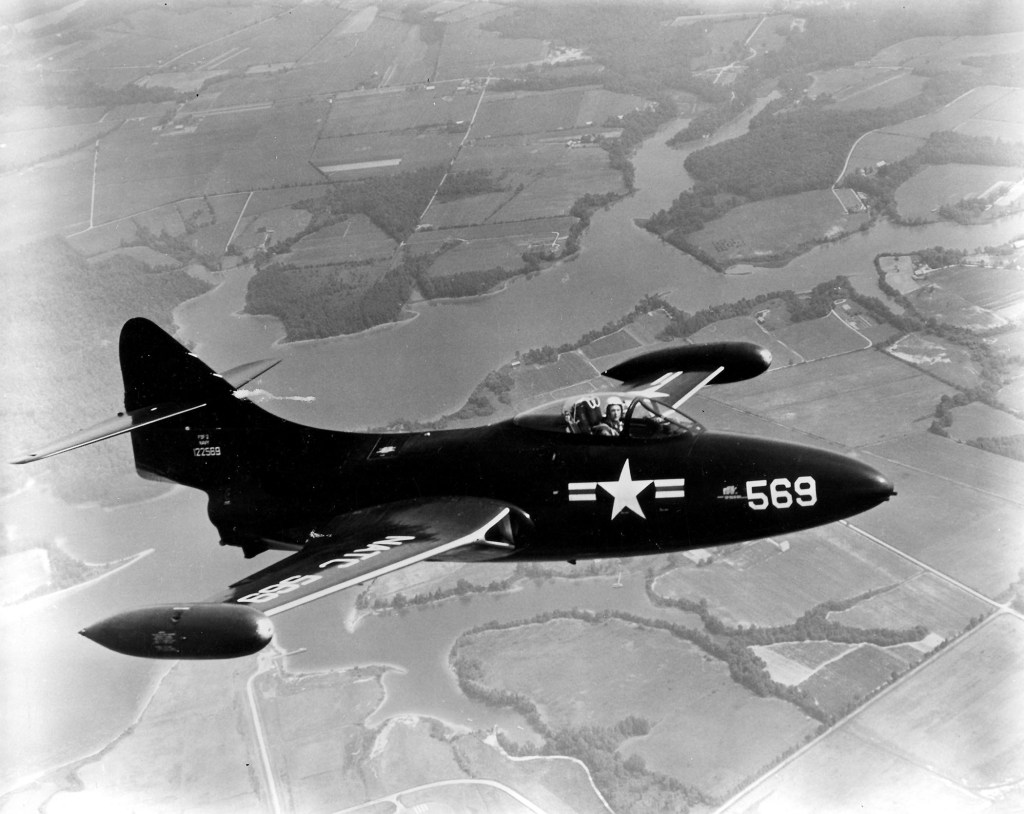
The F9F Panther was an early Cold War carrier-based fighter jet. Developed by Grumman Aircraft Engineering Corporation, the U.S. Navy and Marines used the F9F during the Korean War.
Characterized by its straight wings, fuel tanks, and pointed nose, the F9F was a rather larger single-seat fighter, with a length of some 37 feet, 5 and 3/8th inches to 38 feet, 10 inches — and a wingspan of 38 feet. It was capable of carrying bombs and rockets via underneath pylons and had four 20 mm cannons in its fuselage.
Later versions of the F9F were able to reach cruise speeds of 481 miles an hour and maximum speeds of 603 miles an hour at sea level. The craft, as carrier-based jet, was able to take off and land from military ships – and was used for both air-to-air and air-to-ground combat.
Though not the Navy’s first operational jet fighter, the F9F Panther was prominent in the branch, and with the U.S. Marines, in the early 1950s. The Navy’s use of this aircraft culminated in an improved variant, the swept-wing F9F Cougar, which was first delivered to the branch in November 1952.
Technological Background
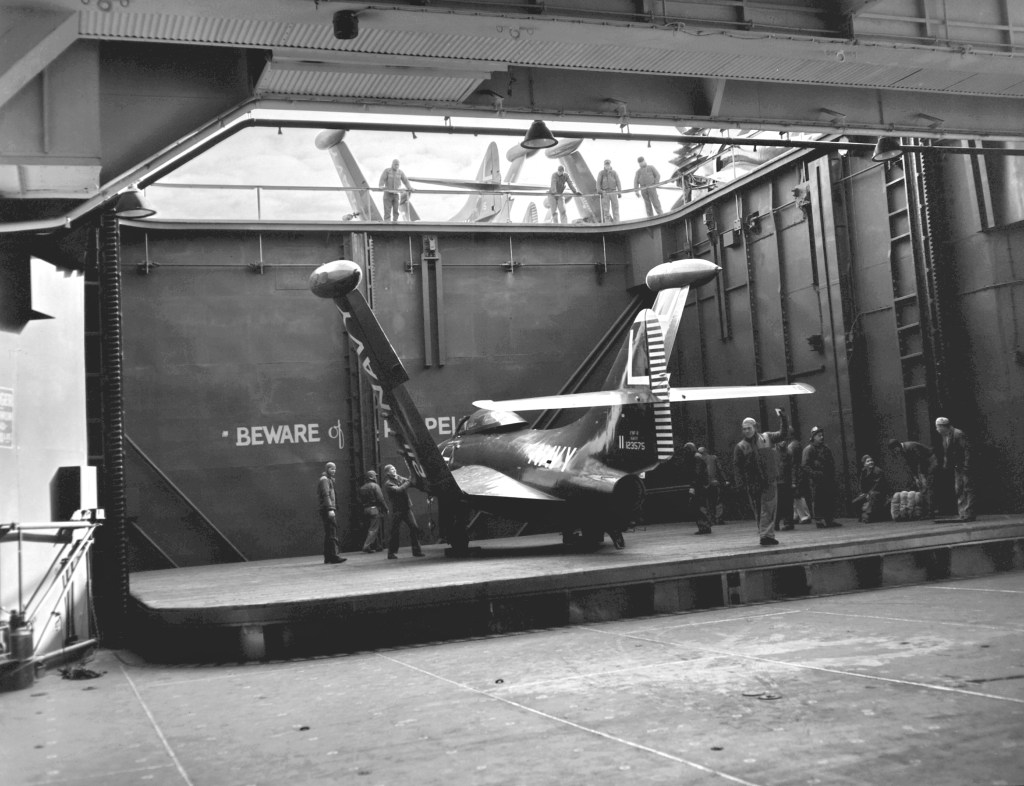
The F9F Panther’s origins begin in Grumman Aircraft Engineering Corporation’s securing of a U.S. Navy contract for a straight-winged, carrier-based jet fighter.
This was in 1946, when Grumman had already begun work on its G-75 (what would be known to the Navy as the XF9F-1), a proposed two-seated jet fighter that was reminiscent of Grumman’s existing propeller-driven F7F Tigercat.
The G-75 was not Grumman’s first attempt at developing a jet fighter, as the company had worked on drafting jet fighters during the war years (around July 1943 to November 1944). However, the G-75 was the first attempt by the company to engineer such a combat jet aircraft in earnest.
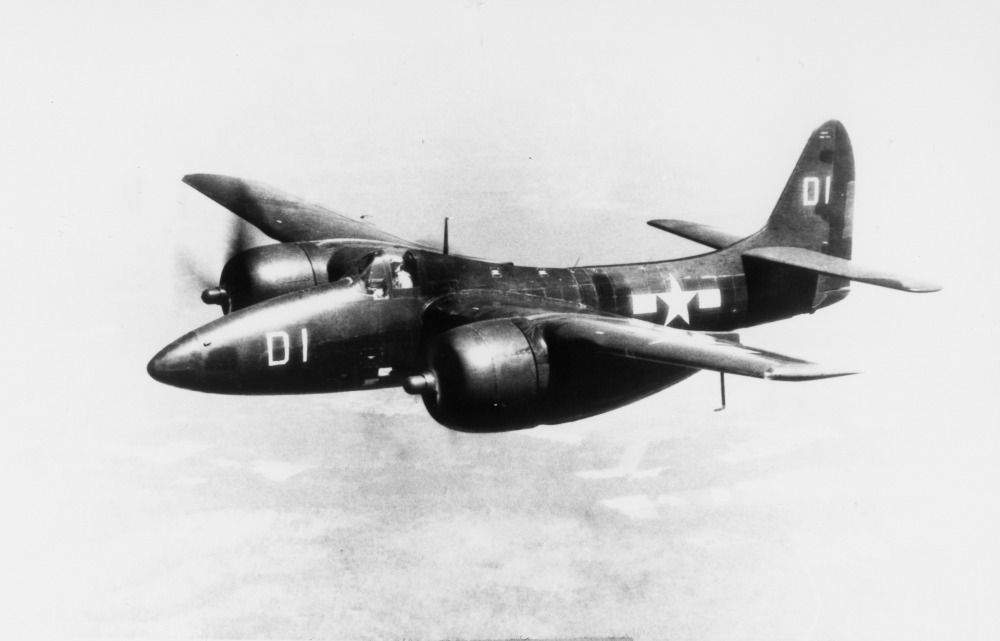
As it stood, Grumman’s G-75 would ultimately be in competition with other manufacturers. This was the case with Douglas Aircraft’s design (which would become the Navy’s F3D Skynight), which was the Navy’s first choice in April 1946.
The Navy deemed the XF9F-1 as a potential back-up option for a new jet fighter – though more research at Grumman revealed their G-75 would not be a feasible design. Therefore, work on the G-75/XF9F-1 was scrapped in the concept stage.
Grumman’s newer design initiative, the company’s single-seated, single-engine G-79 – would eventually become the F9F Panther. The Navy, instead of canceling their contract for their XF9F-1, would order three prototypes – two of what would be considered the XF9F-2, and one the XF9F-3.

The XF9F-2 would be powered by the UK-produced Rolls-Royce Nene turbojet, a powerful centrifugal compressor engine offering some 5,000 pounds of thrust. It had hydraulic folding wings and an arrestor hook (this was a carrier-based fighter, after all) and was not fitted with armaments yet.
The first flight of the XF9F-2 occurred on November 21st 1947. This was a flight from Grumman in Bethpage, Long Island, New York, to Idlewild Airport in Queens, New York – piloted by Corwin H. “Corky” Meyer.
The XF9F-3, in comparison to the -2 version, was powered by the Allison J33-A-8 engine. Thought to be a safer alternative to the Nene engine, the initial production versions of the XF9F-3 (the F9F-3) utilized the Allison J33.
However, as the Panther’s development progressed, more and more F9F-2s and F9F-3s were fitted (and, in the case of the F9F-3, retrofitted) with Pratt & Whitney J42-P-8 engines – American-made “Nene”-type jet engines built under license from Rolls Royce.
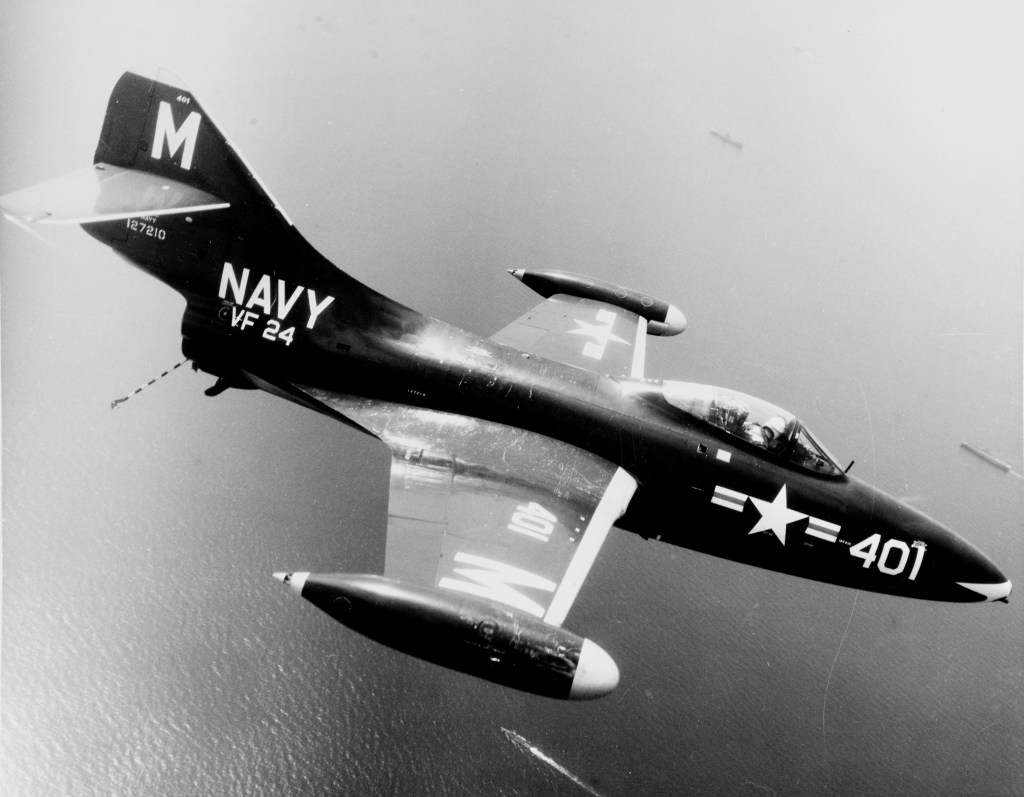
February 1948 saw the addition of fixed wingtip external fuel tanks to the Panther line, and soon afterward the jets were armed with four 20mm cannons, located in the nose. As the F9F was built for carrier-based landings, it featured hydraulic foldable wings. The fighter was also able to carry up to 2,000 pounds of rockets and bombs via underneath wing pylons.
By May 1949 the first Panthers, actually F9F-3s, were delivered to U.S. Navy (Fighter Squadron) VF-51. The F9F-2 was delivered later in greater numbers, becoming the prominent early version of the Panther. It first flew in August 1949 and could reach maximum speeds of 575 miles an hour at sea level, 529 miles an hour at 35,000 feet. The F9F-2 had a cruising speed of 487 miles an hour.
Later versions of the Panther included the F9F-4 and the F9F-5. The F9F-4 had a longer fuselage and more surface area on the vertical section of the tail; it was powered by the Allison J33-A-16 engine. The F9F-5 was structurally similar to the F9F-4 but was powered by the Pratt & Whitney J48-P-6 engine. The F9F-5 would become the prominent later Panther version, and many F9F-4s would be retrofitted with the Pratt & Whitney J48 engine as well.
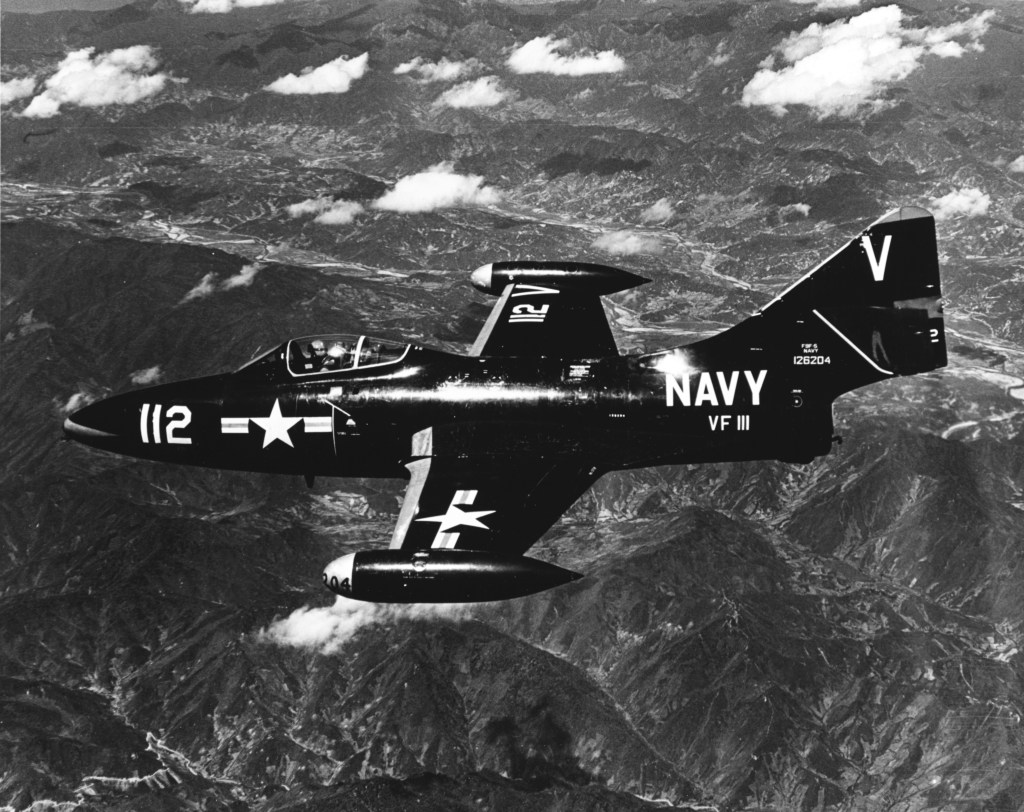
The Panther’s success in operation led Grumman to develop a swept-wing variant – which won a contract from the Navy on March 2nd , 1951. In November 1952, Grumman delivered this variant, which the Navy referred to as the Cougar. In the Navy, the swept-wing Cougar also went by the designation F9F-6, F9F-7, F9F-8, or simply, the F-9.

As the Cougar did not see action in the Korean War, it is the Navy’s (and Marine’s) straight-winged Panther that distinguished itself in combat, as well as performance-wise, in the early 1950s. Later F9Fs, particularly the F9F-5, had a range of 1300 miles, a cruise speed of 481 miles an hour, and a maximum speed of 579 miles an hour at 5,000 feet.
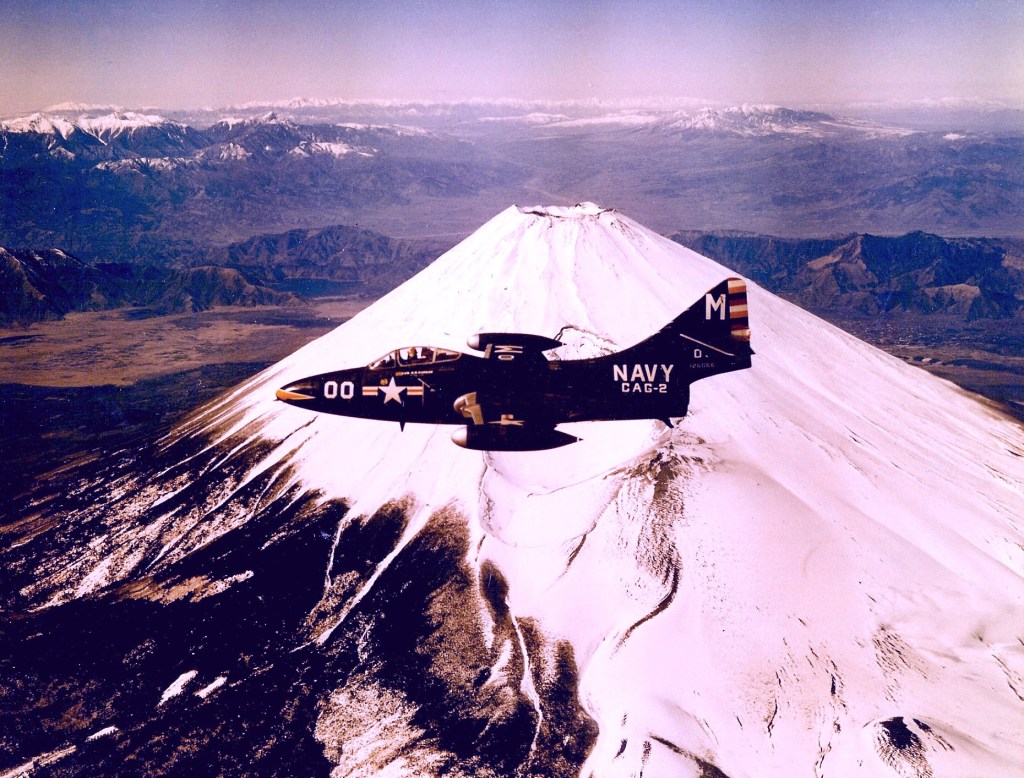
In Service
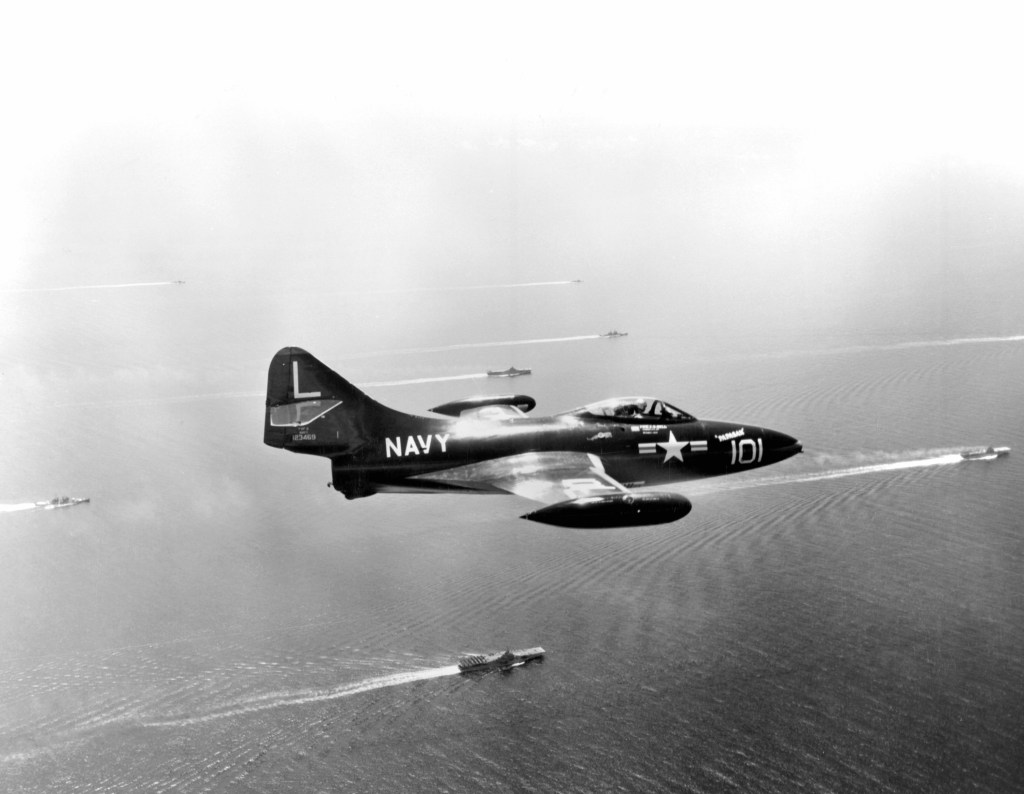
The F9F Panther was used by U.S. Navy and Marine forces during the Korean War. The first use was a little more than a week after the war started (June 25th, 1950) – on July 3rd, 1950.
On this date, F9F-3 Panthers flying off the U.S. Navy carrier Valley Forge (CV-45) in the Yellow Sea escorted piston fighters (such as the AD [A-1] Skyraider and F4U Corsair) which were tasked with attacking ground targets around Pyongyang. These targets included transportation hubs, supply lines, fuel depots, and airfields.
Navy Lieutenant Junior Grade Leonard H. Plog and Ensign Elton W. Brown Jr. were the first F9F-3 pilots to make confirmed kills over North Korea. Flying off the Valley Forge for Fighter Squadron VF-51 on July 3rd, Plog attacked an enemy Yakovlev Yak-9 plane as it was taking off from a Pyongyang area airfield. The plane went down with a damaged wing – and not long after, Brown similarly downed another Yak-9.

The first U.S. Navy jet-to-jet aerial victory occurred a few months later. On November 9th , 1950, Lieutenant Commander William T. Amen (of VF-111) shot down an enemy Mikoyan-Gurevich MiG-15 jet fighter using his F9F2-B Panther. This occurred during a F4U Corsair/AD Skyraider escort mission against bridge targets along the Yalu River in the North Korean province of Sinuiju.
On November 18th, 1950, F9F-2s and F9F-3s downed two MiG-15s during another Corsair/Skyraider attack on Sinuiju bridges. Responsible for this were VF-51’s Frederick C. Weber and VF-52’s Lieutenant Commander William E. Lamb and Lieutenant Robert E. Parker, the latter of which shared a kill.
On April 2nd 1951, two F9F-2B Panthers launching off the USS Princeton (CV 37) attacked ground targets (in this case a railroad bridge) in the vicinity of the North Korean city of Songjin (now known as Kimchaek). The Panthers, which were part of VF-191, were armed with two 100-pound and four 250-pound bombs each. This was notably the U.S. Navy’s first use of F9F Panthers – and jet fighters in general – as bombers.

Besides ground attack and some air-to-air fighting, the Panther was used in air escort duties – such as on August 25th, 1951, when USS Essex (CV-9)-based F9F-2s of VF-51 escorted B-29 Superfortresses to attack a railroad yard near the northeastern Chinese/Soviet border with North Korea. This was a high-altitude mission in which F2H-2 Banshees (slightly older Naval jet fighters) also participated.
Later air-to-air victories for the U.S. Navy’s F9F Panther included those of November 18th, 1952. When seven Mig-15s came close to the U.S. Navy’s Task Force 77 in the Sea of Japan, three F9F-5s – operating off of the carrier the USS Oriskany (CVA-34) – intercepted them. The Panthers, which were of VF-781, damaged one MiG, shot down two others, and cause the rest to retreat.
The U.S. Marines also used the F9F Panther (notably among them VMF-311 and -115) during the Korean War. These units engaged in close air support against Chinese forces, as well as photo-reconnaissance missions using the modified F9F-2P Panther.
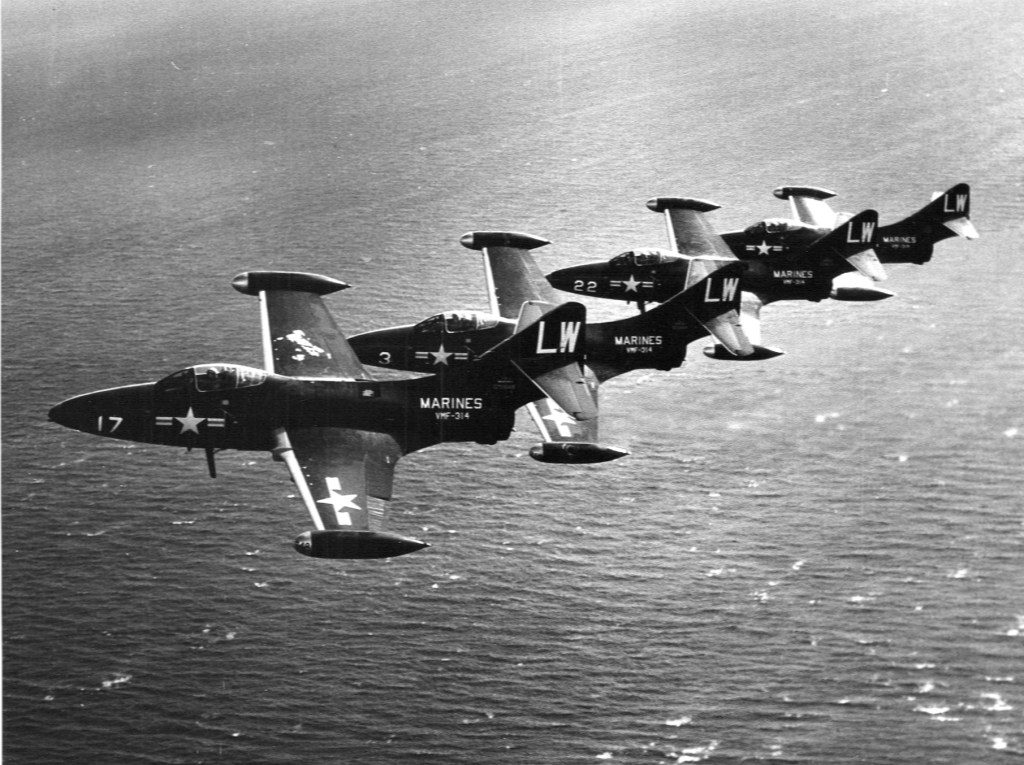
A notable series of Marine airstrikes occurred in June 1953, when 68 F9F Panthers damaged and destroyed buildings (among them supply depots and troop barracks) in North Korea. The planes, which were of VMF-311 and VMF-115, used incendiary bombs and napalm to hit at least 230 buildings.

Notable Marine F9F Panther pilots included future astronauts Neil Armstrong and John H. Glenn (the latter of which was also later a U.S. Senator), future U.S. Marine Major General Ralph H. Spanjer, and Hall of Fame baseball player Ted Williams.
The F9F In Flight

The F9F Panther was, for the most part, a carrier-based jet that was tasked with ground attack missions, escorting missions, photoreconnaissance, and providing fighter cover for propeller-driven planes that similarly would attack enemy ground units.

Early in the Korean War, the F9F would fly at high altitudes – of at least 31,000 feet – to provide cover for attacking F4U Corsairs and AD-1 Skyraiders. Such was the case during the November 18th, 1950 incident in which F9F-2 and -3s shot down two attacking MiGs in the Sinuiju area.
As an early jet fighter, flying the F9F Panther – for some pilots – was one of their first experiences in jet-powered airplanes. At the time, naval pilots were being trained in propeller-driven craft such as the Beechcraft T-34 Mentor and the North American T-28 Trojan.

The Navy’s TV2 SeaStar, a training aircraft based on the Lockheed T-33 – was the jet trainer used to prepare pilots for the F9F Panther. The instruments in both planes were reportedly similar enough for pilots to operate the F9F once training was complete with the TV2.
The difference between the F9F Panther and the TV2 SeaStar, however, was that the F9F was a single, rather that a two-seated aircraft. For some pilots, this was the first time they had been the sole operator of a jet airplane. Some pilots found the experience to be simpler than that of propeller craft.
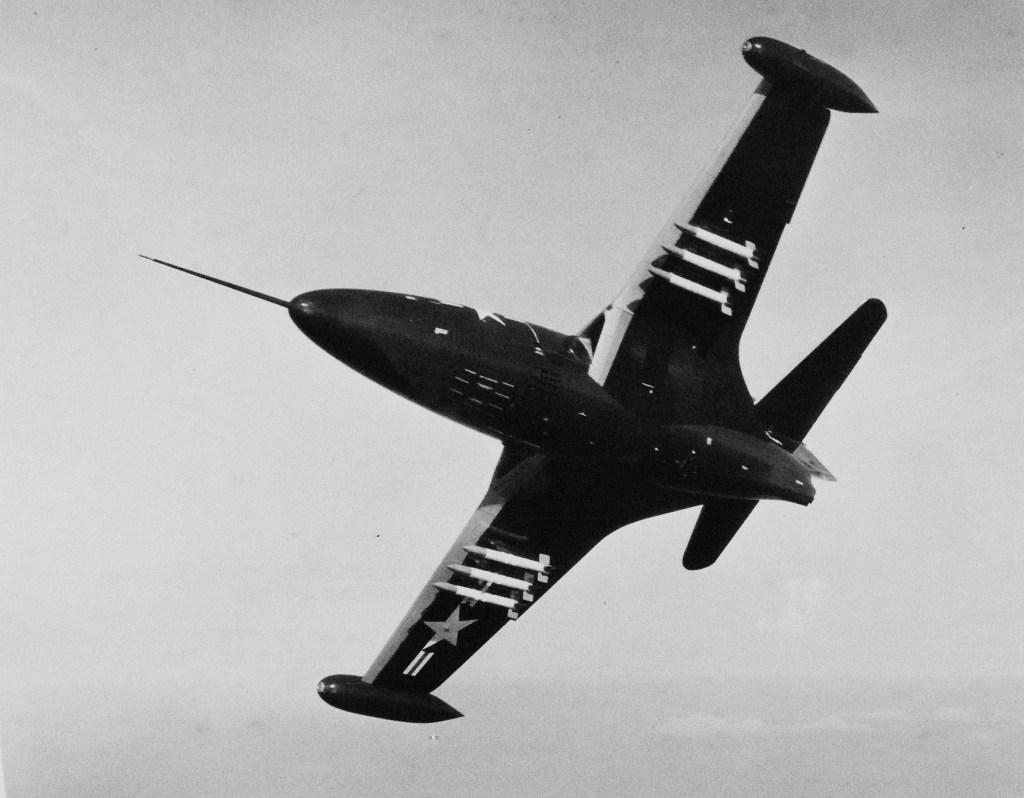
In addition to this, there was no propeller torque or airplane skid (during in-air turns) in controlling the F9F – a common phenomenon in propeller craft that is virtually non-existent in jet airplanes. These control improvements were noted by pilots at the time.

The F9F Panther was also chosen to be the first jet fighter of the U.S. Navy’s Blue Angels flight demonstration team. On August 20th, 1949, the Blue Angels debuted the Panther at a show over Beaumont, Texas under the leadership of Lieutenant Commander Raleigh “Dusty” Rhodes.
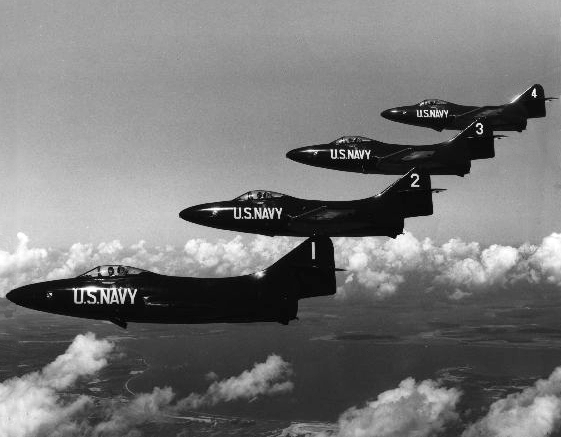
F9F Panthers, including F9F-2s and later F9F-5s, participated in the teams’ aerobatics maneuvers, including holding close formations. These risky flight routines were not without incident – for example, team member Lieutenant Bud Wood was killed on July 7th, 1952 in an in-air collision. The Blue Angels used the F9F Panther from 1949 to early 1955.
Model Variations
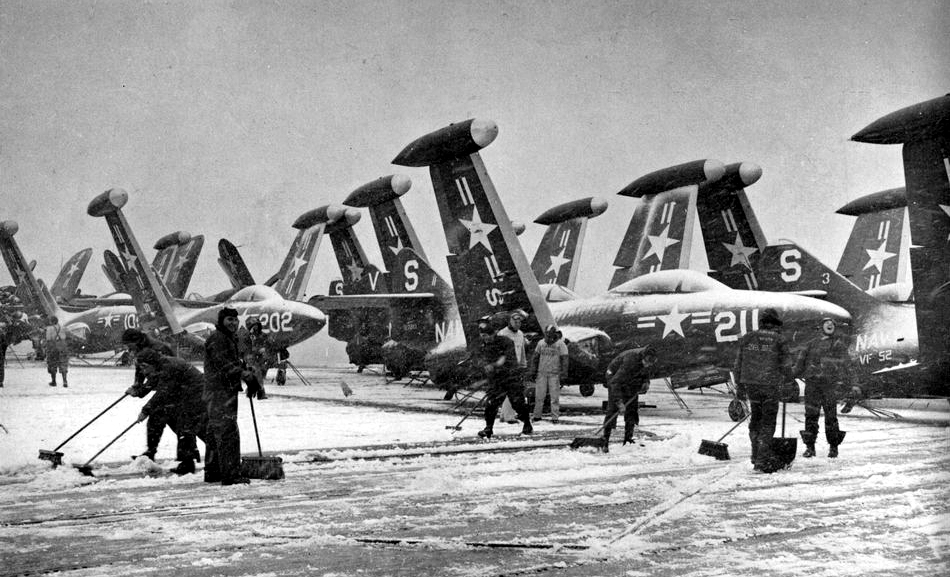
There were numerous versions of the F9F Panther made – with its frame eventually giving way to Grumman’s production of the swept-wing F9F Cougar.
The F9F Cougar (not discussed here) may be considered a different plane on its own, but it did retain the naming convention of the F9F Panther, starting with the F9F-6 Cougar. This is not an exhaustive list of Panther variants, but other versions (such as unarmed F9F -2s and -5s for photoreconnaissance purposes) were produced.
XF9F-1 – Grumman’s first prototype design for what would become the F9F Panther. The XF9F was originally known to the Bethpage, Long Island, New York company as the G-75.
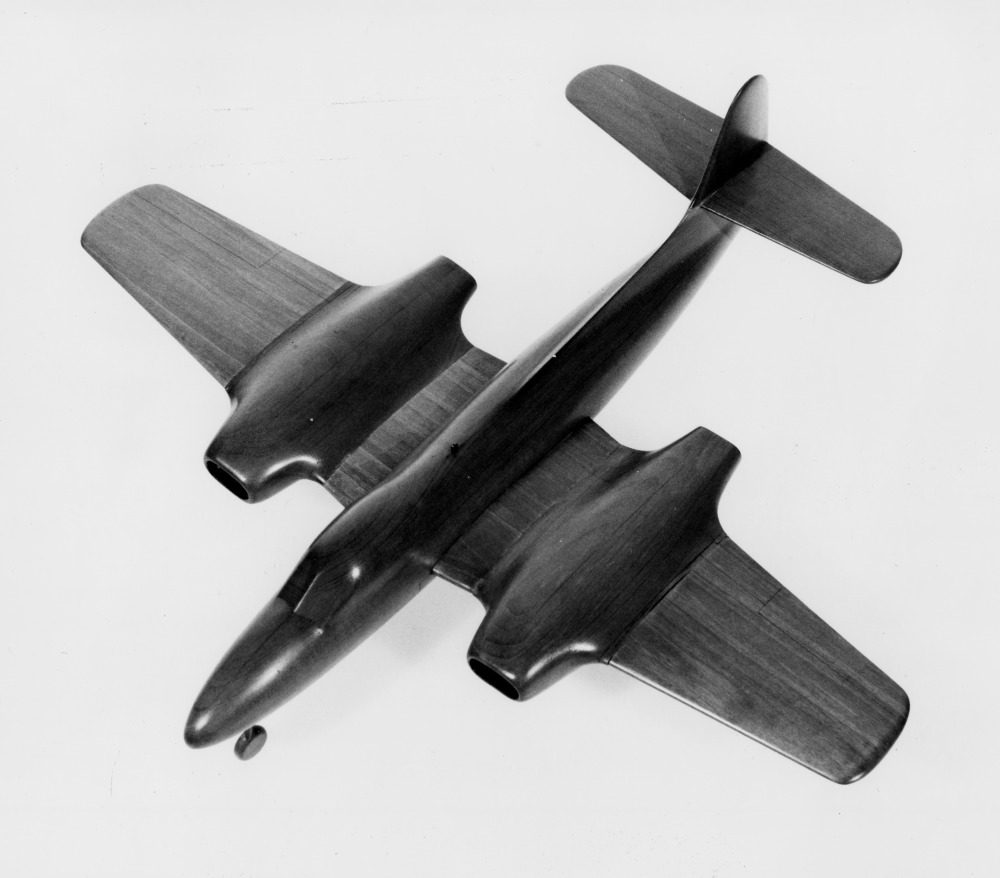
The XF9F-1 was intended to be a night fighter, but did not have suitable jet engines to power its four-jet, two-seated frame sufficiently. As such, plans to complete the XF9F-1 were abandoned in the design stage.
XF9F-2 – The XF9F-2 was Grumman’s next attempt at designing its first jet fighter. This was a single seat, single-engine fighter that could be used in day missions. Two prototypes were made, and were powered by imported Nene engines built by Rolls-Royce (UK).
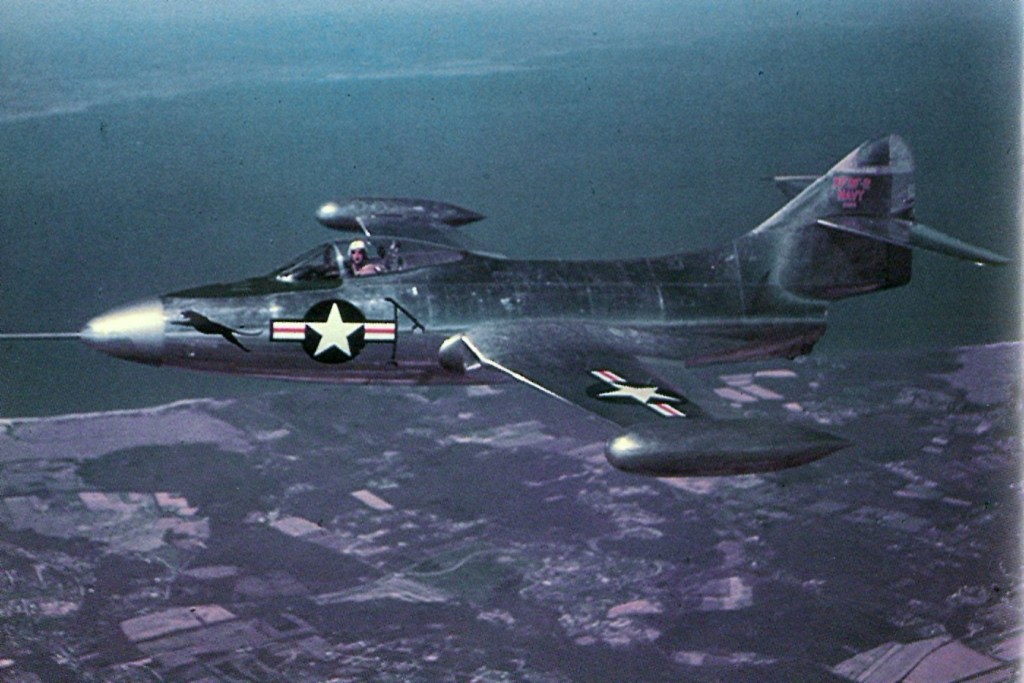

F9F-2 – The production version of the XF9F-2, the F9F-2 Panther was powered by the American-made Pratt & Whitney J42-P-8 engine, a Rolls Royce Nene engine built under license. 567 instances were made.

XF9F-3 – The experimental version of what would become the F9F-3 Panther, equipped with the Allison J33-A-8 engine. One instance made.
F9F-3 – A version of the Panther which, like the XF9F-3, utilized the Allison J33A-8 engine. Structurally identical to the F9F-2, the F9F-3 would later be retrofitted with the Pratt & Whitney J42 engine.
54 instances of the F9F-3 were produced. The addition of fixed tip tanks to the wings in February 1948 was a key addition of early F9F-2s and F9F-3s.

XF9F-4 – The prototype version of the F9F-4 Panther, this version was equipped with the Allison J33-A-16 engine. It had a lengthened fuselage and more area in the vertical area of the tail. 2 instances were produced.
F9F-4 -Production version of the XF9F-4, this version used the Allison J33-A-16, had the longer fuselage and more tail area of the XF9F-4, but was also, in many instances, retrofitted with the Pratt & Whitney J48. 109 instances of this plane were made; they were mostly indistinguishable from the F9F-5.
XF9F-5 – The prototype version of the F9F-5 Panther, powered exclusively by the Pratt & Whitney J48-P-6 engine.
F9F-5 – The production version of the XF9F-5 Panther, fitted with a Pratt & Whitney J48-P-6 engine. This version was able to be equipped with 3,465 pounds of bombs, had four 20mm cannons in the fuselage.
The F9F-5 had a length of 38 feet, 10 inches, and a total wingspan of 38 feet. It was able to reach a cruise speed of 418 nautical miles (481 miles) an hour.
Military Unit Designation Guide

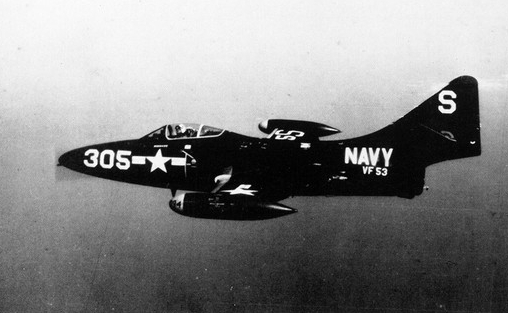
VF (Navy) = V(Heavier-than-air aircraft) Fighting Plane Squadron or Fighter Squadron
CV (Navy) = C(Cruiser) V(Aircraft designation) Aircraft Carrier Ship
VMA (Marines) = V(Heavier-than-air aircraft) Marine Attack Squadron
VMF (Marines) = V(Heavier-than-air aircraft) Marine Fighter Squadron
VMFA (Marines) = V(Heavier-than-air aircraft) Marine Fighter Attack Squadron
 Waves To Jets