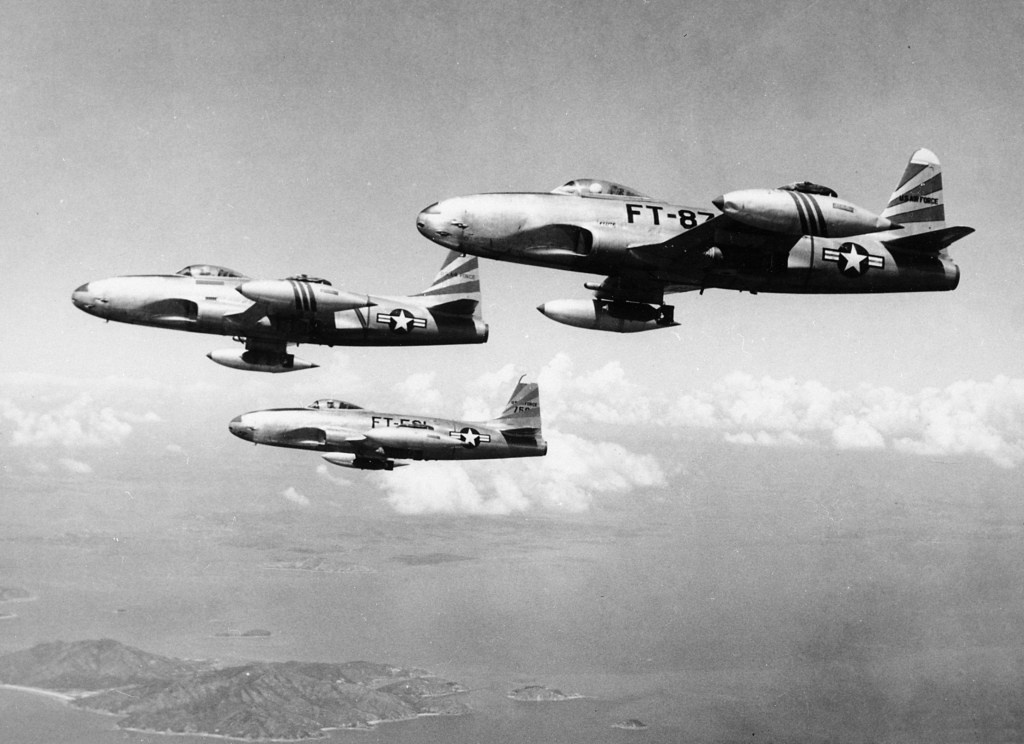
A Jet Age Fighter
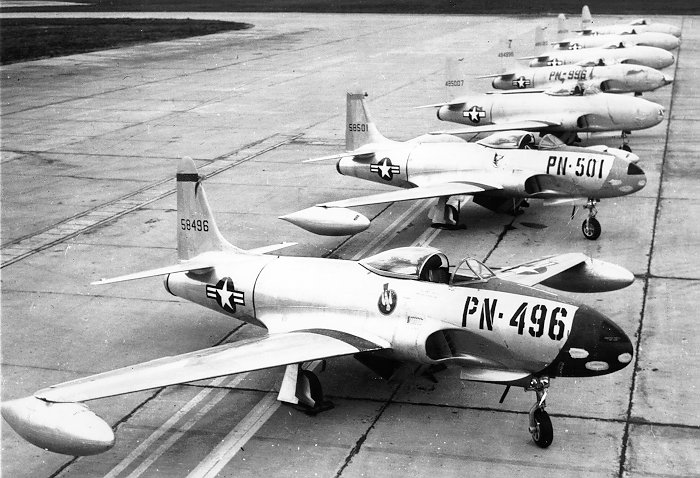
By WavesToJets
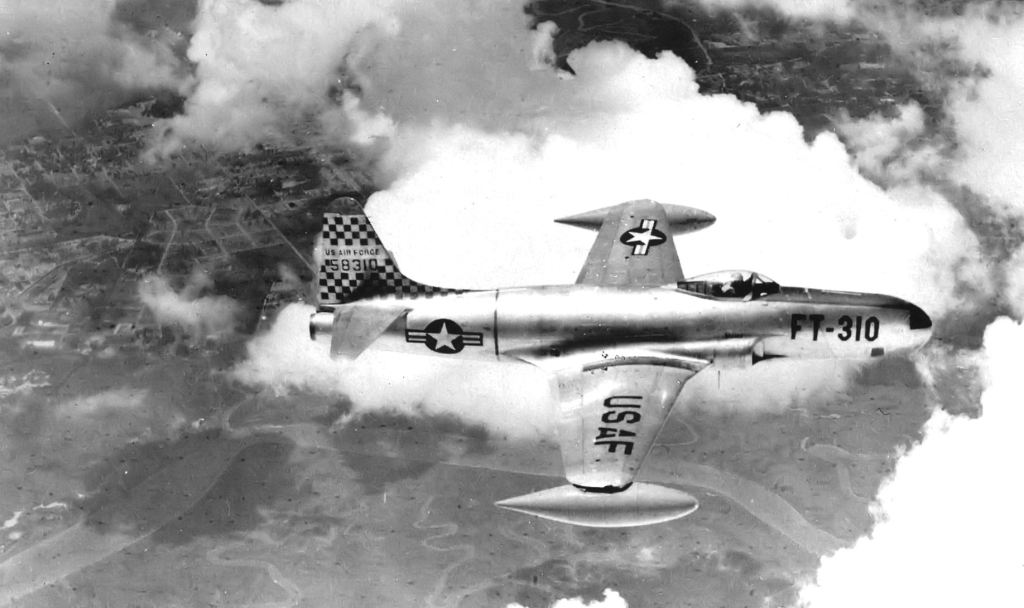
The P-80 Shooting Star was an early Cold War jet fighter aircraft, produced by Lockheed. Also known as the F-80, the P-80 was the U.S. Army Air Force’s (USAAF) first operational combat jet fighter.
Originally powered in its very first prototype by the British-made de Havilland H-1B engine, the planes that would eventually become the P-80 were built with the American-made General Electric/Allison J33-A-35 turbojet engine, offering at least 3,825 pounds of thrust.
The P-80 was a straight-winged fighter with a backwards-sliding bubble canopy, some 34 feet, 5 inches long with a wingspan of 38 feet, 9 inches. Speed varied by model, but the P-80 usually could reach speeds in excess of 500 miles per hour.
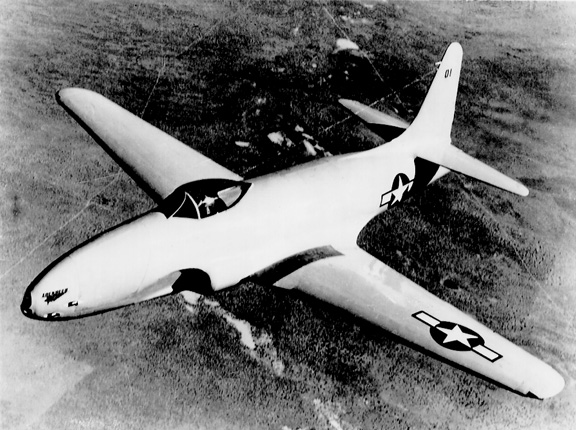
The plane housed six .50-caliber machine guns and was capable of carrying two 1,000-pound bombs. Later Shooting Star variants featured J-33-A-35 engines that offered 4,600 to 5,400 lb.-thrust yields.
During the Korean War, the P-80 Shooting Star was designated by the United States Air Force (USAF) as the F-80. It flew air-to-air missions early in the war, but as it faced increasing encounters with the faster Soviet-made Mikoyan-Gurevich MiG-15, it took on more air-to-ground combat roles.
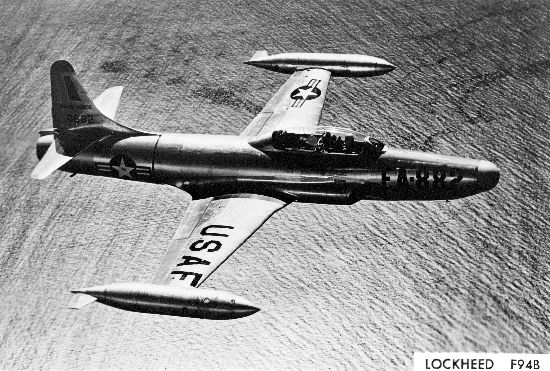
The P-80’s airframe was used in the development of Lockheed’s later F-94 Starfire fighter and T-33 Shooting Star trainer aircraft.
Technological Background
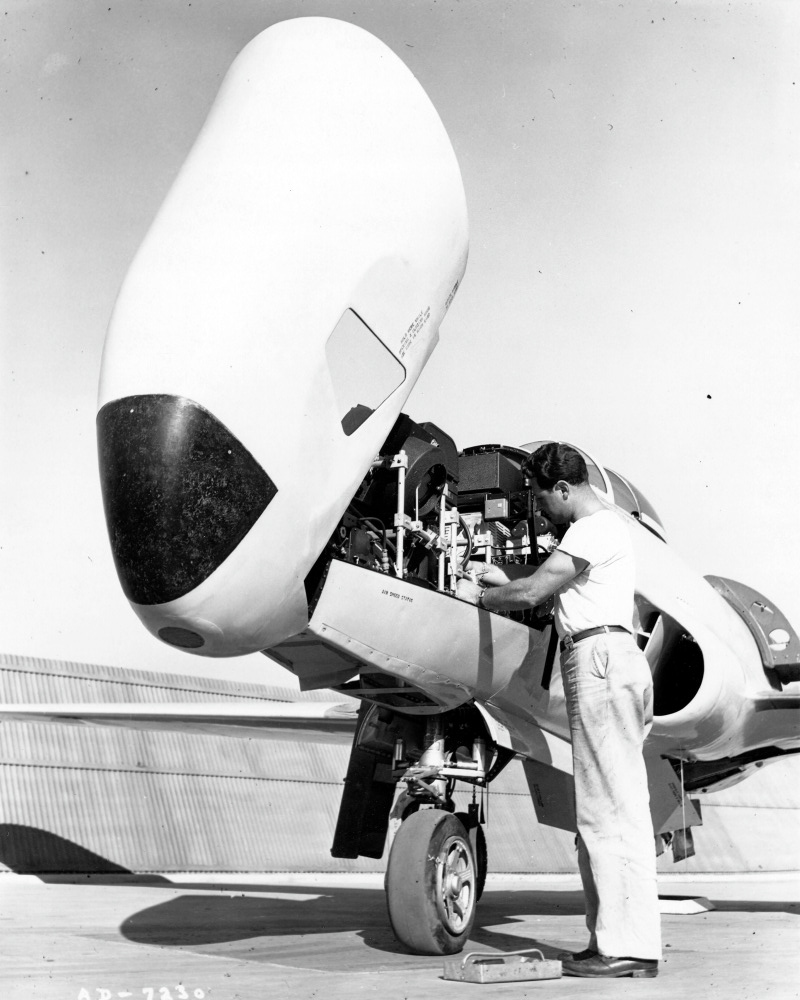
Development of the Lockheed P-80 Shooting Star began during the Second World War as a result of the U.S. Government’s request for a combat-ready jet fighter.
The aircraft manufacturer Bell Aircraft had already designed and produced the Bell P-59 Airacomet – the American military’s first jet fighter – and had first flown it on October 1st, 1942.
The Airacomet, however, was found to be only about as fast as piston-powered fighters of the time (such as the P-51 Mustang, the P-38 Lightning, and the P-47 Thunderbolt), and therefore not suitable for combat.
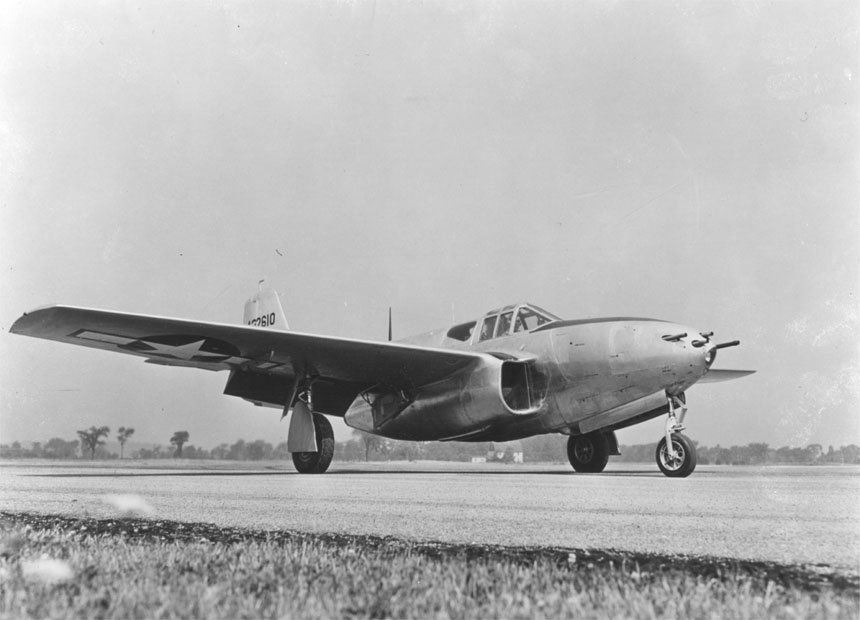
By the spring of 1943, the U.S. Government was well aware of German air-to-air attacks on attacking United States Army Air Force (USAAF) bombers in Europe, made by Axis piston-powered craft.
There was also additional concern that the Germans would start to use jet fighters in the these attacking runs. The USAAF knew the Axis was developing such planes – like what would become the German Messerschmitt Me 262 jet fighter – but had yet to see them used in this capacity.
In order to combat this, the USAAF requested that Lockheed design a new jet fighter. Lockheed accepted, and chose Chief Engineer Clarence “Kelly” Johnson to develop the new craft.

Johnson had promised the War Department that Lockheed could deliver a prototype in 180 days. On June 21st, 1943, Lockheed commenced work on the project, an aircraft that would become known as the XP-80.
The development was done in what would be considered Lockheed’s “Skunk Works” fashion: a team of designers and engineers informally working on a project, spatially separate and free from the regulatory/temporal conventions of the rest of the company – and sometimes beginning work without even a formal business agreement in place.
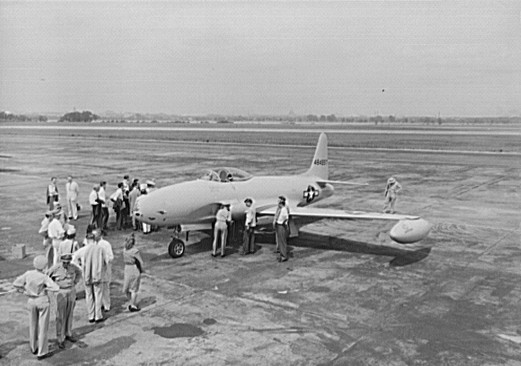
The project was a success, as Lockheed had a flyable prototype ready in only 139 days. Because of storage and transport issues, the prototype would not be able to fly until 143 days into the project. This was still an impressive 37 days ahead of schedule.
On the morning of Saturday, January 8th, 1944, test pilot Milo Burcham flew the XP-80, the P-80 prototype, for the first time.
The prototype was officially named the XP-80, but nicknamed “Lulu-Belle”. Being flown out of California’s Muroc Flight Test Base, the XP-80 was able to reach speeds of 502 miles per hour in level flight (at 20,480 feet) in later tests.
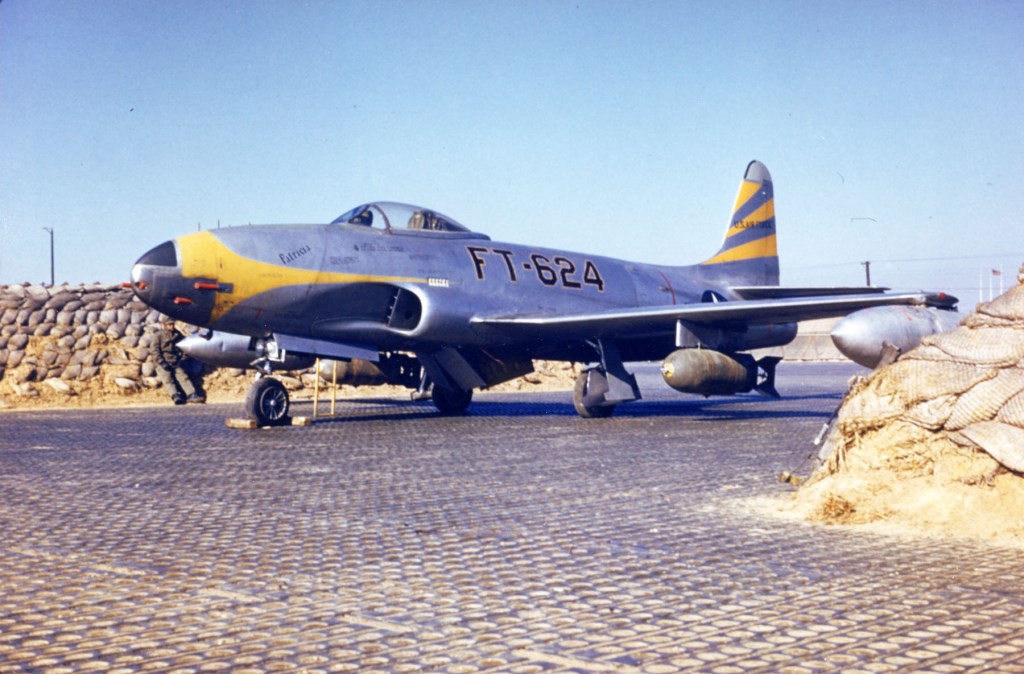
The original prototype used a 2,700 pound-thrust, British-produced de Havilland Halford H1-B “Goblin” engine. Use of the Goblin engine, however, would not last as engines from Britain would be increasingly harder to acquire in the United States.
General Electric’s I-40 engines (also produced as the Allison Engine Company’s J33 engines) were used in later models. These engines offered, in their early incarnations, 3,850 pounds (or more) of thrust.
Two more prototypes – the Silver Ghost and the Gray Ghost – were developed with the General Electric/Allison engine and designated the XP-80A.

By late 1944, YP-80As (pre-production model variants of what would become the P-80) were being tested. These planes did have several fatal accidents, including those that killed Milo Burcham and fighter ace/test pilot Richard L. Bong.
A separate December 6th, 1944 accident involved a mid-air collision with a test-purpose B-25 Mitchell bomber and a testing YP-80A built for reconnaissance purposes (known as the XF-14). All aboard the bomber were killed, as well as the pilot of the YP-80A.
Two YP-80As did serve in a limited reconnaissance capacity during the Second World War in Italy. Operating out of Lesina Airfield, they were assigned to the 1st Fighter Group, U.S. Fifteenth Air Force.
The first production P-80 Shooting Star, known as the P-80A, was ready for service in the summer of 1945. It became known in the U.S. Air Force as the F-80 in 1947.
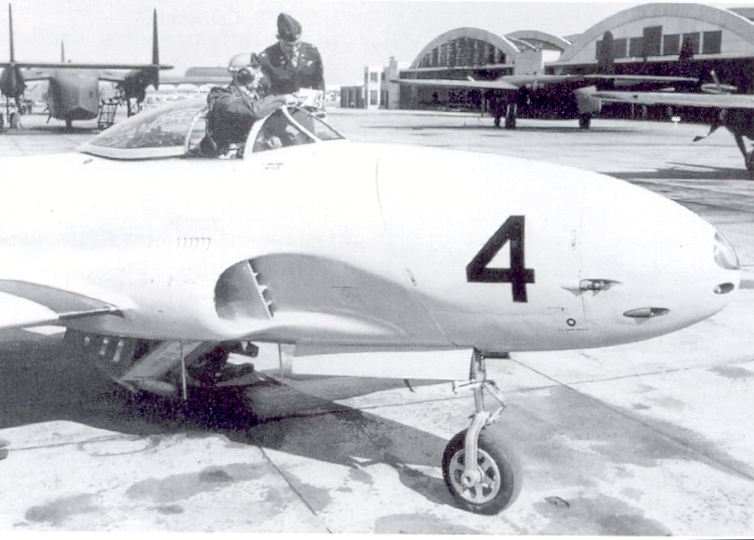
The P/F-80 was 34 feet, 6 inches long, with a wingspan of 38 feet, 10.5 inches, with some variation. It had six .50 caliber machine guns, and could carry eight High Velocity Aircraft Rockets (HVAR), or two 1,000-lb bombs.
The P-80 was identifiable (in part) by its tip tanks – two fuel tanks located at the very end of the each wing – that could carry 225 or 260 gallons of fuel in each tank, depending on the variant.

Later versions of the P-80 (like the F-80C) could reach speeds of 594 miles an hour at sea level – and at 25,000 feet, 543 miles an hour. The Allison J33-A-35 engine would offer some 4,600 to 5,400 pounds of thrust. The F-80C Shooting Star was the most-produced version of the jet with 670 planes accepted by the USAF.
Other versions of the P-80 Shooting Star included the reconnaissance RF-80 version (equipped with cameras), the USAF training craft the T-33 Shooting Star (first known as the TF-80C, a modified two-seated F-80C), and the version of the F-80C Shooting Star operated by the U.S. Navy, the TO-1.

In Service
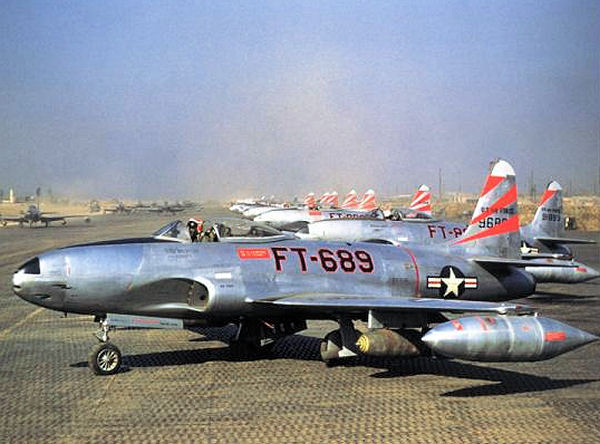
As mentioned before, the P-80 Shooting Star (as the YP-80A) saw reconnaissance service during the Second World War. It did not encounter enemy aircraft, and therefore was not used in a combat capacity.
Towards the end of World War II in 1945, some 30 instances of the P-80A were to be sent to the USAAF 414th Fighter Group, Twentieth Air Force in the Philippines. Though the planes had been put aboard an aircraft carrier, they were delayed and the war had ended – so they did not see action in the Pacific.
After the war, the USAAF used the P-80 to set new time records, particularly over transcontinental distances. This, and the P-80’s participation in air races of the time, were for public relations purposes.
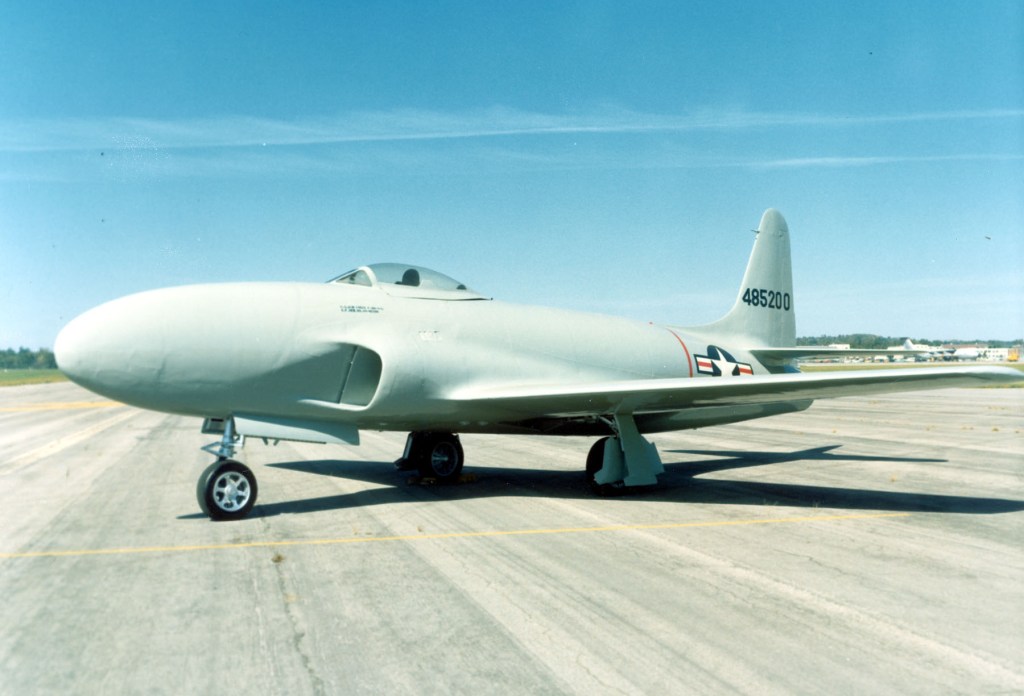
For example, a 4-hour, 13-minute, 26-second flight was made between Long Beach, California, and LaGuardia Airport, New York by USAAF Colonel William H. Councill flying a P-80A on January 26th , 1946.
Between 1946 and 1950, the P-80 (known as the F-80 by 1947) was being assigned to stateside air units and U.S. Air Force units overseas in Germany, Japan, the Philippines, and Okinawa.
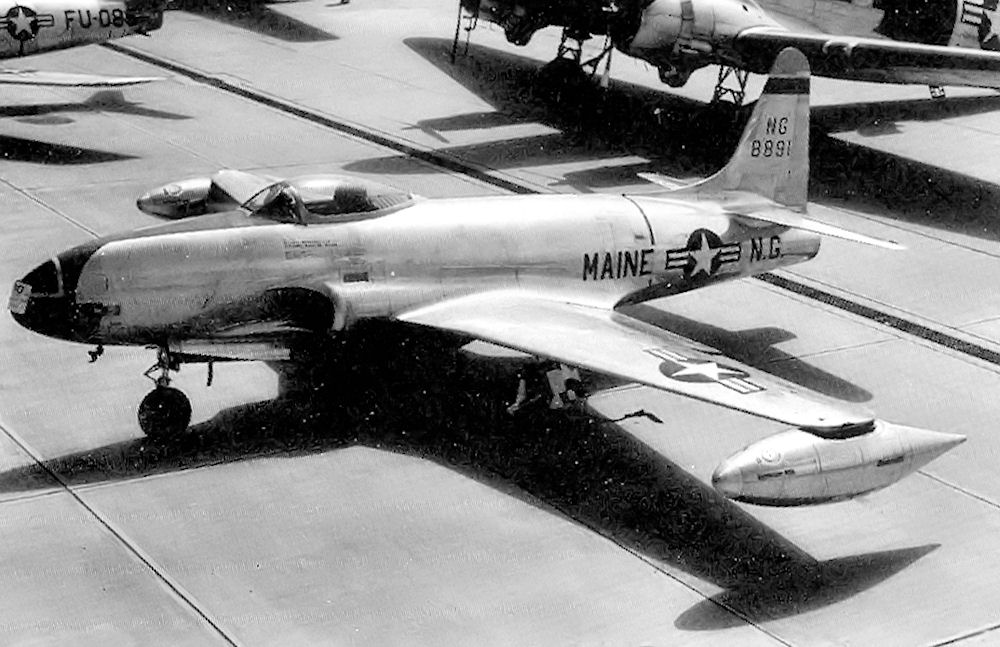
When the Korean War broke out on June 25th, 1950, the F-80 was stationed only in American bases in Japan. But the Shooting Star would soon take action in escorting, patrolling, and ground-attack duties.
The F-80 would gain the upper hand early in the war against Soviet propeller-driven aircraft. Such was the case on July 19th, 1950, when F-80s shot down three Yakovlev Yak-9s near the central South Korean city of Taejon (known today as Daejon).
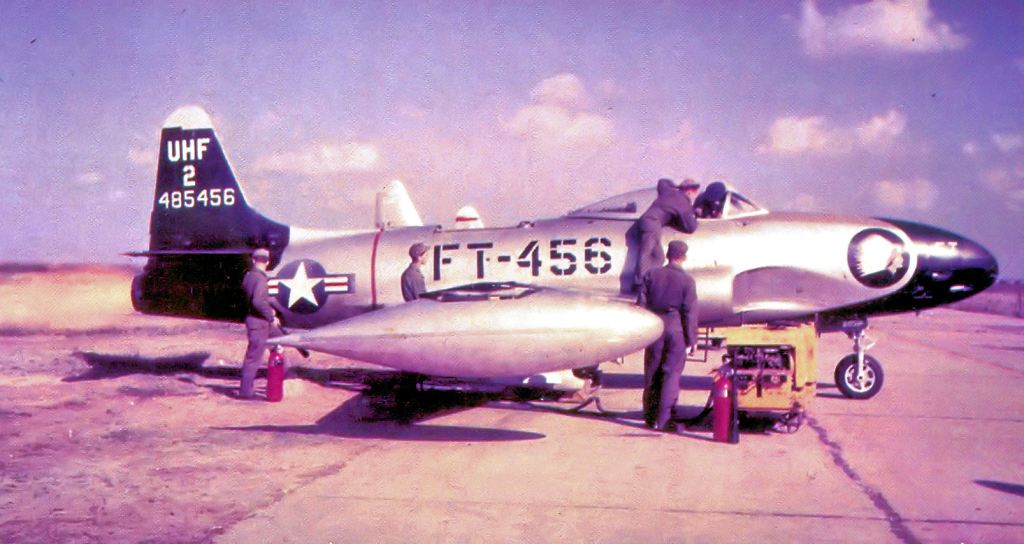
The F-80 contributed to UN air superiority early in the war, but this did not necessarily slow down advances on the ground. Opposition forces continued to push toward the southern end of the Korean peninsula.
For the F-80, air-to-air victories would not resume until late in 1950. Between July and November 1950, however, the F-80 was also involved in ground and napalm attacks.
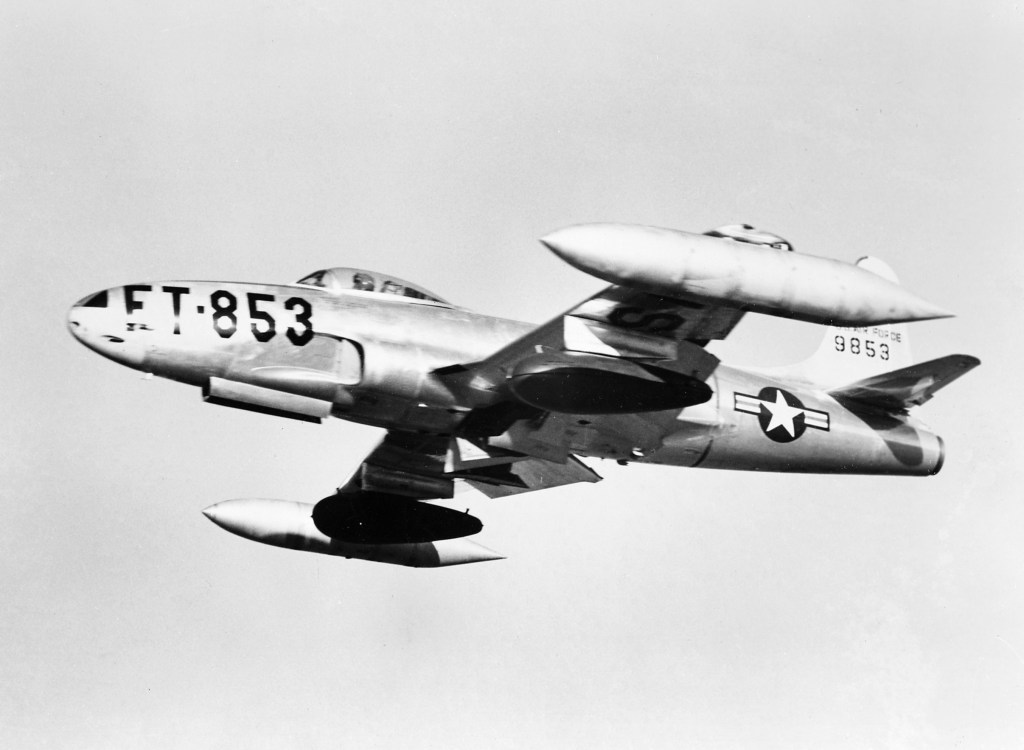
This was the case during the September 17th, 1950 napalm attacks on North Korean soldiers along the Naktong (now Nakdong) River during the Battle of Tabu-dong. In these attacks, F-80 and F-51 units were believed to have caused 1,200 enemy casualties.
Soviet Mikoyan-Gurevich MiG-15s entered the Korean War on November 1st, 1950. These planes were considerably faster than the F-80 with a top speed of 668 miles an hour (compared to the F-80C’s maximum 594 miles an hour).
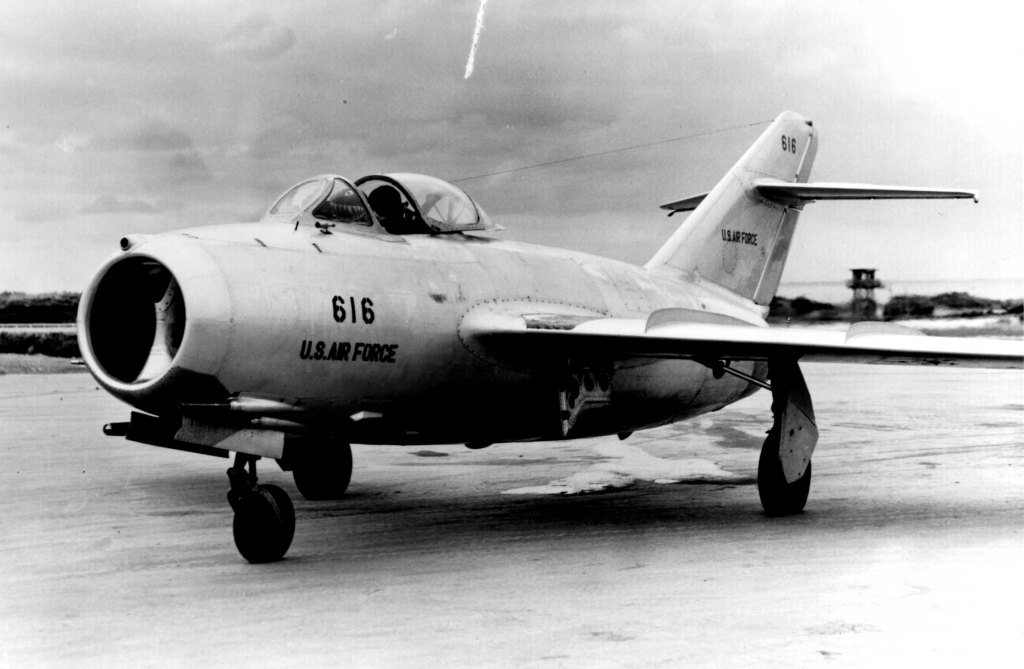
For the Americans, however, there were still early F-80 victories against the MiG. The first jet-to-jet air victory, for example was claimed over a MiG-15 on November 8th, 1950. In this instance, USAF Lieutenant Russell J. Brown of the 16th Fighter-Interceptor Squadron shot down the MiG over the Yalu River.
By December 1950, the USAF’s much faster, swept-wing F-86 Sabre jet had entered the conflict. This aircraft could engage the MiG-15 on better terms in regard to speed and maneuverability. The F-80 Shooting Star would continue to engage in air-to-air conflict for the remainder of the war, but very infrequently.
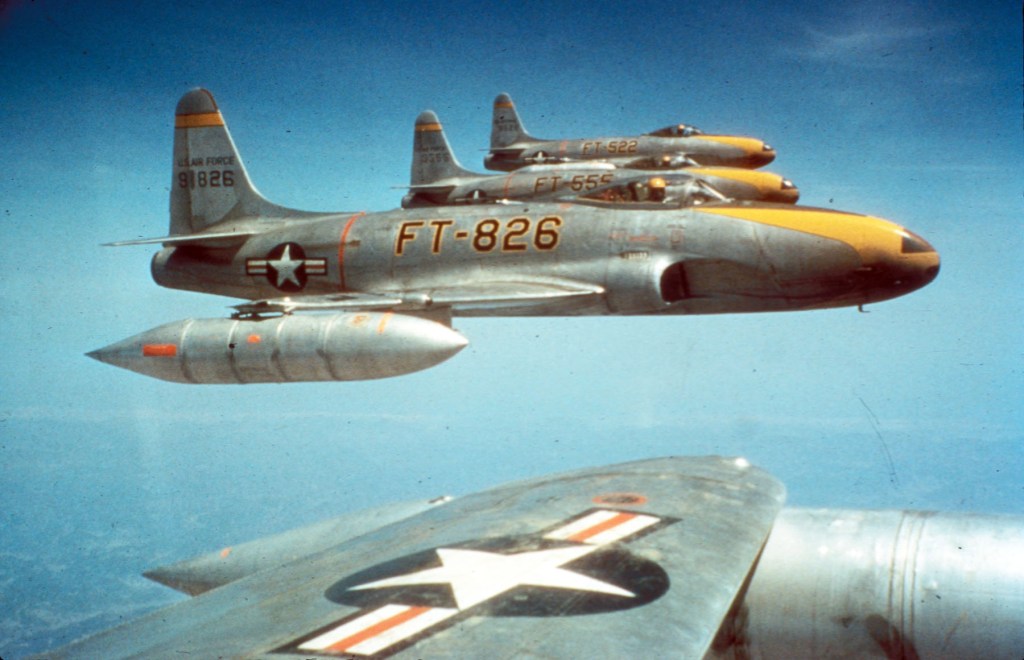
This was the case on November 8th 1951, when F-80 Shooting Stars and F-86 Sabre jets attacked planes in a group of over one hundred MiG-15s. Though few enemy planes chose to engage, USAF jets downed one MiG and damaged another MiG, at the loss of one Sabre.
Still, from January 1951 until the July 27th, 1953 armistice, the F-80 was used in ground-attack missions, cargo airplane escort duties, patrolling duties, close air support, and (with the reconnaissance-purposed RF-80) as a photo-reconnaissance craft.
The P-80 In Flight
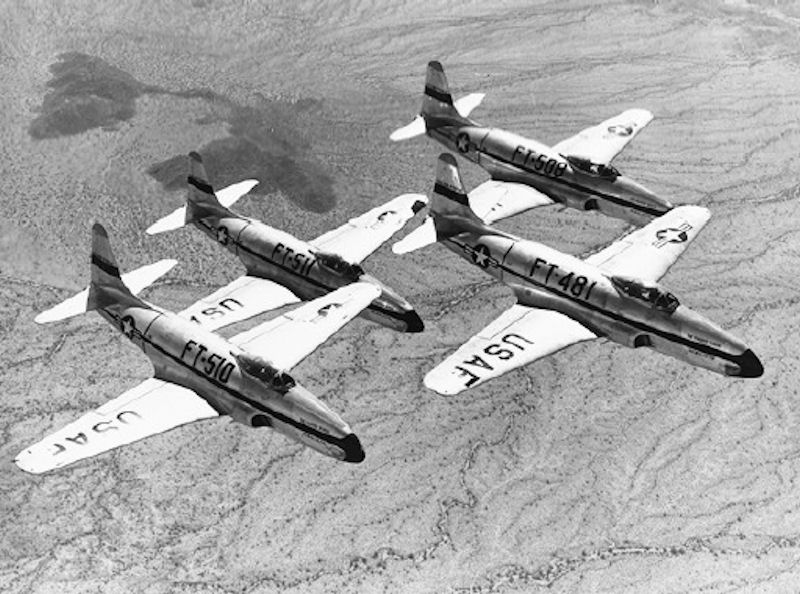
For many U.S. Army Air Force (and later, U.S. Air Force) pilots and personnel, the P-80 Shooting Star was their first exposure to jet aircraft. A number of pilots, who had previously flown propeller-driven planes in the Second World War, were not familiar with the speeds and maneuvering associated with jet fighters.
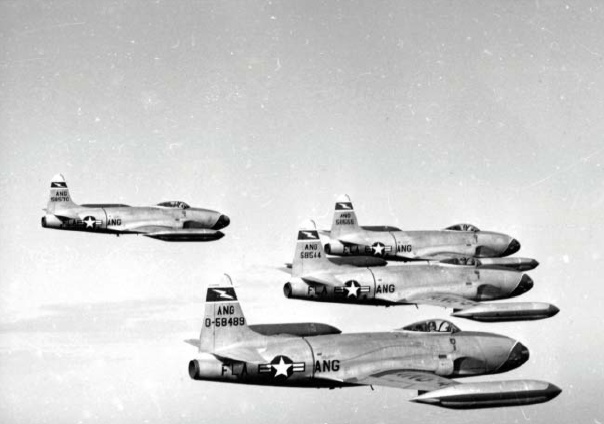
For example, some pilots flew P-47 Thunderbolts prior to their experience with the P-80. They noted how the P-80 was faster than anything they had flown before.
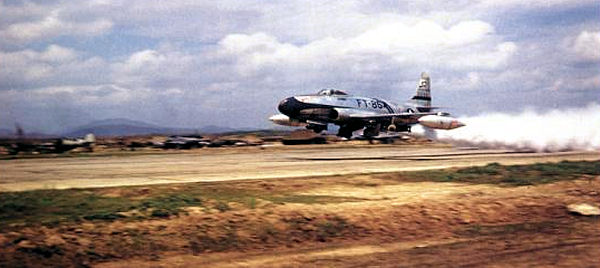
Indeed this was the case, as the P-47 could reach a top speed of 426 miles an hour, compared to the F-80 Shooting Star’s maximum speed of 594 miles an hour.
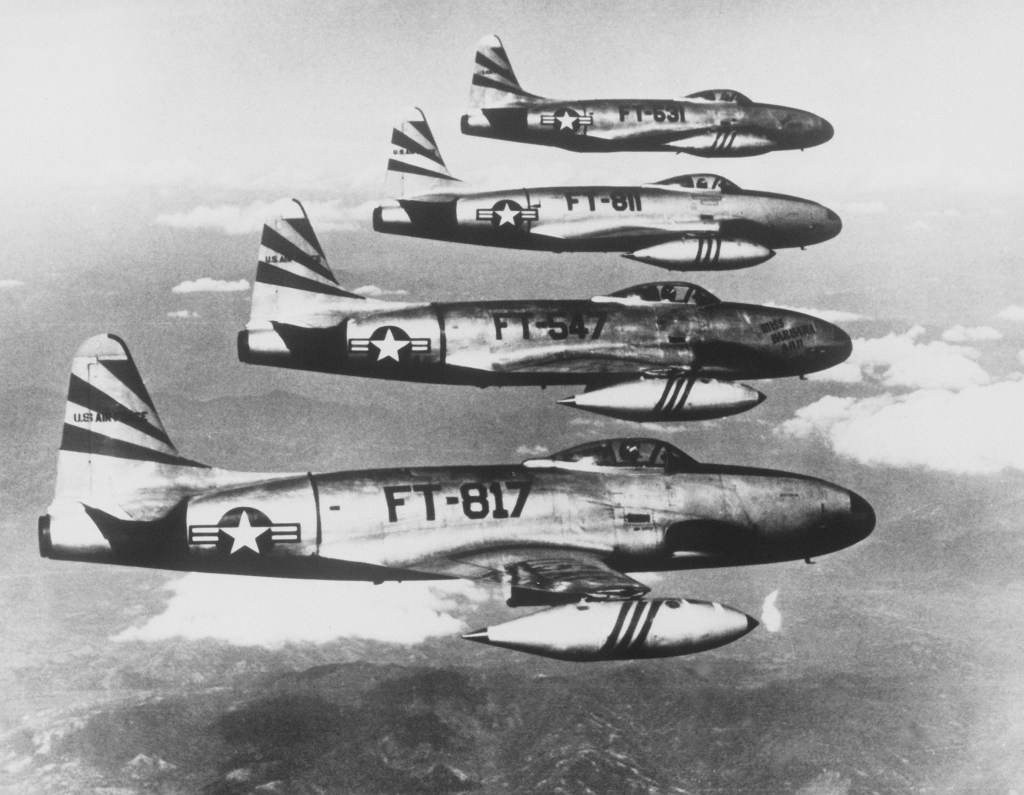

Other pilots recalled being thrilled with their first experience in a jet – with some pilots reporting unconventional take-offs (sometimes without their retracting landing gear) or landings.

Though F-80’s speed was advanced in its initial years of operation – but it did see quite a few losses during the Korean War (1950 – 1953). The Shooting Star was also already around five years old by 1950 – and its speed and performance could not compare to newer enemy jet fighters like the Soviet-made MiG-15.
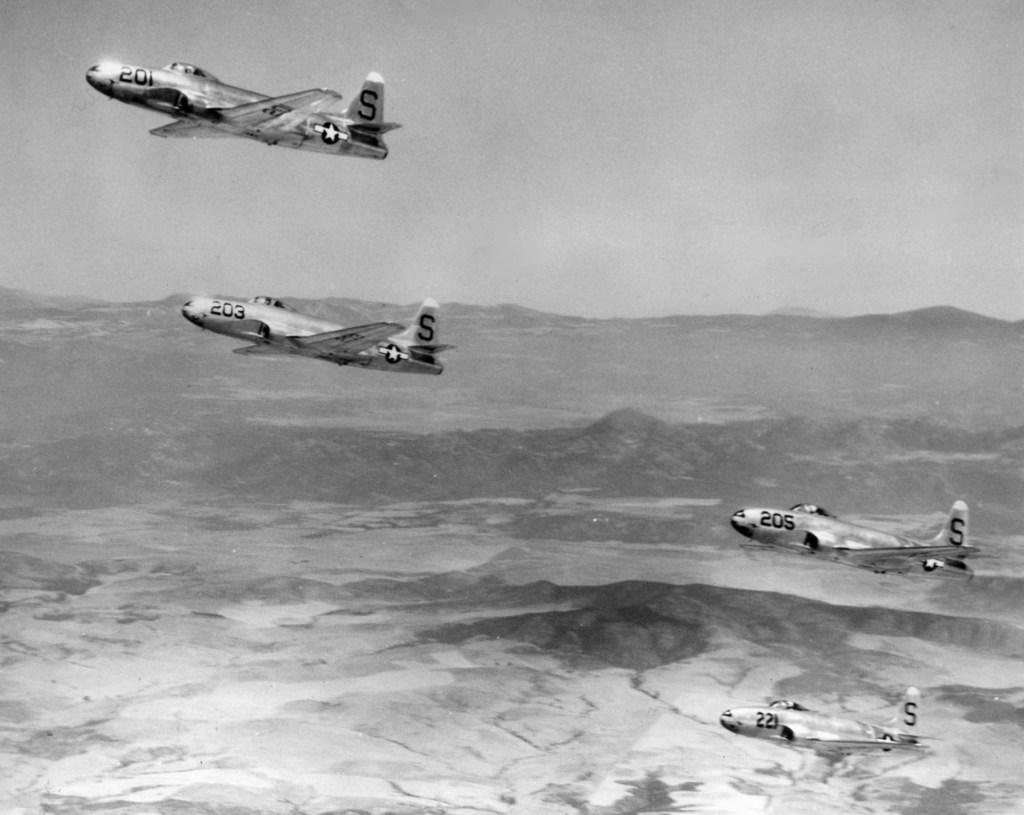
The plane was especially vulnerable to ground-based anti-aircraft fire. A total of 277 F-80Cs were lost in operation in Korea, for example, with 113 lost from anti-aircraft fire alone. The plane was tasked with strafing duties, a dangerous task with anti-aircraft guns on the front lines.
Still, the F-80 could be used as an effective ground fighter. It was capable of carrying two 1,000-pound bombs, eight HVAR rockets, or napalm – and was used to great effect in low-altitude troop support.
Model Variations
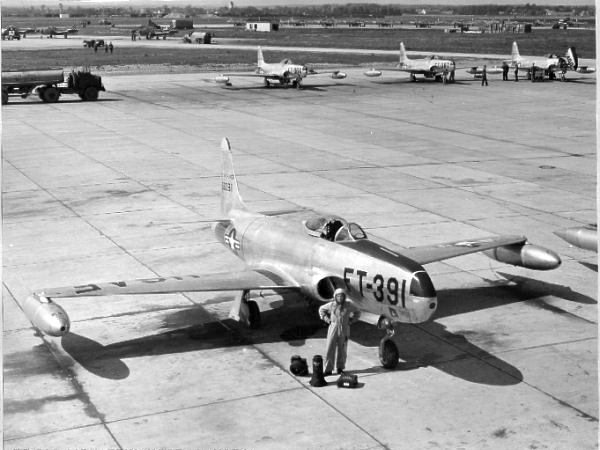
The P-80 Shooting Star was produced in a number of model variations, some suited for air-to-air combat, and some for different purposes such as training and reconnaissance. Here is a list of some of the most prominent types of P/F-80 models.
XP-80 – The original prototype developed by Lockheed, colloquially known as “Lulu-Belle”. First flown by Milo Burcham at Muroc Air Base, California, on the morning of Sunday, January 9th (with many sources saying January 8th), 1944 , the XP-80 was powered by a ~3,000 pound-thrust de Havilland “Goblin” turbojet engine of British make. The XP-80 was able to reach speeds of 502 miles an hour at sea level.
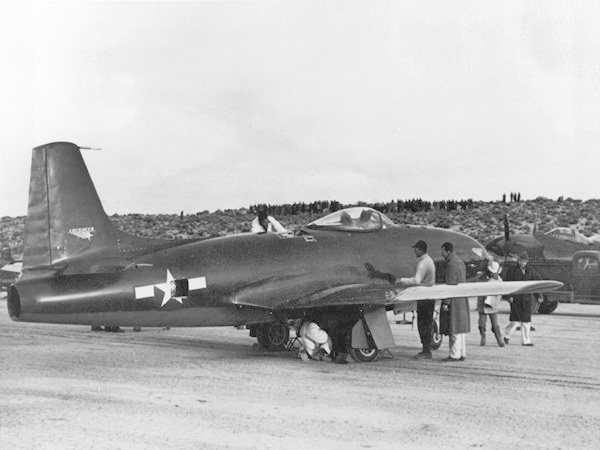
XP-80A – A larger, heavier prototype P-80 powered by the General Electric I-40 turbojet engine. This engine supplied the craft with around 4,000 pounds of thrust; the engine was later produced by General Electric/Allison under the name J33.
The aircraft had a wingspan of 39 feet, and a length of 34.5 feet. It also was the first type to feature a pressurized cockpit. The two instances of this craft made were able to carry 165-gallon drop tanks below each wingtip, a somewhat distinguishing feature of the P-80.
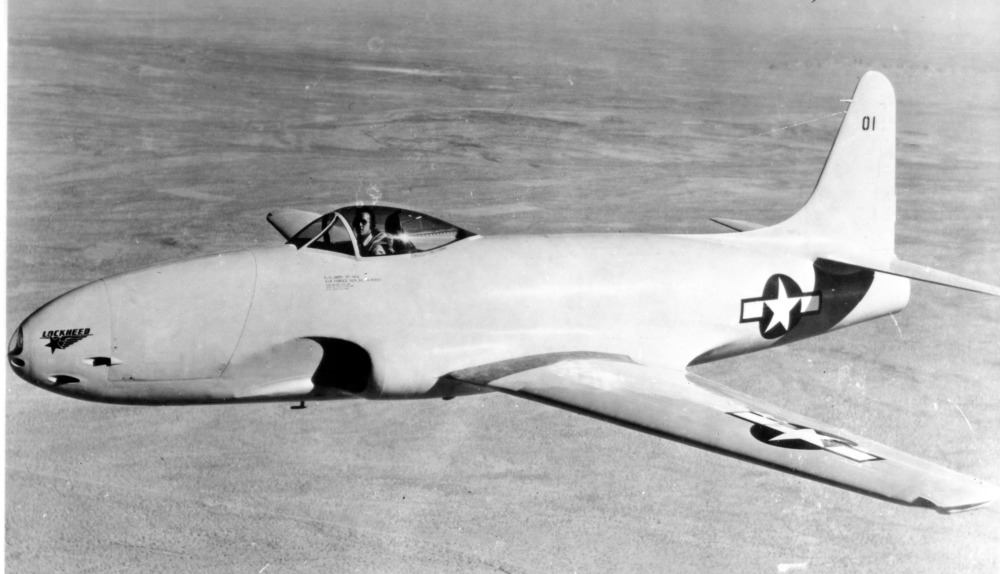
YP-80A –A pre-production type of P-80 that was structurally similar to the XP-80A. Powered by the same I-40-type engine, thirteen instances of this plane were made, with at least one fitted with cameras for photo-reconnaissance purposes.
P-80A/F-80A – The first production model of the P-80 delivered to the U.S. Army Air Force (USAAF), between February 1945 and December 1946. The P-80A was produced in two makes: the P-80A-1-LO and the P-80A-5-LO. There were 345 instances of P-80A-1-LOs made and 218 instances of P-80A-5-LOs made. By June of 1948, these models were referred to as the F-80A and (in camera-fitted reconnaissance craft) the RF-80A.
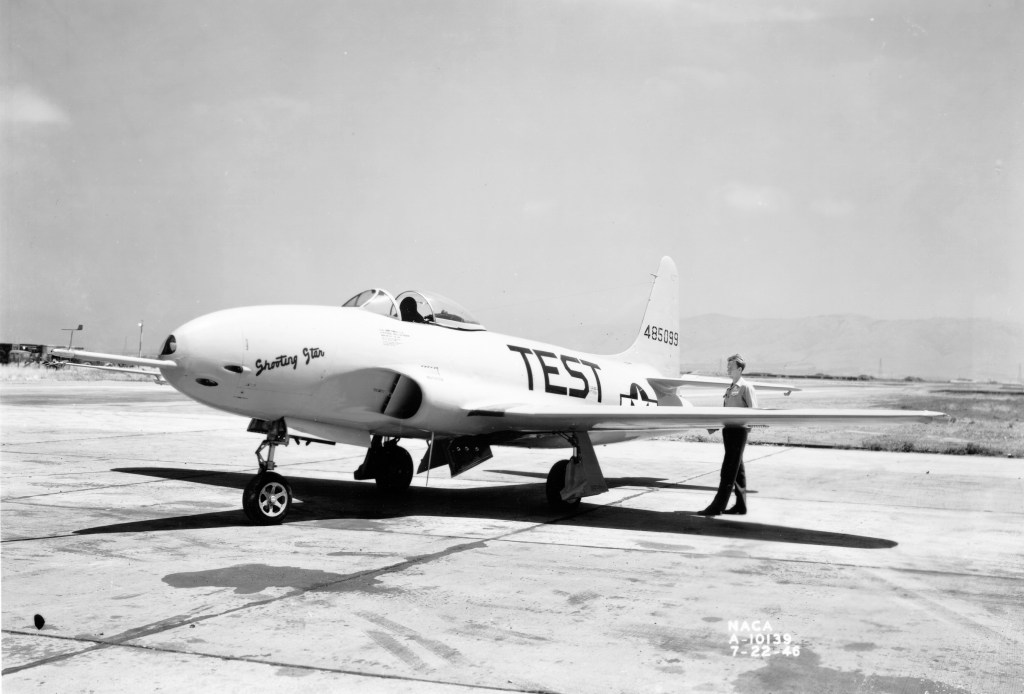
P-80B/F-80B – A model equipped with the 4,000 pound-thrust Allison J33-A-17 turbojet engine (a similar pound-thrust engine was equipped to the later P-80A versions), an ejection seat in the cockpit, and a pitot tube located in the tailfin (instead of the nose). 240 instances of this plane were made; this aircraft became known to the USAF as the F-80B in June 1948.

P-80C/F-80C –The most-produced variant of the main P-80 Shooting Star series, this aircraft was made as the P-80C-1-LO (with 162 instances), the P-80C-5-LO (with 76 instances), and the P-80C-10-LO (with 561 instances). Engine pound-thrust levels ranged from 4,600 pounds (from the Allison J33-A-23 engine) to 5,400 pounds (from the Allison J33-A35 engine) in later models. This aircraft became known in the USAF as the F-80C in June 1948.
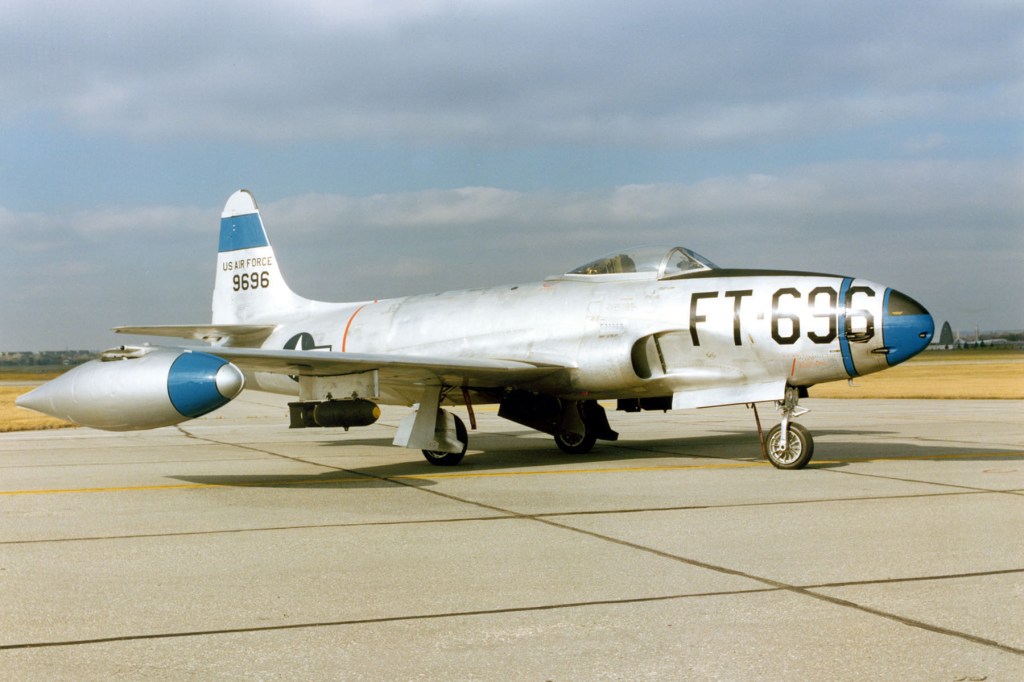
The F-80C was the type most commonly found in the Korean War, with six .50-caliber machine guns in the nose, and the capacity to carry two 1,000-pound bombs, napalm tanks, or rockets. It could carry two 230 or 265 gallon tip tanks. The F-80C had a faster speed at sea level – some 594 miles an hour – than that at 25,000 feet (543 miles an hour).

RF-80 (A, C) – Several F-80A and C models were fitted with cameras for photo-reconnaissance purposes, usually located in a modified nose. These planes saw service in the Korean War; they were among some of the last F-80s serving an active role during the conflict.
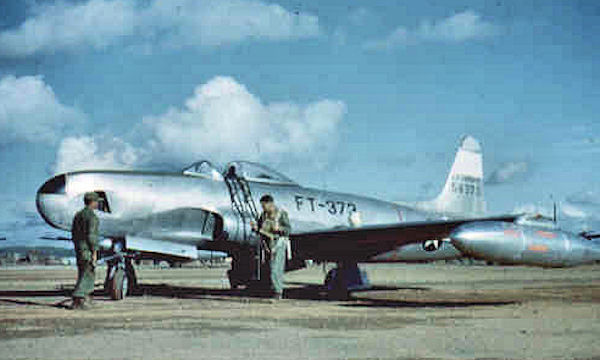
T-33 Shooting Star – A two-seated training aircraft based on the P-80 airframe. Considered a related but separate aircraft to the P-80 Shooting Star, 6,557 instances of this plane were made, being produced until the late 1950s.
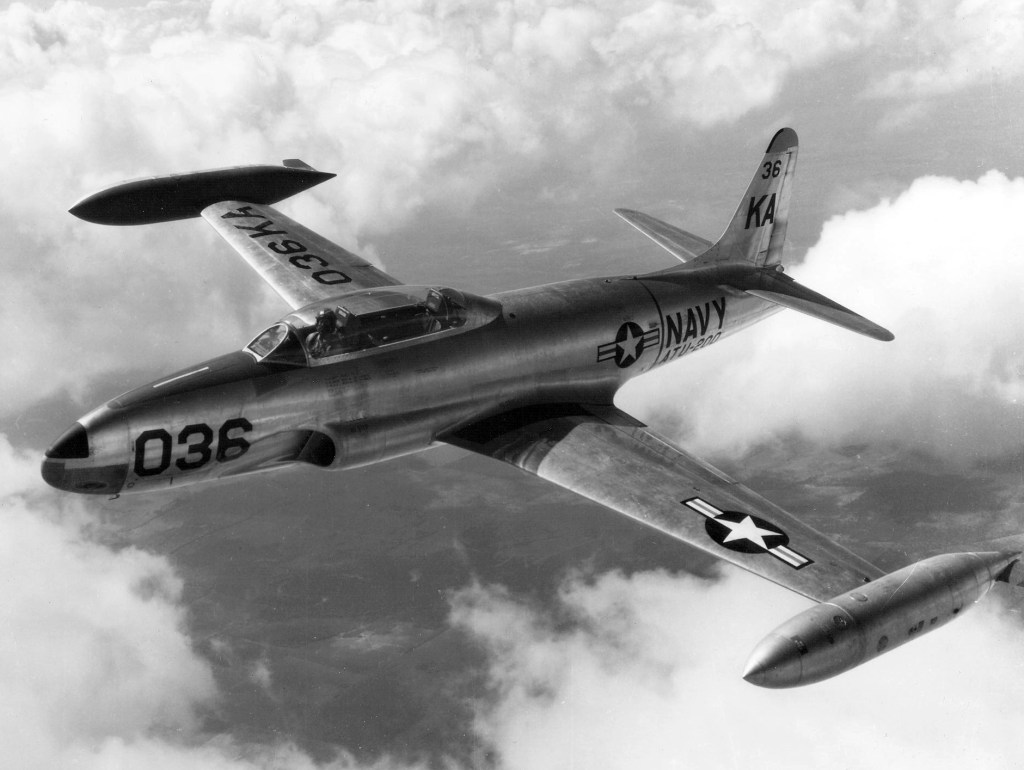
F-94 Starfire – An interceptor-type plane that was based on the T-33 Shooting Star, equipped with an afterburner, 855 instances were built. The F-94 was utilized by the USAF worldwide, mostly in Air Command units outside combat missions. The Starfire was largely taken out of USAF service by the late 1950s.
 Waves To Jets