
By WavesToJets
Although watercraft differ in numerous ways, they share several structural similarities. The following is a list of common ship and boat parts.
Fore – The portion of a watercraft in the direction ahead of the stern. Also of, or related to, the front of the watercraft.
Aft – The portion of the watercraft near the stern. Usually refers to the hind part of the ship, the rear.
Stern – The aft, or rearmost part of the ship. It consists of the rear of the ship from the area above the deck – known as the taffarel – to the areas below the deck – known as the counters.
Port – Refers to the left side of a watercraft. The port is referred in reference to a forward-looking view on the craft. It was traditionally called larboard, but use of the latter term was deemed too similar to the opposing term starboard.
Starboard –Refers to the right side of a watercraft when facing forward (towards the fore). The term is used in opposition to port.
Bow – The part of the ship which is at the fore (or front). The bow starts where the sides of the hull begin to angle to the foremost (front-most) part of the ship. It ends at the very front of the ship where the angled sides of the hull meet.
Rudder – A part of a ship or boat that extends into the water, at the aft of the watercraft, usually at the rearmost part of the stern. The rudder is controlled from a position on the aft deck – or, in larger watercraft – from the bridge. The rudder is used to guide passing water as the craft moves forward; it is used for navigation purposes, i.e., to steer the watercraft.
Tiller – In smaller watercraft, a long, straight metal or wood beam (or bar) that fits through the topmost part of the rudder. The tiller is moved in a lateral direction to control the rudder. In larger watercraft, the tiller can be controlled via (or alternately, is synonymous with) a part of the ship known as the helm.
Deck – The portion of a watercraft that consists of platforms laid over beams built in or over the hull. Larger watercraft can have one or several large decks, alternately, some smaller watercraft have decks that are reduced in size.
Gunwale –The top edge of the hull of a watercraft. The gunwale usually is a lining that wraps inboard (“inwale”) of the hull’s top edge, but also can have an outboard (“outwale”) component. The gunwale is usually part of the topmost longitudinal planking (the “sheer-strake”) of the hull.
Hull – The external portion of a watercraft, which is not associated with sails, masts, riggings, or other such ship components. The hull is usually in contact with the water; the bottommost portion of the hull is called the keel.
Keel – The lowermost part of the hull, one that runs from the front (fore) to the back (aft) of a ship. If the hull was turned upside-down – and was as in appearance like the back of a four-legged animal – the keel would appear as its spine.
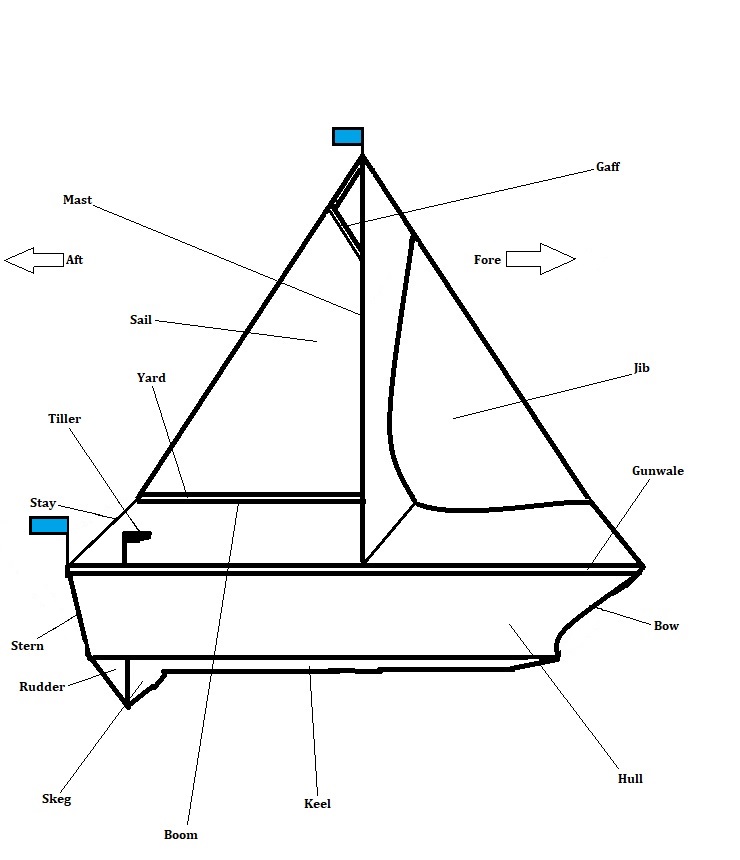
Mast – The vertical pole or poles of the watercraft that carry the sails, yards, and riggings. The mast is perpendicular in orientation in relation to the keel.
Yard – The (generally) horizontally-oriented poles that are fixed to the mast. The yards are used to carry the sails.
Sail – The part of a watercraft that is attached to the mast and is used to harness the wind for propulsion. The sail can be made of fabric, cloth, or other such material.
Head – The head can refer to the upper part or upper end any part of the watercraft, such as a mast (mast-head). The head can also refer to the front of the watercraft (i.e. both sides of the fore/bow).
Stay – A line (usually rope) attached to a mast-head to the stern (rear) of the ship – and sometimes to the bow/fore (front). Stays are used to stabilize the masts.
Foot – The bottom edge of a sail.
Jib – A triangular-shaped sail that is attached to a fore (bow) – located stay of the ship.
Gaff – On non-stay-positioned sails, the gaff is a spar that that can increase/decrease the head (size) of a sail.
Riggings – Refers to the sails, the masts, and the stays of the watercraft.
Skeg – Located near the stern of a watercraft, the skeg (or skegg) is part of the keel. It is a protruding structure that can contain a rudder.
Spar – A term that is used to refer to pole-like protruding parts of the ship such as the mast, boom, yard, or gaff.
Boom – A pole-like structure (spar) that forms the bottommost part of a sail. The boom is located at the sail foot and usually can be adjusted.
 Waves To Jets